Normalization, Standardization, Regularization

with a claude’s help
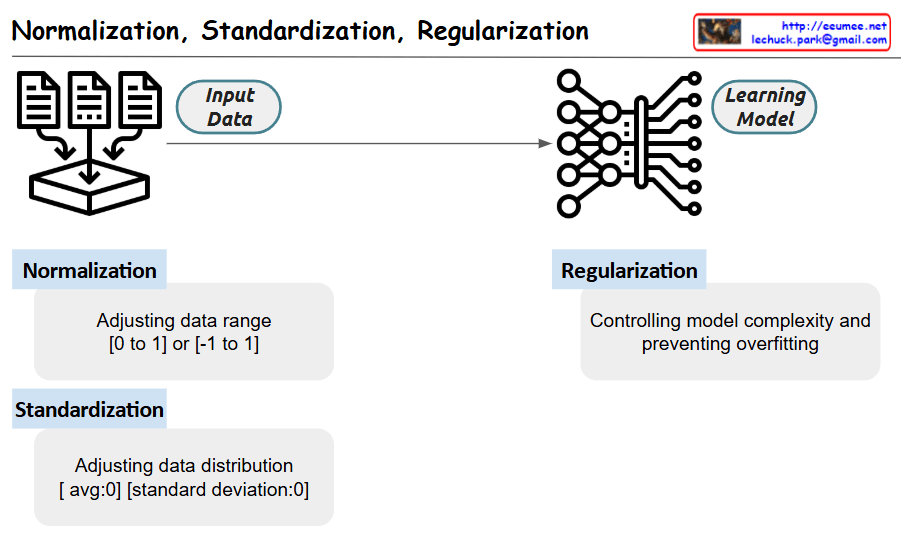
This image is a diagram explaining three important concepts in machine learning: Normalization, Standardization, and Regularization.

The diagram is structured as follows:

  1. On the left side, there are document icons representing Input Data, and on the right side, there is a neural network structure representing the Learning Model.

Each concept is explained:

  1. Normalization:
  • Process of adjusting data range to [0 to 1] or [-1 to 1]
  • Scales data to fit within a specific range
  1. Standardization:
  • Process of adjusting data distribution
  • Transforms data to have an average of 0 and standard deviation of 0
  1. Regularization:
  • Controls model complexity and prevents overfitting
  • Prevents the model from becoming too closely fitted to the training data

These techniques are essential preprocessing and training steps for improving machine learning model performance and ensuring stable learning.

These techniques are fundamental in machine learning as they help in:

Enhancing overall model performance

Making data consistent and comparable

Improving model training efficiency

Preventing model overfitting

Standardization

From Claude + ChatGPT with some prompting
The image you provided shows a standardization process aimed at delivering high-quality data and consistent services. Here’s a breakdown of the structure based on the image:

Key Areas:

  1. [Data]
    • Facility: Represents physical systems or infrastructure.
    • Auto Control: Automatic controls used to manage the system.
  2. [Service]
    • Mgt. System: Management system that controls and monitors operations.
    • Process: Processes to maintain efficiency and quality.

Optimization Paths:

  1. Legacy Optimization:
    • a) Configure List-Up: Listing and organizing the configurations for the existing system.
    • b) Configure Optimization (Standardization): Optimizing and standardizing the existing system to improve performance.
    • Outcome: Enhances the existing system by improving its efficiency and consistency.
  2. New Setup:
    • a) Configure List-Up: Listing and organizing configurations for the new system.
    • b) Configure Optimization (Standardization): Optimizing and standardizing the configuration for the new system.
    • c) Configuration Requirement: Defining the specific requirements for setting up the new system.
    • d) Verification (on Installation): Verifying that the system operates correctly after installation.
    • Outcome: Builds a completely new system that provides high-quality data and consistent services.

Outcome:

The aim for both paths is to provide high-quality data and consistent service by standardizing either through optimizing legacy systems or creating entirely new setups.

This structured approach helps improve efficiency, consistency, and system performance.

Golden Circle For DC Operation

From perplexity with some prompting
The image explains the “Golden Circle for DC Operation,” focusing on optimizing data center operations.

WHY: Data Center Operation Optimization

  • Purpose: To optimize the operation of data centers.
  • Service Development: Through data-driven processes, including monitoring, automation, tool development, and customer-focused services.

HOW: Consistent Process & Data Management

  • Method: Ensures reliable data through consistent processes and management.
  • Standardization: Achieved through data lists, hardware/software protocols, and service/process views and flows.

WHAT: Integrated Digital Operation Platform

  • Objective: To build an integrated digital operation platform.
  • Platform: Operator-led development that involves analysis, AI integration, and service creation.

This structure emphasizes efficiency, standardization, and a data-centric approach to data center operations.

Standardization & Platform Why?

From Claude with some prompting
This diagram illustrates the importance of standardization and platform development, highlighting two key objectives:

  1. Standardization:
    • Encompasses the stages from real work (machine and processing) through digitization, collecting, and verification.
    • Purpose: “Move on with data trust”
    • Meaning: By establishing standardized processes for data collection and verification, it ensures data reliability. This allows subsequent stages to proceed without concerns about data quality.
  2. Software Development Platform:
    • Includes analysis, improvement, and new development stages.
    • Purpose: “Make easy to improve & go to new”
    • Meaning: Building on standardized data and processes, the platform facilitates easier service improvements and new service development and expansion.

This structure offers several advantages:

  1. Data Reliability: Standardized processes for collection and verification ensure trustworthy data, eliminating concerns about data quality in later stages.
  2. Efficient Improvement and Innovation: With reliable data and a standardized platform, improving existing services or developing new ones becomes more straightforward.
  3. Scalability: The structure provides a foundation for easily adding new services or features.

In conclusion, this diagram visually represents two core strategies: establishing data reliability through standardization and enabling efficient service improvement and expansion through a dedicated platform. It emphasizes how standardization allows teams to trust and focus on using the data, while the platform makes it easier to improve existing services and develop new ones.

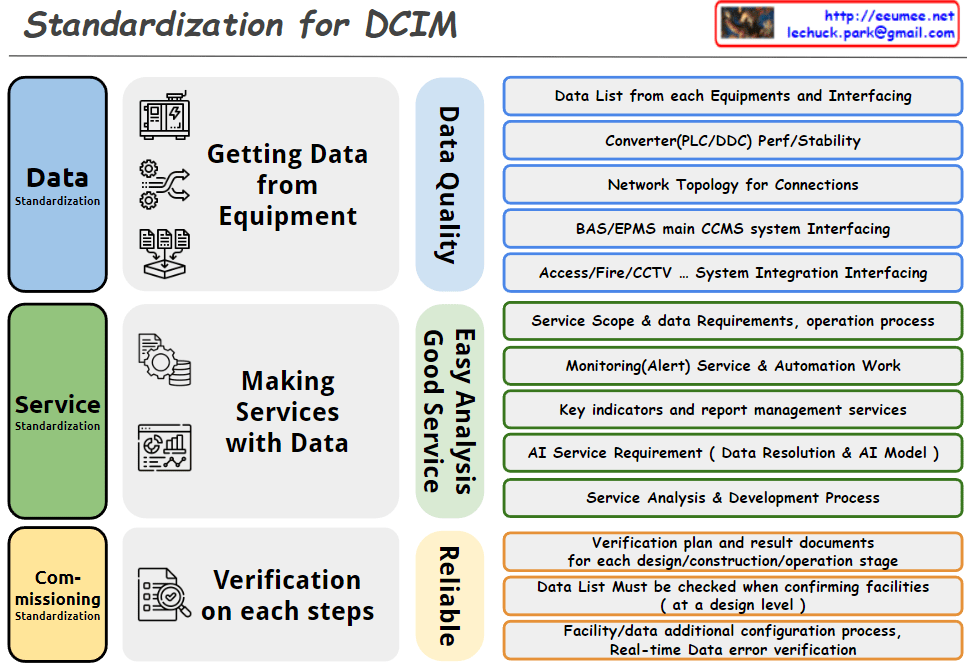
Standardization for DCIM

From Claude with some prompting
Data Standardization:

  • Defined a clear process for systematically collecting data from equipment.
  • Proposed an integrated data management approach, including network topology and interfacing between various systems.
  • Emphasized data quality management as a key factor to establish a reliable data foundation.

Service Standardization:

  • Structured the process of connecting data to actual services.
  • Highlighted practical service implementation, including monitoring services and automation tasks.
  • Specified AI service requirements, showing a forward-looking approach.
  • Established a foundation for continuous service improvement by including service analysis and development processes.

Commissioning Standardization:

  • Emphasized verification plans and documentation of results at each stage of design, construction, and operation to enable quality management throughout the entire lifecycle.
  • Prepared an immediate response system for potential operational issues by including real-time data error verification.
  • Considered system scalability and flexibility by incorporating processes for adding facilities and data configurations.

Overall Evaluation:

This DCIM standardization approach comprehensively addresses the core elements of data center infrastructure management. The structured process, from data collection to service delivery and continuous verification, is particularly noteworthy. By emphasizing fundamental data quality management and system stability while considering advanced technologies like AI, the approach is both practical and future-oriented. This comprehensive framework will be a valuable guideline for the implementation and operation of DCIM.

DC OP Platform

From Claude with some prompting
This image depicts a diagram of the “DC op Platform” (Data Center Operations Platform). The main components are as follows:

  1. On the left, there’s “DC Op Env.” (Data Center Operations Environment), which consists of three main parts:
    • DCIM (Data Center Infrastructure Management)
    • Auto Control
    • Facility These three elements undergo a “Standardization” process.
  2. In the center, there are two “Standardization” server icons, representing the standardization process of the platform.
  3. On the right, there’s the “Data Center Op. Platform”, which comprises three main components:
    • Service Development
    • Integrated operations
    • Server Room Digital Twin
  4. Arrows show how the standardized elements connect to these three main components.

This diagram visually illustrates how the data center operations environment evolves through a standardization process into an integrated data center operations platform.

Standardized Platform with the AI

From Claude with some prompting
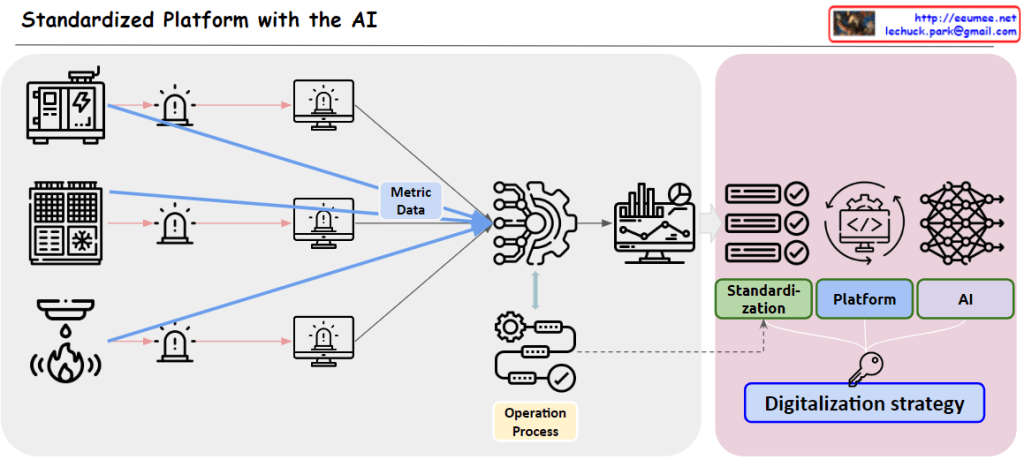
This image illustrates a “Standardized Platform with the AI”. Here’s a breakdown of the key components and processes:

  1. Left side: Various devices or systems (generator, HVAC system, fire detector, etc.) are shown. Each device is connected to an alarm system and a monitoring screen.
  2. Center: “Metric Data” from these devices is sent to a central gear-shaped icon, representing a data processing system.
  3. Upper right: The processed data is displayed on a dashboard or analytics screen.
  4. Lower right: There’s a section labeled “Operation Process”, indicating management or optimization of operational processes.
  5. Far right: Boxes representing the system’s components:
    • “Standardization”
    • “Platform”
    • “AI”
  6. Bottom: “Digitalization strategy” serves as the foundation for the entire system.

This diagram visualizes a digital transformation strategy that collects data from various systems and devices, processes it using AI on a standardized platform, and uses this to optimize and manage operations.

The flow shows how raw data from different sources is standardized, processed, and utilized to create actionable insights and improve operational efficiency, all underpinned by a comprehensive digitalization strategy.