From RNN to Transformer

Visual Analysis: RNN vs Transformer

Visual Structure Comparison

RNN (Top): Sequential Chain

  • Linear flow: Circular nodes connected left-to-right
  • Hidden states: Each node processes sequentially
  • Attention weights: Numbers (2,5,11,4,2) show token importance
  • Bottleneck: Must process one token at a time

Transformer (Bottom): Parallel Grid

  • Matrix layout: 5×5 grid of interconnected nodes
  • Self-attention: All tokens connect to all others simultaneously
  • Multi-head: 5 parallel attention heads working together
  • Position encoding: Separate blue boxes handle sequence order

Key Visual Insights

Processing Pattern

  • RNN: Linear chain → Sequential dependency
  • Transformer: Interconnected grid → Parallel freedom

Information Flow

  • RNN: Single path with accumulating states
  • Transformer: Multiple simultaneous pathways

Attention Mechanism

  • RNN: Weights applied to existing sequence
  • Transformer: Direct connections between all elements

Design Effectiveness

The diagram succeeds by using:

  • Contrasting layouts to show architectural differences
  • Color coding to highlight attention mechanisms
  • Clear labels (“Sequential” vs “Parallel Processing”)
  • Visual metaphors that make complex concepts intuitive

The grid vs chain visualization immediately conveys why Transformers enable faster, more scalable processing than RNNs.

Summary

This diagram effectively illustrates the fundamental shift from sequential to parallel processing in neural architecture. The visual contrast between RNN’s linear chain and Transformer’s interconnected grid clearly demonstrates why Transformers revolutionized AI by enabling massive parallelization and better long-range dependencies.

With Claude

3 Computing in AI

AI Computing Architecture

3 Processing Types

1. Sequential Processing

  • Hardware: General CPU (Intel/ARM)
  • Function: Control flow, I/O, scheduling, Data preparation
  • Workload Share: Training 5%, Inference 5%

2. Parallel Stream Processing

  • Hardware: CUDA core (Stream process)
  • Function: FP32/FP16 Vector/Scalar, memory management
  • Workload Share: Training 10%, Inference 30%

3. Matrix Processing

  • Hardware: Tensor core (Matrix core)
  • Function: Mixed-precision (FP8/FP16) MMA, Sparse matrix operations
  • Workload Share: Training 85%+, Inference 65%+

Key Insight

The majority of AI workloads are concentrated in matrix processing because matrix multiplication is the core operation in deep learning. Tensor cores are the key component for AI performance improvement.

With Claude

Analytical vs Empirical

Analytical vs Empirical Approaches

Analytical Approach

  1. Theory Driven: Based on mathematical theories and logical reasoning
  2. Programmable with Design: Implemented through explicit rules and algorithms
  3. Sequential by CPU: Tasks are processed one at a time in sequence
  4. Precise & Explainable: Results are accurate and decision-making processes are transparent

Empirical Approach

  1. Data Driven: Based on real data and observations
  2. Deep Learning with Learn: Neural networks automatically learn from data
  3. Parallel by GPU: Multiple tasks are processed simultaneously for improved efficiency
  4. Approximate & Unexplainable: Results are approximations and internal workings are difficult to explain

Summary

This diagram illustrates the key differences between traditional programming methods and modern machine learning approaches. The analytical approach follows clearly defined rules designed by humans and can precisely explain results, while the empirical approach learns patterns from data and improves efficiency through parallel processing but leaves decision-making processes as a black box.

with claude

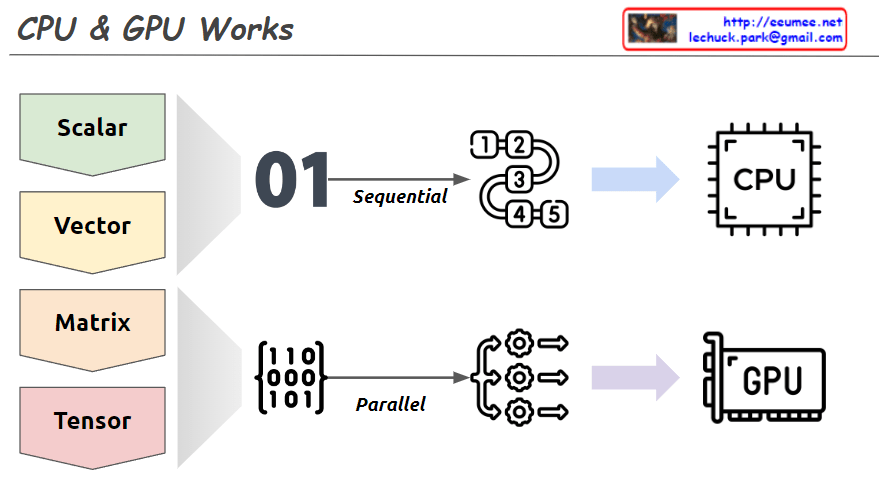
CPU & GPU Works

From Claude with some prompting
This image explains the working principles of CPU (Central Processing Unit) and GPU (Graphics Processing Unit) in a visual manner.

  1. Data Types:
    • Scalar: A single value
    • Vector: One-dimensional array
    • Matrix: Two-dimensional array
    • Tensor: Multi-dimensional array
  2. CPU Work Method:
    • Sequential processing, denoted by ’01’
    • Tasks are processed in order, as shown by 1, 2, 3, 4, 5
    • Primarily handles scalar data, processing complex tasks sequentially
  3. GPU Work Method:
    • Parallel processing, represented by a matrix
    • Icons show multiple tasks being processed simultaneously
    • Mainly deals with multi-dimensional data like matrices or tensors, processing many tasks in parallel

The image demonstrates that while CPUs process tasks sequentially, GPUs can handle many tasks simultaneously in parallel. This helps explain which processing unit is more efficient based on the complexity and volume of data. Complex and large-scale data (matrices, tensors) are better suited for GPUs, while simple, sequential tasks are more appropriate for CPUs.