Basic of Reasoning

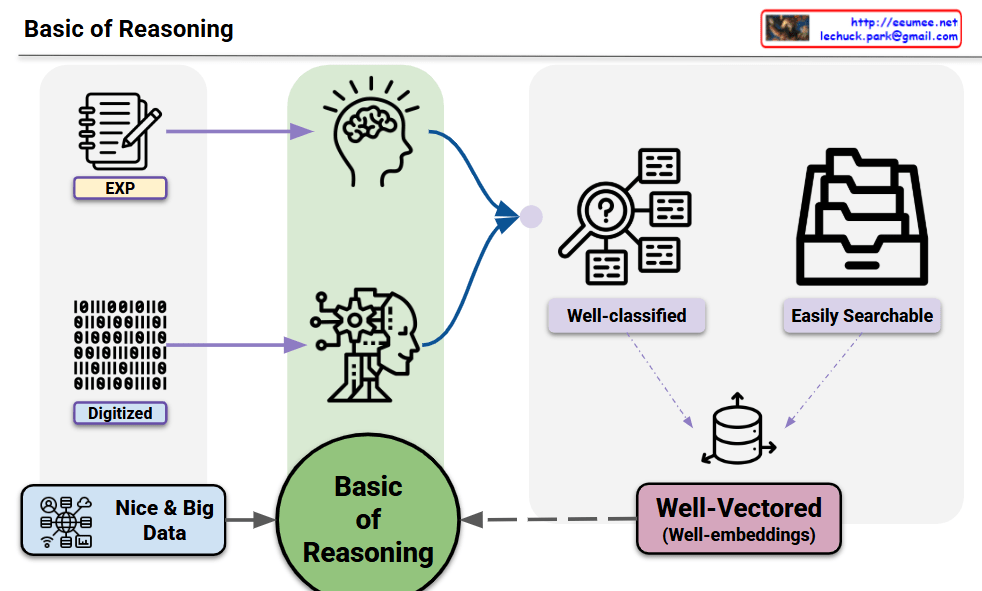
This diagram illustrates that human reasoning and AI reasoning share fundamentally identical structures.

Key Insights:

Common Structure Between Human and AI:

  • Human Experience (EXP) = Digitized Data: Human experiential knowledge and AI’s digital data are essentially the same information in different representations
  • Both rely on high-quality, large-scale data (Nice & Big Data) as their foundation

Shared Processing Pipeline:

  • Both human brain (intuitive thinking) and AI (systematic processing) go through the same Basic of Reasoning process
  • Information gets well-classified and structured to be easily searchable
  • Finally transformed into well-vectorized embeddings for storage

Essential Components for Reasoning:

  1. Quality Data: Whether experience or digital information, sufficient and high-quality data is crucial
  2. Structure: Systematic classification and organization of information
  3. Vectorization: Conversion into searchable and associative formats

Summary: This diagram demonstrates that effective reasoning – whether human or artificial – requires the same fundamental components: quality data and well-structured, vectorized representations. The core insight is that human experiential learning and AI data processing follow identical patterns, both culminating in structured knowledge storage that enables effective reasoning and retrieval.

Human-AI Collaborative Reasoning

This image illustrates the collaborative problem-solving process between humans and AI through reasoning, emphasizing their complementary relationship rather than a simple comparison.

Key Components and Interpretation

1. AI’s Operational Flow (Upper Section)

  • Big Data → Learning → AI Model: The process by which AI builds models through learning from vast amounts of data
  • Reasoning → Inferencing → Answer: The process by which AI receives questions and generates answers through reasoning

2. Human Role (Lower Section)

  • Experience: Knowledge and information acquired through direct experience
  • Logic: A logical thinking framework built upon experience
  • Reasoning: The cognitive process that combines experience and logic

3. Critical Interaction Mechanisms

Question:

  • Human reasoning results are input to AI in the form of sophisticated questions
  • These are not simple queries, but systematic and meaningful questions based on experience and logic

Answer:

  • AI’s responses are fed back into the human reasoning process
  • Humans verify AI’s answers and integrate them into new experiences and logic for deeper reasoning

4. Core Message

The red-highlighted phrase “humans must possess a strong, experience-based logical framework” represents the diagram’s central theme:

  • To collaborate effectively with AI, humans must also possess strong logical thinking frameworks based on experience
  • The ability to provide appropriate questions and properly verify and utilize AI’s responses is essential

Conclusion

This image demonstrates that human roles do not disappear in the AI era, but rather become more crucial. Human reasoning abilities based on experience and logic play a pivotal role in AI collaboration, and through this, humans and AI can create synergy for better problem-solving. The diagram presents a collaborative model where both entities work together to achieve superior results.

The key insight is that AI advancement doesn’t replace human thinking but rather requires humans to develop stronger reasoning capabilities to maximize the potential of human-AI collaboration.

With Claude, Gemini

Learning , Reasoning, Inference

This image illustrates the three core processes of AI LLMs by drawing parallels to human learning and cognitive processes.

Learning

  • Depicted as a wise elderly scholar reading books in a library
  • Represents the lifelong process of absorbing knowledge and experiences accumulated by humanity over generations
  • The bottom icons show data accumulation and knowledge storage processes
  • Meaning: Just as AI learns human language and knowledge through vast text data, humans also build knowledge throughout their lives through continuous learning and experience

Reasoning

  • Shows a character deep in thought, surrounded by mathematical formulas
  • Represents the complex mental process of confronting a problem and searching for solutions through internal contemplation
  • The bottom icons symbolize problem analysis and processing stages
  • Meaning: The human cognitive process of using learned knowledge to engage in logical thinking and analysis to solve problems

Inference

  • Features a character confidently exclaiming “THE ANSWER IS CLEAR!”
  • Expresses the confidence and decisiveness when finally finding an answer after complex thought processes
  • The bottom checkmark signifies reaching a final conclusion
  • Meaning: The human act of ultimately speaking an answer or making a behavioral decision through thought and analysis

These three stages visually demonstrate how AI processes information in a manner similar to the natural human sequence of learning → thinking → conclusion, connecting AI’s technical processes to familiar human cognitive patterns.

With Claude