With AI

1. Image Structure

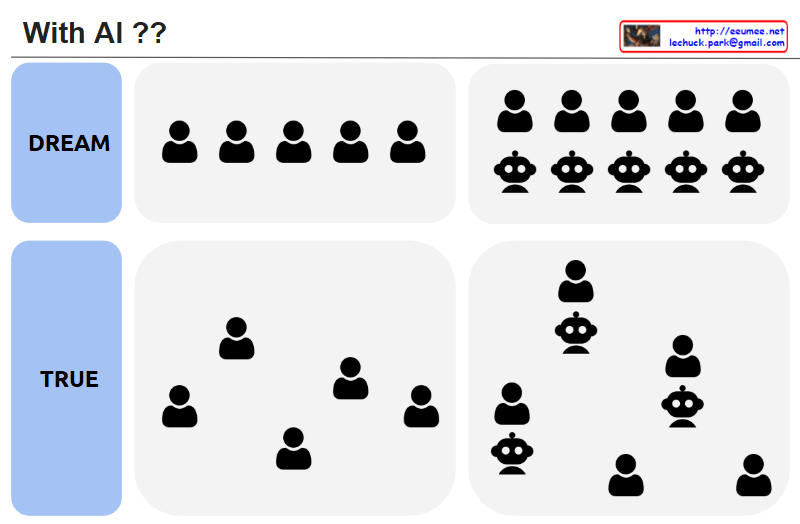
The image is divided into “DREAM” (ideal) and “TRUE” (reality), contrasting human society and AI integration scenarios.

2. Human Society Representation

Ideal (DREAM)

  • All human icons positioned at the same height
  • Symbolizes perfect social equality
  • Presents a utopian vision without hierarchical or power differences

Reality (TRUE)

  • Human icons placed irregularly at different heights
  • Reflects the inevitable existence of social hierarchy and power structures
  • Suggests that perfect equality is difficult to achieve in reality

3. AI and Human Relationship

Ideal (DREAM)

  • AI icons aligned uniformly below human icons
  • Represents AI under complete human control
  • Expresses the expectation that humans can perfectly control AI as a tool

Reality (TRUE)

  • AI and human icons randomly placed at various heights
  • Some AI icons positioned higher than humans
  • Indicates that AI may surpass human capabilities or authority in certain domains

4. Key Messages

  1. Perfect equality in human society remains an ideal, while reality always contains some form of hierarchy.
  2. The expectation of complete control over AI may be unrealistic, as AI can potentially exceed human capabilities in specific areas.
  3. It’s important to acknowledge and understand the gap between ideals and reality.

5. Overall Implications

The image effectively visualizes the disconnect between our expectations and reality in both human social structures and AI integration. It suggests that while we may dream of perfect equality and control, the reality is more complex and unpredictable, requiring us to adapt our understanding and expectations accordingly.

With Claude
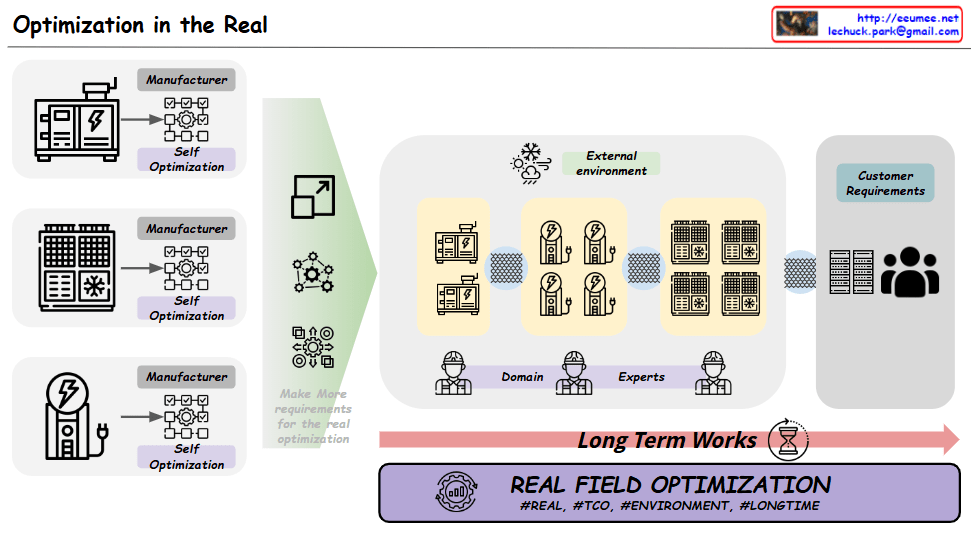
Optimization in the Real

From Claude with some prompting
The Real Field Optimization diagram and its extended implications:

  1. Extended Scope of Optimization:
  • Begins with equipment Self-Optimization but extends far beyond
  • Increasing complexity in real operating environments:
    • Equipment/system interactions
    • Operational scale expansion
    • Service quality requirements
    • Various stakeholder requirements
  1. Real Operating Environment Considerations:
  • Domain Experts’ practical experience and knowledge
  • Customer requirements and feedback
  • External Environment impacts
  • Variables emerging from Long Term operations
  1. TCO (Total Cost of Ownership) Perspective:
  • Beyond initial installation/deployment costs
  • Operation/maintenance costs
  • Energy efficiency
  • Lifecycle cost optimization
  1. Data-Driven Optimization Necessity:
  • Collection and analysis of actual operational data
  • Understanding operational patterns
  • Predictive maintenance
  • Performance/efficiency monitoring
  • Data-driven decision making for continuous improvement
  1. Long-Term Perspective Importance:
  • Performance change management over time
  • Scalability considerations
  • Sustainable operation model establishment
  • Adaptability to changing requirements
  1. Real Field Integration:
  • Interaction between manufacturers, operators, and customers
  • Environmental factor considerations
  • Complex system interdependencies
  • Real-world constraint management

This comprehensive optimization approach goes beyond individual equipment efficiency, aiming for sustainable operation and value creation of the entire system. This can be achieved through continuous improvement activities based on real operational environment data. This represents the true meaning of “Real Field Optimization” with its hashtags #REAL, #TCO, #ENVIRONMENT, #LONGTIME.

The diagram effectively illustrates that while equipment-level optimization is fundamental, the real challenge and opportunity lie in optimizing the entire operational ecosystem over time, considering all stakeholders, environmental factors, and long-term sustainability. The implicit need for data-driven optimization in real operating environments becomes crucial for achieving these comprehensive optimization goals.

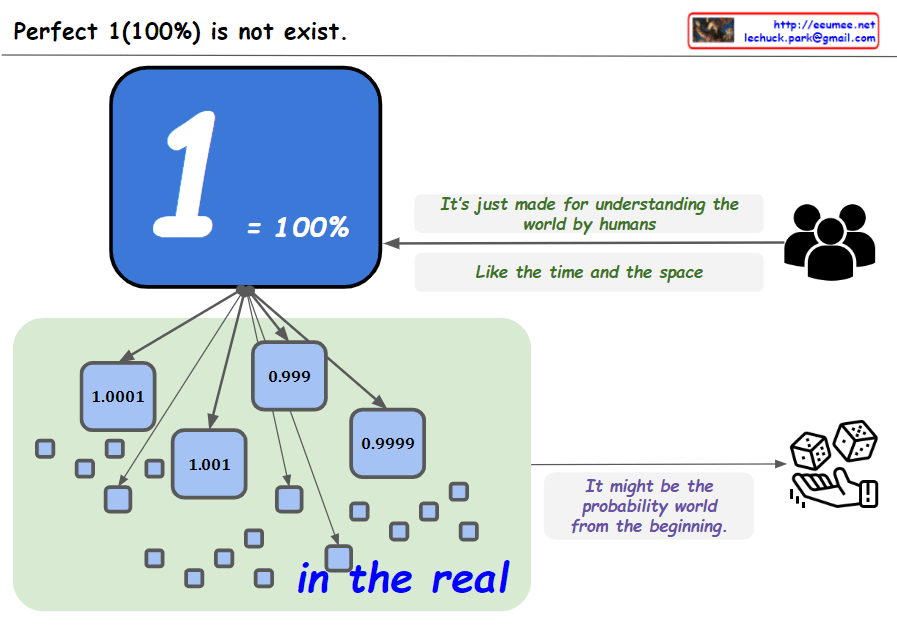
Perfect 1 ??

From the bard with some prompting
The image you provided consists of 10 squares with numbers from 1 to 0.9999, along with the phrase “Perfect 1 (100%) does not exist.”

The image conveys the message that perfection is impossible. The 10 squares represent 100%, but it is impossible to reach 100%, no matter how close we get. The number 0.9999 in the last square shows that it is close to perfection, but ultimately not perfect.

The image can also convey the message that the real world is uncertain and unpredictable. There is nothing that we can be 100% sure of, and there is always some uncertainty.

Finally, the image can convey the message that we are always growing and learning. The numbers from 1 to 0.9999 show that we are always getting closer to perfection, but we are never perfect.

The image is an open image that can be interpreted in many ways. Each individual can interpret the image according to their own experiences and values.

Here are some specific interpretations of the image:

Perfection is impossible: No matter how hard we try, we will never be perfect. There will always be room for improvement.
The real world is uncertain: There is always some risk or uncertainty in life. We cannot control everything that happens.
We are always growing and learning: We are constantly learning and evolving. We can always strive to be better.
Ultimately, the meaning of the image is up to the individual to decide.

maintain 1

From DALL-E with some prompting
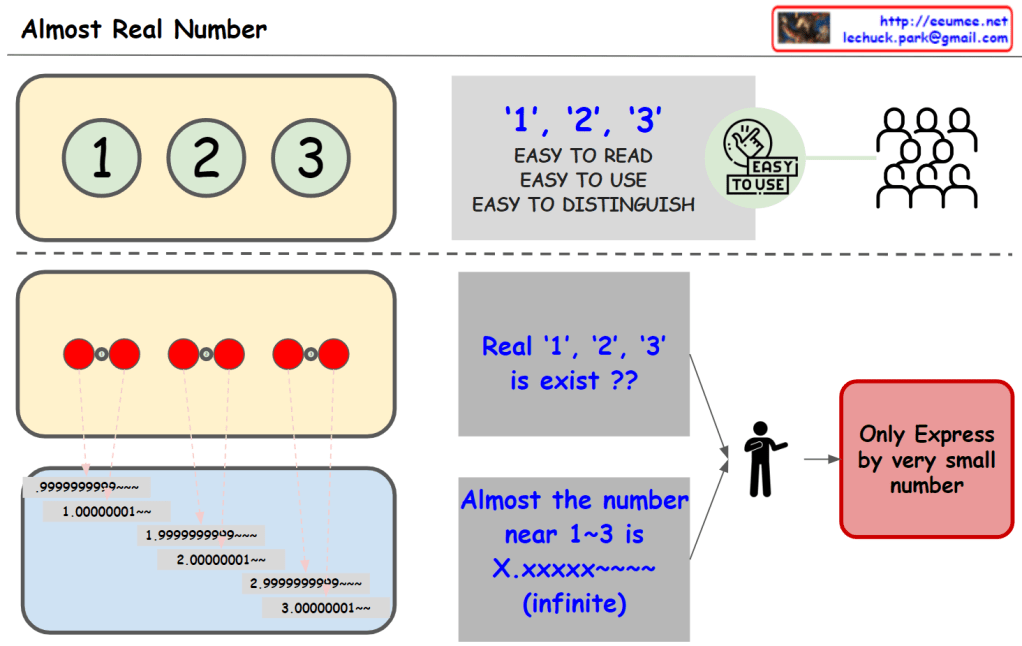
The image contrasts the concept of maintaining the number “1” in the digital world versus the real world.

  • In the Digital World: The “1” represented in binary code is said to be very easy to maintain in the digital realm, implying that as long as there is electricity, the data “1” can be precisely preserved.
  • In the Real World: It questions the existence of a perfect “1,” showing values like 0.99999 and 1.00001 around the numerical representation of “1,” suggesting that maintaining an absolute “1” in the real world is challenging.
  • The phrases “Everything is Changed” and “Everything is Connected” at the bottom emphasize that in the real world, everything is subject to change and interconnected.

Overall, the image presents a philosophical inquiry into how the concept of “1” can be applied and interpreted differently between the digital and real worlds. While the digital world can uphold the accuracy and consistency of data, the real world embeds complexities and nuances within the concept of constancy.