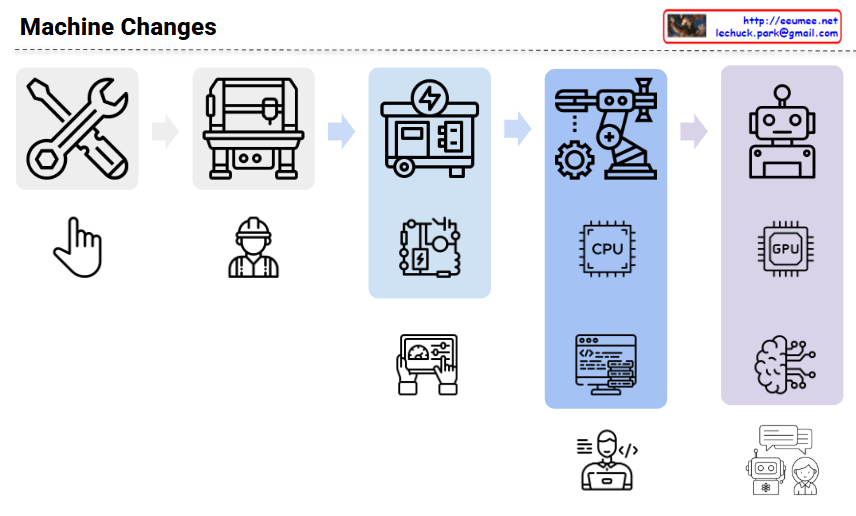
Machine Changes

This image titled “Machine Changes” visually illustrates the evolution of technology and machinery across different eras.

The diagram progresses from left to right with arrows showing the developmental stages:

Stage 1 (Left): Manual Labor Era

  • Tool icons (wrench, spanner)
  • Hand icon
  • Worker icon Representing basic manual work using simple tools.

Stage 2: Mechanization Era

  • Manufacturing equipment and machinery
  • Power-driven machines Depicting the industrial revolution period with mechanized production.

Stage 3 (Blue section): Automation and Computer Era

  • Power supply systems
  • CPU/processor chips
  • Computer systems
  • Programming code Representing automation through electronics and computer technology.

Stage 4 (Purple section): AI and Smart Technology Era

  • Robots
  • GPU processors
  • Artificial brain/AI
  • Interactive interfaces Representing modern smart technology integrated with artificial intelligence and robotics.

Additional Insight: The transition from the CPU era to the GPU era marks a fundamental shift in what drives technological capability. In the CPU era, program logic was the critical factor – the sophistication of algorithms and code determined system performance. However, in the GPU era, training data has become paramount – the quality, quantity, and diversity of data used to train AI models now determines the intelligence and effectiveness of these systems. This represents a shift from logic-driven computation to data-driven learning.

Overall, this infographic captures humanity’s technological evolution: Manual Labor → Mechanization → Automation → AI/Robotics, highlighting how the foundation of technological advancement has evolved from human skill to mechanical power to programmed logic to data-driven intelligence.

With Claude

Legacy AI (Rule-based)

The image shows a diagram explaining “Legacy AI” or rule-based AI systems. The diagram is structured in three main sections:

  1. At the top: A workflow showing three steps:
    • “Analysis” (illustrated with a document and magnifying glass with charts)
    • “Prioritize” (shown as a numbered list with 1-2-3 and an upward arrow)
    • “Choose the best” (depicted with a network diagram and pointing hand)
  2. In the middle: Programming conditional statement structure:
    • “IF [ ]” section contains analysis and prioritization icons, representing the condition evaluation
    • “THEN [ ]” section includes “optimal choice” icons, representing the action to execute when the condition is true
    • “It’s Rule” label on the right indicates this is a traditional program code processing approach
  3. At the bottom: A pipeline process labeled “It’s Algorithm (Rule-based AI)” showing:
    • A series of interconnected components with arrows
    • Each component contains small icons representing analysis and rules
    • The process ends with “Serialize without duplications”

This diagram effectively illustrates the structure and workflow of traditional rule-based AI systems, demonstrating how they operate like conventional programming with IF-THEN statements. The system first analyzes data, then prioritizes information based on predefined criteria, and finally makes decisions by selecting the optimal choice according to the programmed rules. This represents the foundation of early AI approaches before the advent of modern machine learning techniques, where explicit rules rather than learned patterns guided the decision-making process.

With Claude

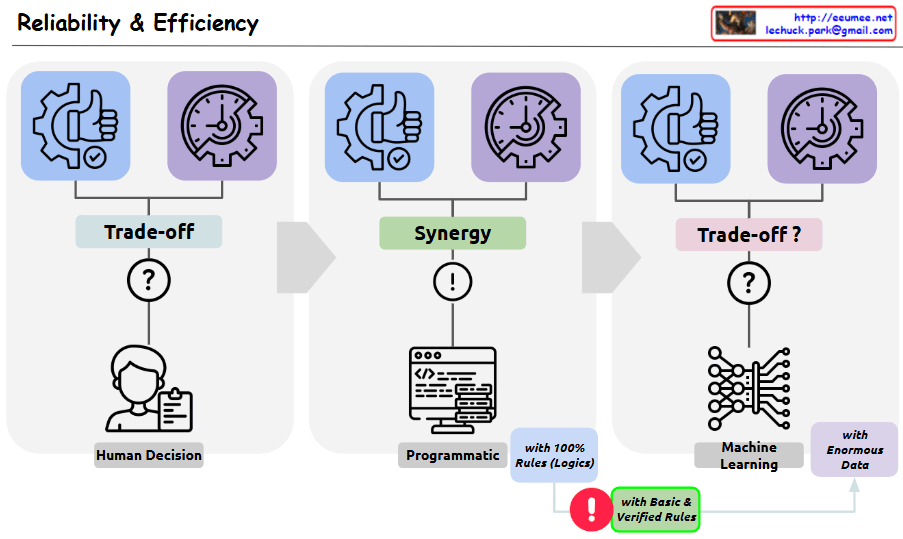
Reliability & Efficiency

This image is a diagram showing the relationship between Reliability and Efficiency. Three different decision-making approaches are compared:

  1. First section – “Trade-off”:
    • Shows Human Decision making
    • Indicates there is a trade-off relationship between reliability and efficiency
    • Displays a question mark (?) symbol representing uncertainty
  2. Second section – “Synergy”:
    • Shows a Programmatic approach
    • Labeled as using “100% Rules (Logic)”
    • Indicates there is synergy between reliability and efficiency
    • Features an exclamation mark (!) symbol representing certainty
  3. Third section – “Trade-off?”:
    • Shows a Machine Learning approach
    • Labeled as using “Enormous Data”
    • Questions whether the relationship between reliability and efficiency is again a trade-off
    • Displays a question mark (?) symbol representing uncertainty

Importantly, the “Basic & Verified Rules” section at the bottom presents a solution to overcome the indeterminacy (probabilistic nature and resulting trade-offs) of machine learning. It emphasizes that the rules forming the foundation of machine learning systems should be simple and clearly verifiable. By applying these basic and verified rules, the uncertainty stemming from the probabilistic nature of machine learning can be reduced, suggesting an improved balance between reliability and efficiency.

with Claude

Data & Decision

with a Claude’s Help
This diagram illustrates the process of converting real-world analog values into actionable decisions through digital systems:

  1. Input Data Characteristics
  • Metric Value: Represents real-world analog values that are continuous variables with high precision. While these can include very fine digital measurements, they are often too complex for direct system processing.
  • Examples: Temperature, velocity, pressure, and other physical measurements
  1. Data Transformation Process
  • Through ‘Sampling & Analysis’, continuous Metric Values are transformed into meaningful State Values.
  • This represents the process of simplifying and digitalizing complex analog signals.
  1. State Value Characteristics and Usage
  • Converts to discrete variables with high readability
  • Examples: Temperature becomes ‘High/Normal/Low’, speed becomes ‘Over/Normal/Under’
  • These State values are much more programmable and easier to process in systems
  1. Decision Making and Execution
  • The simplified State values enable clear decision-making (Easy to Decision)
  • These decisions can be readily implemented through Programmatic Works
  • Leads to automated execution (represented by “DO IT!”)

The key concept here is the transformation of complex real-world measurements into clear, discrete states that systems can understand and process. This conversion facilitates automated decision-making and execution. The diagram emphasizes that while Metric Values provide high precision, State Values are more practical for programmatic implementation and decision-making processes.

The flow shows how we bridge the gap between analog reality and digital decision-making by converting precise but complex measurements into actionable, programmable states. This transformation is essential for creating reliable and automated decision-making systems.

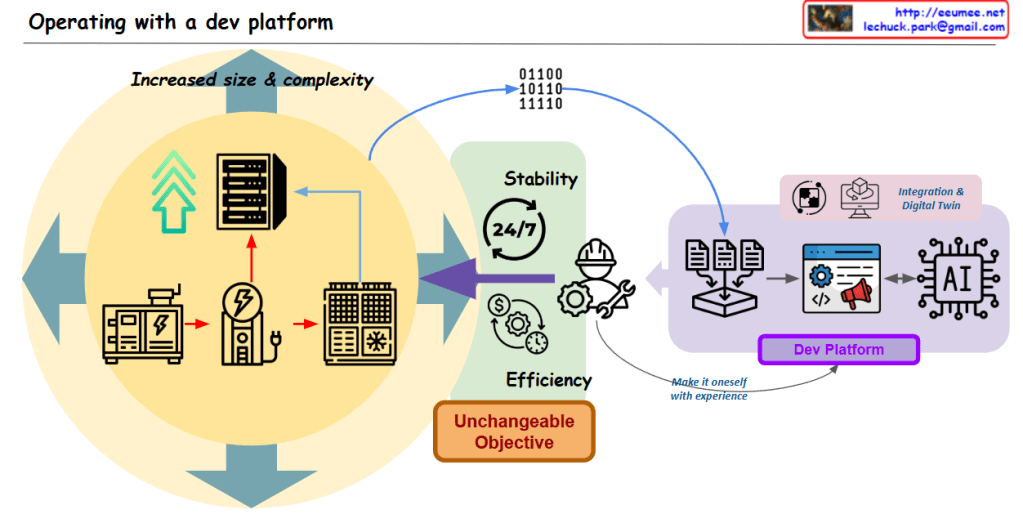
Operating with a dev Platform

with a Claude’s help
The main points covered in this image are:

  1. Increased Size and Complexity of Data
  • The central upward-pointing arrow indicates that the size and complexity of data is increasing.
  1. Key Operational Objectives
  • The three main operational goals presented are Stability, Efficiency, and an “Unchangeable Objective”.
  • Stability is represented by the 24/7 icon, indicating the need for continuous, reliable operation.
  • Efficiency is depicted through various electrical/mechanical icons, suggesting the need for optimized resource utilization.
  • The “Unchangeable Objective” is presented as a non-negotiable goal.
  1. Integration, Digital Twin, and AI-based Development Platform
  • To manage the increasing data and operations, the image shows the integration of technologies like Digital Twin.
  • An AI-powered Development Platform is also illustrated, which can “make it [the operations] itself with experience”.
  • This Development Platform seems to leverage AI to help achieve the stability, efficiency, and unchangeable objectives.
  1. Interconnected Elements
  • The image demonstrates the interconnected nature of the growing data, the key operational requirements, and the technological solutions.
  • The Development Platform acts as a hub, integrating data and AI capabilities to support the overall operational goals.

In summary, this image highlights the challenges posed by the increased size and complexity of data that organizations need to manage. It presents the core operational objectives of stability, efficiency, and immutable goals, and suggests that an integrated, AI-powered development platform can help address these challenges by leveraging the synergies between data, digital technologies, and autonomous problem-solving capabilities.

Evolutions

From Claude with some prompting
Summarize the key points from the image :

  1. Manually Control:
    • This stage involves direct human control of the system.
    • Human intervention and judgment are crucial at this stage.
  2. Data Driven:
    • This stage uses data analysis to control the system.
    • Data collection and analysis are the core elements.
  3. AI Control:
    • This stage leverages artificial intelligence technologies to control the system.
    • Technologies like machine learning and deep learning are utilized.
  4. Virtual:
    • This stage involves the implementation of systems in a virtual environment.
    • Simulation and digital twin technologies are employed.
  5. Massive Data:
    • This stage emphasizes the importance of collecting, processing, and utilizing vast amounts of data.
    • Technologies like big data and cloud computing are utilized.

Throughout this progression, there is a gradual shift towards automation and increased intelligence. The development of data and AI technologies plays a critical role, while the use of virtual environments and massive data further accelerates this technological evolution.