Human Control

Human-Centered AI Decision-Making System

This diagram illustrates a human-in-the-loop AI system where humans maintain control over critical decision-making processes.

System Components

Top Process Flow:

  • Data QualityAnalysisDecision
  • Sequential workflow with human oversight at each stage

Bottom Control Layer:

  • AI Works in the central processing area
  • Ethics Human Rules (left side) – Human-defined ethical guidelines
  • Probability Control (right side) – Human oversight of AI confidence levels

Human Control Points:

  • Human Intent feeds into the system at the beginning
  • Final Decision remains with humans at the end
  • Human Control emphasized as the foundation of the entire system

Key Principles

  1. Human Agency: People retain ultimate decision-making authority
  2. AI as Tool: AI performs analysis but doesn’t make final decisions
  3. Ethical Oversight: Human-defined rules guide AI behavior
  4. Transparency: Probability controls allow humans to understand AI confidence
  5. Accountability: Clear human responsibility throughout the process

Summary: This represents a responsible AI framework where artificial intelligence enhances human decision-making capabilities while ensuring humans remain in control of critical choices and ethical considerations.

With Claude
The Era of True Artificial Intelligence: Bridging Human and Machine Learning  

AI has now reached a level that can truly be called Artificial Intelligence. This is especially evident in the era of Machine Learning (ML). Humans learn through experiences—essentially data—and make judgments and take actions based on them. These actions are not always perfect or correct, but through continuous learning and experience, they strive for better outcomes, which inherently reflects a probabilistic and statistical perspective.

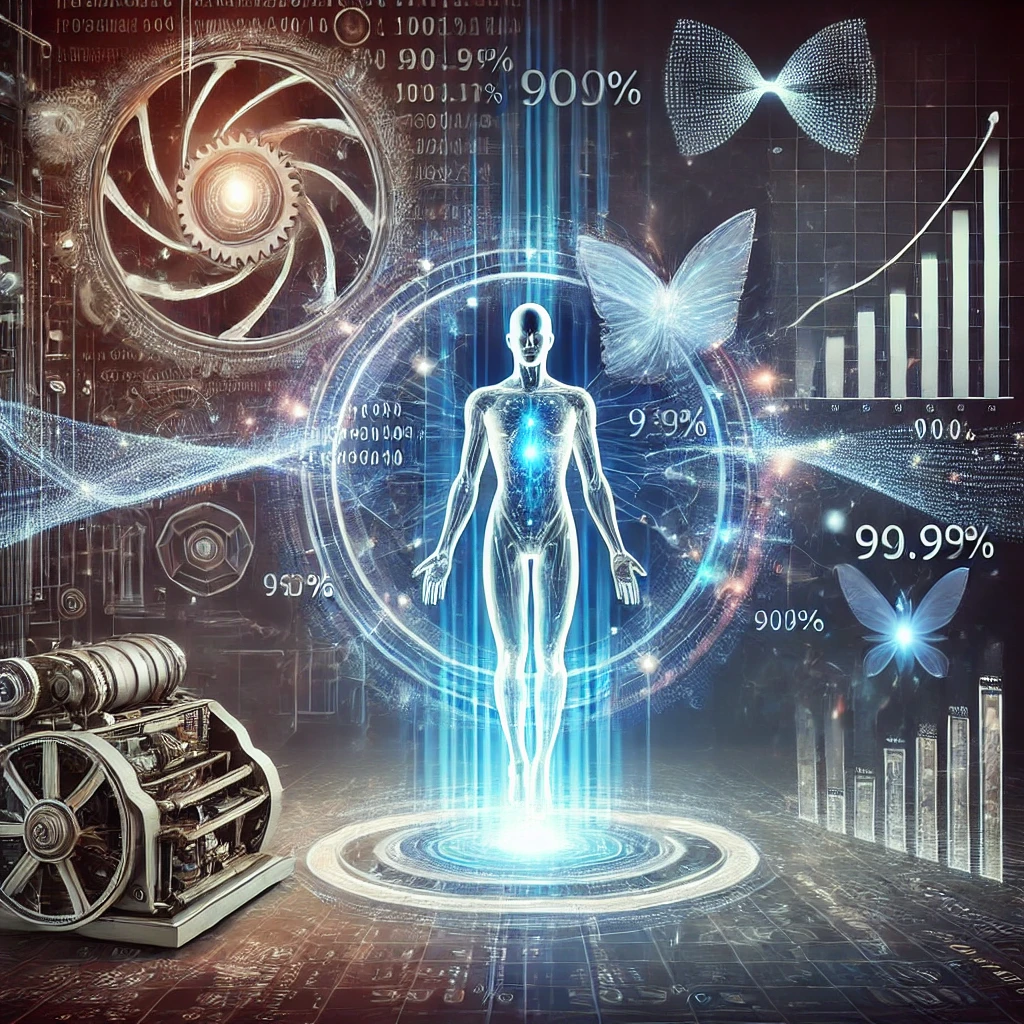
Similarly, ML learns from massive datasets to identify rules and minimize errors. However, it cannot achieve 100% perfection because it cannot learn all possible data, which is essentially infinite. Despite this, recent advancements in infrastructure and access to vast amounts of data have enabled AI to reach accuracy levels of 90% to 99.99%, appearing almost perfect.

Nevertheless, there still remains the elusive 0.00…1% of uncertainty, stemming from the fundamental limitation of incomplete data learning. Ultimately, AI is not so different from humans in how it learns and makes probabilistic decisions. For this reason, we can truly call it Artificial Intelligence.

Anyway, The probability

From Claude with some prompting
Traditional View: AI’s probability-based decisions are seen in contrast to human’s logical, “100% certain” decisions, and this difference could be perceived as problematic.

New Insight: In reality, the concept of human’s “100% certainty” itself might be an illusion. Human judgments are also based on limited data and experiences, making them inherently probabilistic in nature.

Finding Common Ground: Both humans and AI make decisions based on incomplete information. Even human’s logical certainty ultimately stems from restricted data, making it fundamentally probability-based.

Paradigm Shift: This perspective suggests that AI’s probabilistic approach isn’t a flaw but rather a more accurate modeling of human decision-making processes. What we believe to be “100% certainty” is actually a high-probability estimation based on limited information.

Implications: This prompts a reevaluation of the perceived gap between AI and human decision-making styles. AI’s probabilistic approach might not be inferior to human logic; instead, it may more accurately reflect our cognitive processes.

This viewpoint encourages us to see AI’s probabilistic tendencies not as a problem, but as a tool providing deeper insights into human thought processes. It invites us to reconsider how AI and humans collaborate, opening new possibilities to complementarily leverage the strengths of both sides.

The image and your interpretation together challenge the notion that human reasoning is purely logical and certain. Instead, they suggest that both human and AI decisions are fundamentally based on probabilities derived from limited data. This realization can foster a more harmonious and effective partnership between humans and AI, recognizing that our decision-making processes may be more similar than previously thought.

AI vs Human

From Claude with some prompting
Sure, here’s an explanation of the image in English, with a detailed description of the graph’s contents:

This image contrasts the capabilities of rule-based human logic and data-driven AI. The graph shows two curves:

  1. The blue curve represents rule-based human logic, which is stated to be “Always 100%” accurate. However, the curve flattens out, indicating that as data volume increases, human logic reaches its limits and analysis stagnates.
  2. The purple curve represents data-driven AI output, which starts at 0% accuracy but increases “dramatically based on more data” as computing power increases. The curve asymptotically approaches but never quite reaches 100%, with values like 99.99%, 99.999% mentioned.

The key points made are:

  • Rule-based human logic is 100% accurate but limited in its ability to process excessive data volumes.
  • Data-driven AI has lower initial accuracy but can approach near-perfect accuracy (99.99%+) by analyzing vast amounts of data powered by immense computing capabilities.
  • As more data and computing power become available, the effectiveness of data-driven AI surpasses the limits of human logic analysis.

So the image suggests that while human logic is perfect within its constraints, the future lies with data-driven AI systems that can harness massive data and computing resources to deliver extremely high accuracy, potentially exceeding human capabilities.


Perfect 1 ??

From the bard with some prompting
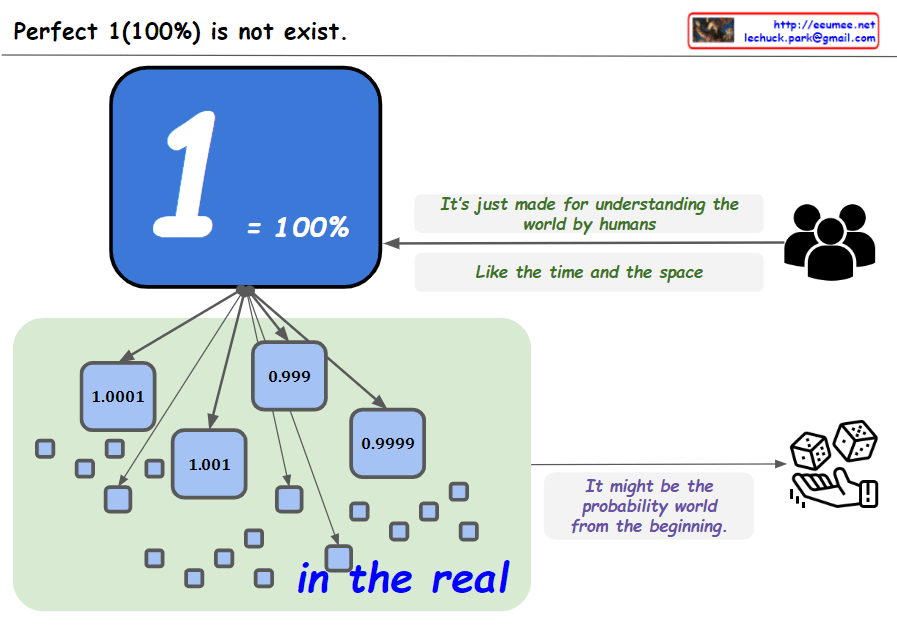
The image you provided consists of 10 squares with numbers from 1 to 0.9999, along with the phrase “Perfect 1 (100%) does not exist.”

The image conveys the message that perfection is impossible. The 10 squares represent 100%, but it is impossible to reach 100%, no matter how close we get. The number 0.9999 in the last square shows that it is close to perfection, but ultimately not perfect.

The image can also convey the message that the real world is uncertain and unpredictable. There is nothing that we can be 100% sure of, and there is always some uncertainty.

Finally, the image can convey the message that we are always growing and learning. The numbers from 1 to 0.9999 show that we are always getting closer to perfection, but we are never perfect.

The image is an open image that can be interpreted in many ways. Each individual can interpret the image according to their own experiences and values.

Here are some specific interpretations of the image:

Perfection is impossible: No matter how hard we try, we will never be perfect. There will always be room for improvement.
The real world is uncertain: There is always some risk or uncertainty in life. We cannot control everything that happens.
We are always growing and learning: We are constantly learning and evolving. We can always strive to be better.
Ultimately, the meaning of the image is up to the individual to decide.

A probability world

From DALL-E with some prompting
The image explores how human decision-making has evolved from data analysis to probabilistic judgments. Initially, rules derived from data led to definitive decisions, but with the advent of AI, we have returned to probabilistic decision-making. The phrases at the top suggest that the real world may be inherently probabilistic and that humans still lack complete knowledge of the quantum realm.