AI Operation with numbers

From DALL-E with some prompting
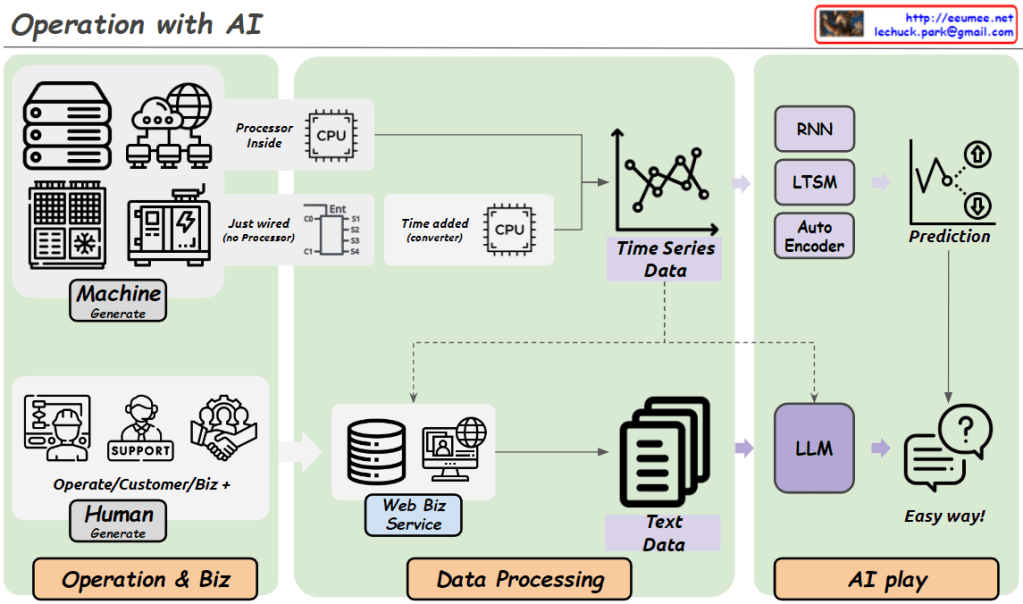
The image illustrates an AI-based operational framework using numerical data for real-time operation, monitoring, and predictive maintenance. Data, such as temperature readings, is collected in digital form (“Get Digitals”). When operating within normal parameters (18°C to 27°C), the system maintains a “Normal Case” status. Any changes in the data trigger alerts and cautions. The AI model learns from numerical data to differentiate between normal and abnormal patterns. Upon detecting an anomaly, the system initiates a recovery process as part of predictive maintenance, aiming to address issues before they escalate.

Works with data

From DALL-E with some prompting
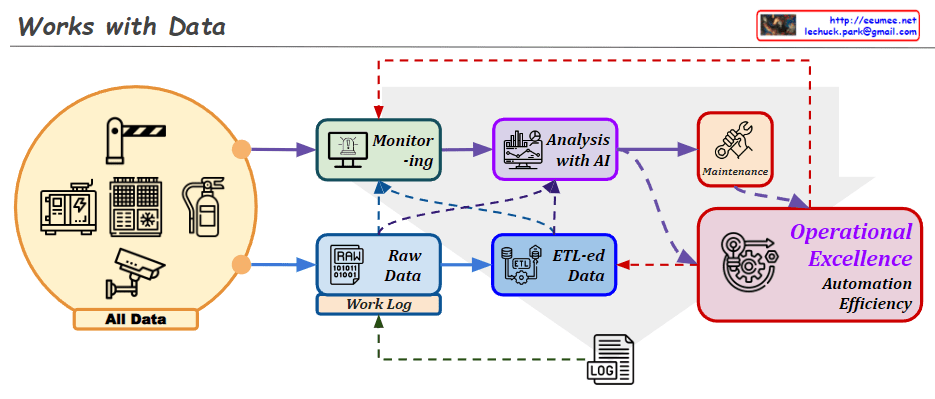
The image describes a data workflow process that involves various stages of data handling and utilization for operational excellence. “All Data” from diverse sources feeds into a monitoring system, which then processes raw data, including work logs. This raw data undergoes ETL (Extract, Transform, Load) procedures to become structured “ETL-ed Data.” Following ETL, the data is analyzed with AI to extract insights and inform decisions, which can lead to actions such as maintenance. The ultimate goal of this process is to achieve operational excellence, automation, and efficiency.

Service cycle

From DALL-E with some prompting
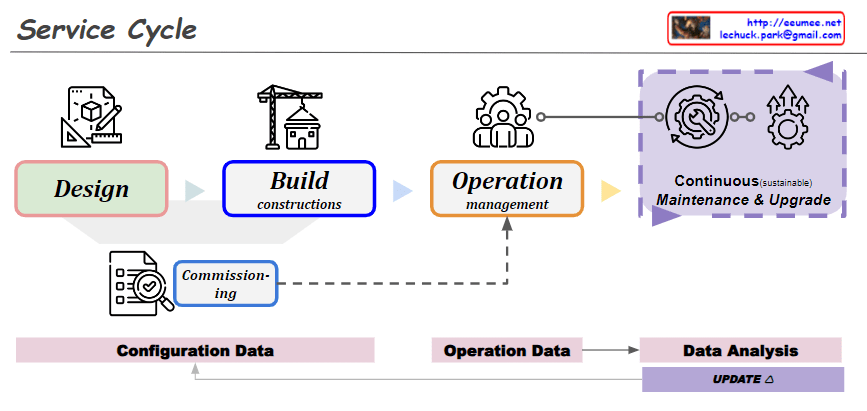
The image depicts a “Service Cycle” comprising several phases in a service’s lifecycle. These phases are visually represented and include “Design,” “Build constructions,” and “Operation management.” Additionally, the cycle includes “Commissioning” and “Continuous (sustainable) Maintenance & Upgrade” stages, emphasizing the ongoing process of maintaining and upgrading services. The flow of information through “Configuration Data,” “Operation Data,” and “Data Analysis” is also presented, highlighting the importance of data in managing and improving service operations.

DT for new biz

From DALL-E with some prompting
The image is a diagram that illustrates the process of digital transformation for discovering new business opportunities through the digitization of data center operations. The stages included are as follows:

  1. Digitization: The initial step of converting data into digital form.
  2. Digitalization: The process of enhancing operational know-how and creating new value through the experience and analysis with AI, as indicated by the phrases “Exp & Analysis with AI” and “Selling EXP and more!!”.
  3. Digital Transformation: The stage where insights and ideas gained from digitalization are actualized into new business changes.

At the bottom of the diagram, the phrase “All New for DC By Digital(data)” is accompanied by four boxes labeled Design, Deployment, Operating, and Customer. This indicates that all components of business operations are undergoing new changes based on digital data. The “NEW” marker emphasizes the new business opportunities that arise through digital transformation.

The diagram visually explains how transforming existing data into a digital format and using technologies like AI for analysis can improve operational knowledge and, as a result, generate and implement new business ideas. It specifically highlights that digital transformation in data center operations can provide opportunities for uncovering new business ventures.

AI DC Operation

from DALL-E with some prompting
The image represents a diagram that outlines the transformation of data center operations through the integration of Artificial Intelligence (AI). The flow from left to right demonstrates the transition from traditional data center operations to a new paradigm facilitated by AI. The diagram begins with legacy operations characterized by machines, alarm systems, and the processes managed by experts.

The section titled ‘DC Growing’ highlights the expansion of data centers and the new challenges that arise, including hyperscale, increased complexity, and shifts in customer demographics from retail to major Cloud Service Providers (CSP).

In the subsequent ‘DT’ and ‘AI’ sections, the diagram showcases how Digital Transformation (DT) and AI are integrated into data center operations, enhancing service reliability, automation, energy optimization, and customer service. The ‘AI Accelerator’ section illustrates the role of AI in speeding up the operations of a data center, setting new benchmarks for AI-driven operations.

This diagram visually summarizes how data centers evolve with technological advancements and how AI and digital transformation technologies are revolutionizing traditional operational practices.

AI driven Machine Operation Optimization 

From DALL-E with some prompting
The image illustrates an AI-driven approach to machine operation optimization, with a detailed operation plan that incorporates expert risk assessments. The process is structured as follows:

  1. AI Guide:
    • AI recommends strategies for optimizing operations, including metrics like the number of operations, operating ratio, and load balancing.
  2. Operation Plan:
    • This section emphasizes the creation of a comprehensive operation plan that includes expert assessments of risk and importance in case of failures, alongside safety and emergency response strategies. It also suggests a methodical plan for incrementally applying AI to operations.
  3. Operation Risk and Step-by-Step Operation Expansion:
    • It involves managing operational risks identified by domain experts and the systematic expansion of operations using AI guidance. The gradual application of AI is based on expert risk assessments, leading to a refined approach to risk management and the transformation of operations towards AI-driven processes.

In summary, the key to successfully optimizing operations through AI involves leveraging the expertise of domain professionals to assess risks and guide the step-by-step implementation of AI strategies, ensuring operations are both efficient and secure. 

Operational Excellence

From DALL-E with some prompting
The image delineates a progressive digital transformation process aimed at achieving operational efficiency. It comprises four main stages, each incorporating specific elements and influencing improvements in the preceding stages:

  1. Manual Operation (Operating by Hand): This foundational stage involves the hands-on operation of facilities or machinery, focusing on the physical manipulation of equipment.
  2. Digital Transformation (DT): Data derived from manual operations are analyzed by experts and digitized through programmatic processes. This stage fosters automation, enhancing the efficiency and optimization of processes.
  3. AI/ML: The data processed through digital transformation are further analyzed with AI and machine learning technologies, driven by large-scale data to achieve more accurate and detailed insights. These analyses facilitate the acceleration and consistent expansion of processes and services.
  4. Service Standardization: The final stage involves standardizing data and processes based on the insights from AI/ML analysis. Essential for delivering high-quality services, it necessitates a clear definition of necessary data, its integration, and performance parameters from facilities and machinery.

Each of these stages is interdependent, with the arrows at the bottom indicating a feedback loop to the previous stages. For instance, insights from AI/ML promote data standardization, which, in turn, contributes to the improvement of digital transformation and manual operations. This creates a cyclical mechanism where each phase reinforces the others, allowing for continuous enhancement of the overall system.