3 Key on the AI era

This diagram illustrates the 3 Core Technological Components of AI World and their surrounding challenges.

AI World’s 3 Core Technological Components

Central AI World Components:

  1. AI infra (AI Infrastructure) – The foundational technology that powers AI systems
  2. AI Model – Core algorithms and model technologies represented by neural networks
  3. AI Agent – Intelligent systems that perform actual tasks and operations

Surrounding 3 Key Challenges

1. Data – Left Area

Data management as the raw material for AI technology:

  • Data: Raw data collection
  • Verified: Validated and quality-controlled data
  • Easy to AI: Data preprocessed and optimized for AI processing

2. Optimization – Bottom Area

Performance enhancement of AI technology:

  • Optimization: System optimization
  • Fit to data: Data fitting and adaptation
  • Energy cost: Efficiency and resource management

3. Verification – Right Area

Ensuring reliability and trustworthiness of AI technology:

  • Verification: Technology validation process
  • Right?: Accuracy assessment
  • Humanism: Alignment with human-centered values

This diagram demonstrates how the three core technological elements – AI Infrastructure, AI Model, and AI Agent – form the center of AI World, while interacting with the three fundamental challenges of Data, Optimization, and Verification to create a comprehensive AI ecosystem.

With Claude
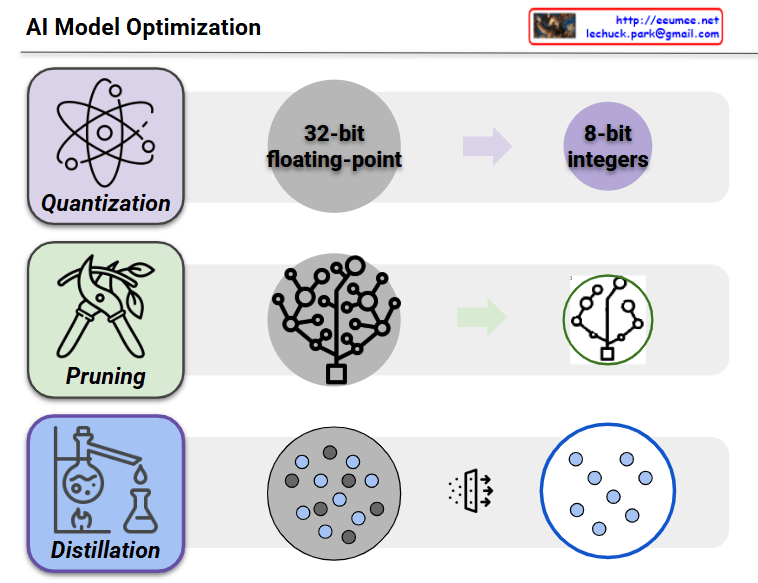
AI Model Optimization

This image shows a diagram illustrating three major AI model optimization techniques.

1. Quantization

  • The process of converting 32-bit floating-point numbers to 8-bit integers
  • A technique that dramatically reduces model size while maintaining performance
  • Significantly decreases memory usage and computational complexity

2. Pruning

  • The process of removing less important connections or neurons from neural networks
  • Transforms complex network structures into simpler, more efficient forms
  • Reduces model size and computation while preserving core functionality

3. Distillation

  • A technique that transfers knowledge from a large model (teacher model) to a smaller model (student model)
  • Reproduces the performance of complex models in lighter, more efficient models
  • Greatly improves efficiency during deployment and execution

All three techniques are essential methods for optimizing AI models to be more efficiently used in real-world environments. They are particularly crucial technologies when deploying AI models in mobile devices or edge computing environments.

With Claude

Digital Twin and the LLM

Digital Twin Concept

A Digital Twin is composed of three key elements:

  • High Precision Data: Exact, structured numerical data
  • Real 3D Model: Visual representation that is easy to comprehend
  • History/Prediction Simulation: Temporal analysis capabilities

LLM Approach

Large Language Models expand on the Digital Twin concept with:

  • Enormous Unstructured Data: Ability to incorporate and process diverse, non-structured information
  • Text-based Interface: Making analysis more accessible through natural language rather than requiring visual interpretation
  • Enhanced Simulation: Improved predictive capabilities leveraging more comprehensive datasets

Key Advantages of LLM over Traditional Digital Twin

  1. Data Flexibility: LLMs can handle both structured and unstructured data, expanding beyond the limitations of traditional Digital Twins
  2. Accessibility: Text-based interfaces lower the barrier to understanding complex analyses
  3. Implementation Efficiency: Recent advances in LLM and GPU technologies make these solutions more practical to implement than complex Digital Twin systems
  4. Practical Application: LLMs offer a more approachable alternative while maintaining the core benefits of Digital Twin concepts

This comparison illustrates how LLMs can serve as an evolution of Digital Twin technology, providing similar benefits through more accessible means and potentially expanding capabilities through their ability to process diverse data types.

With Claude

Trend & Prediction

From Claude with some prompting
The image presents a “Trend & Predictions” process, illustrating a data-driven prediction system. The key aspect is the transition from manual validation to automation.

  1. Data Collection & Storage: Digital data is gathered from various sources and stored in a database.
  2. Manual Selection & Validation: a. User manually selects which metric (data) to use b. User manually chooses which AI model to apply c. Analysis & Confirmation using selected data and model
  3. Transition to Automation:
    • Once optimal metrics and models are confirmed in the manual validation phase, the system learns and switches to automation mode. a. Automatically collects and processes data based on selected metrics b. Automatically applies validated models c. Applies pre-set thresholds to prediction results d. Automatically detects and alerts on significant predictive patterns or anomalies based on thresholds

The core of this process is combining user expertise with system efficiency. Initially, users directly select metrics and models, validating results to “educate” the system. This phase determines which data is meaningful and which models are accurate.

Once this “learning” stage is complete, the system transitions to automation mode. It now automatically collects, processes data, and generates predictions using user-validated metrics and models. Furthermore, it applies preset thresholds to automatically detect significant trend changes or anomalies.

This enables the system to continuously monitor trends, providing alerts to users whenever important changes are detected. This allows users to respond quickly, enhancing both the accuracy of predictions and the efficiency of the system.