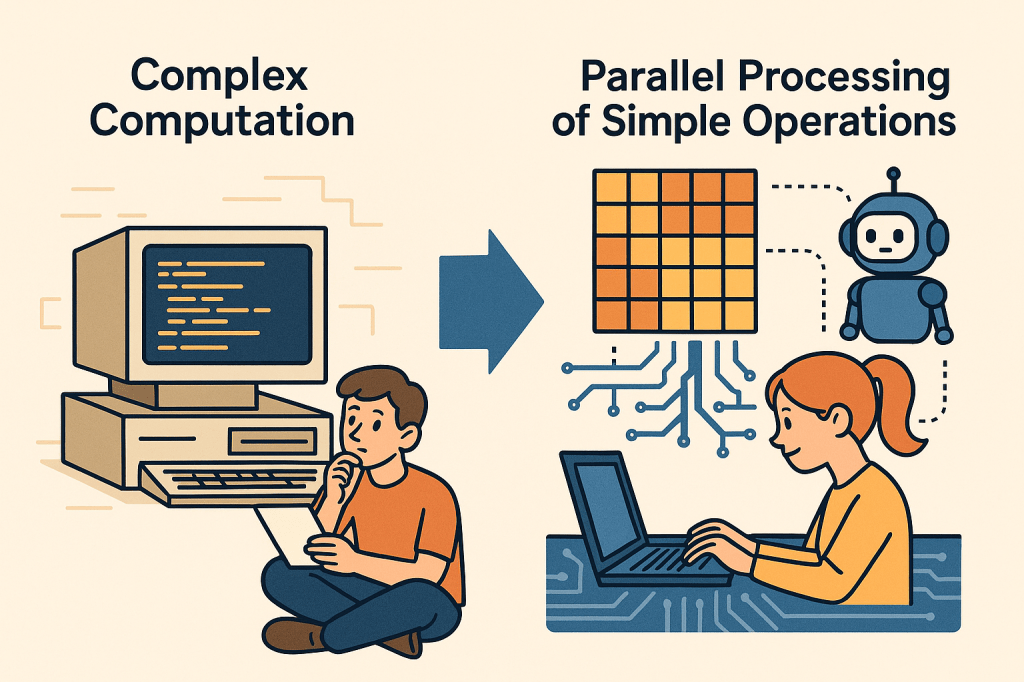
Computing is shifting from complex logic to massive parallel processing of simple matrix operations, especially in AI. As computation becomes faster, memory—its speed, structure, and reliability—becomes the new bottleneck and the most critical resource.
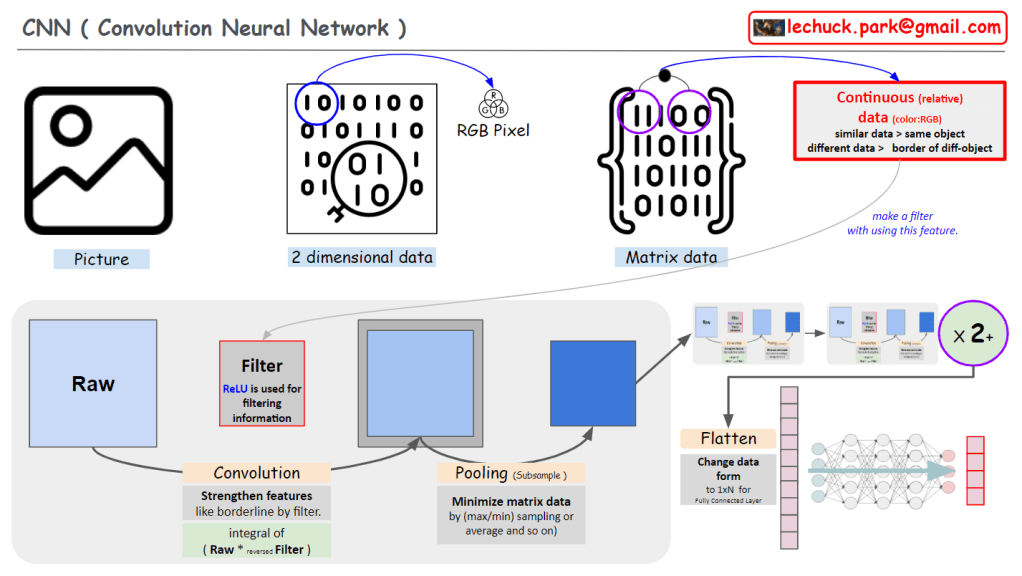
The majority of AI workloads are concentrated in matrix processing because matrix multiplication is the core operation in deep learning. Tensor cores are the key component for AI performance improvement.
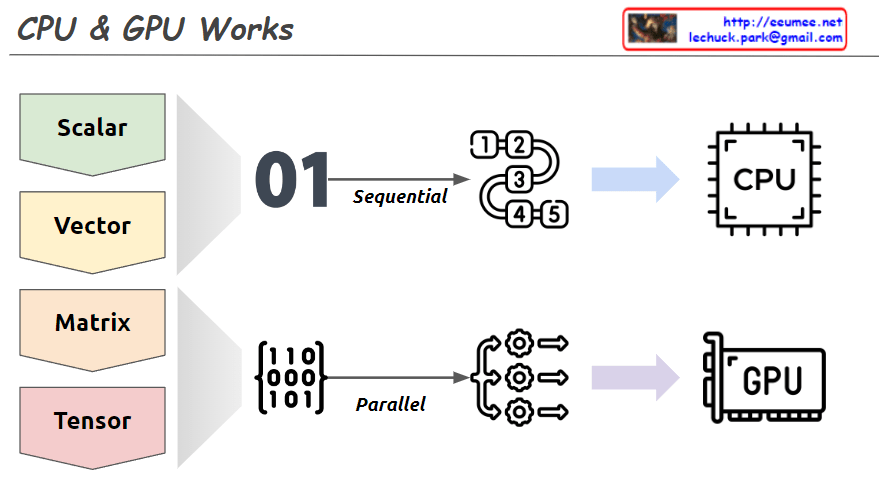
From Claude with some prompting This image explains the working principles of CPU (Central Processing Unit) and GPU (Graphics Processing Unit) in a visual manner.
Data Types:
Scalar: A single value
Vector: One-dimensional array
Matrix: Two-dimensional array
Tensor: Multi-dimensional array
CPU Work Method:
Sequential processing, denoted by ’01’
Tasks are processed in order, as shown by 1, 2, 3, 4, 5
Icons show multiple tasks being processed simultaneously
Mainly deals with multi-dimensional data like matrices or tensors, processing many tasks in parallel
The image demonstrates that while CPUs process tasks sequentially, GPUs can handle many tasks simultaneously in parallel. This helps explain which processing unit is more efficient based on the complexity and volume of data. Complex and large-scale data (matrices, tensors) are better suited for GPUs, while simple, sequential tasks are more appropriate for CPUs.
From DALL-E with some prompting This image appears to be a diagram explaining the concepts of scalar, vector, matrix, and tensor in the context of dimensions and data structures:
Scalar: Represented as a zero-dimensional entity and is simply a single value that exists. Vector: Shown as one-dimensional, it is depicted as an arrow, indicating a feature or a point with direction and magnitude. Matrix: Illustrated as two-dimensional, like a grid, representing connected data points. Tensor: Described with ‘N dimension’, suggesting a complex structure where all elements are interconnected, like a network of points extending beyond two dimensions. This progression shows how data structures become more complex and capable of representing more intricate relationships as the number of dimensions increases.



 Lechuck Park