Intelligent Event Processing Architecture Analysis
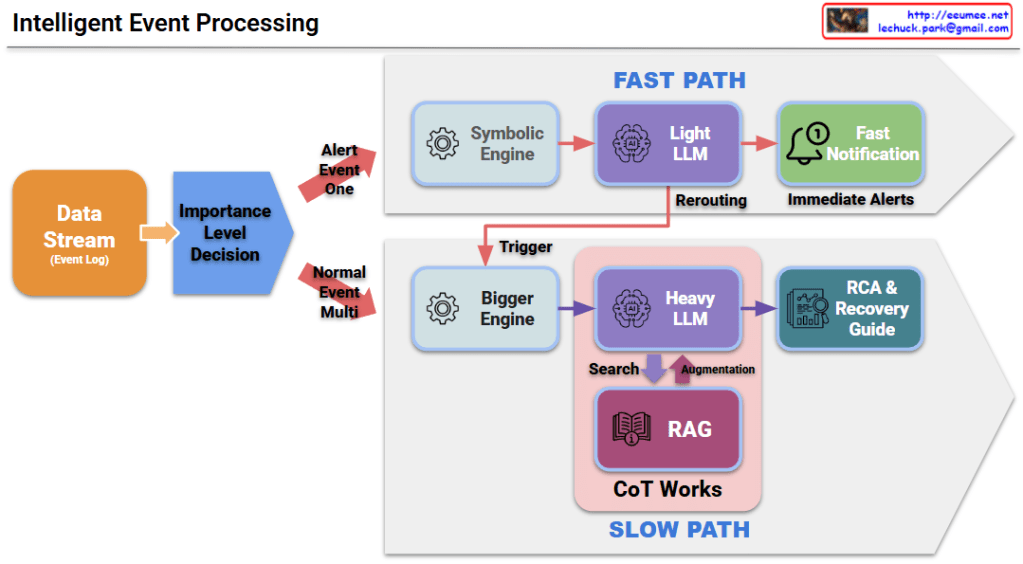
The provided diagrams, titled Event Level Flow and Intelligent Event Processing, illustrate a sophisticated dual-path framework designed to optimize incident response within data center environments. This architecture effectively balances the need for immediate awareness with the requirement for deep, evidence-based diagnostics.
1. Data Ingestion and Intelligent Triage
The process begins with a continuous Data Stream of event logs. An Importance Level Decision gate acts as a triage point, routing traffic based on urgency and complexity:
- Critical, single-source issues are designated as Alert Event One and sent to the Fast Path.
- Standard or bulk logs are labeled Normal Event Multi and directed to the Slow Path for batch or deeper processing.
2. Fast Path: The Low-Latency Response Track
This path minimizes the time between event detection and operator awareness.
- A Symbolic Engine handles rapid, rule-based filtering.
- A Light LLM (typically a smaller parameter model) summarizes the event for human readability.
- The Fast Notification system delivers immediate alerts to operators.
- Crucially, a Rerouting function triggers the Slow Path, ensuring that even rapidly reported issues receive full analytical scrutiny.
3. Slow Path: The Comprehensive Diagnostic Track
The Slow Path focuses on precision, using advanced reasoning to solve complex problems.
- Upon receiving a Trigger, a Bigger Engine prepares the data for high-level inference.
- The Heavy LLM executes Chain of Thought (CoT) Works, breaking down the incident into logical steps to avoid errors.
- This is supported by a Retrieval-Augmented Generation (RAG) system that performs a Search across internal knowledge bases (like manuals) and performs an Augmentation to enrich the LLM prompt with specific context.
- The final output is a comprehensive Root Cause Analysis (RCA) and an actionable Recovery Guide.
Summary
- This architecture bifurcates incident response into a Fast Path for rapid awareness and a Slow Path for in-depth reasoning.
- By combining lightweight LLMs for speed and heavyweight LLMs with RAG for accuracy, it ensures both rapid alerting and reliable recovery guidance.
- The integration of symbolic rules and AI-driven Chain of Thought logic enhances both the operational efficiency and the technical reliability of the system.
#AIOps #LLM #RAG #DataCenter #IncidentResponse #IntelligentMonitoring #AI_Operations #RCA #Automation
With Gemini
 Lechuck Park