The Optimization of Parallel Works

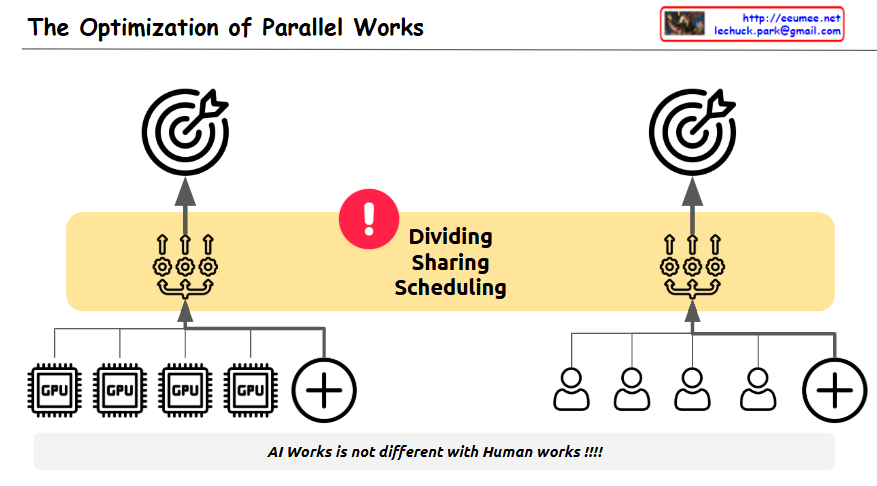
The image illustrates “The Optimization of Parallel Works,” highlighting the inherent challenges in optimizing parallel processing tasks.

The diagram cleverly compares two parallel systems:

  • Left side: Multiple CPU processors working in parallel
  • Right side: Multiple humans working in parallel

The central yellow band emphasizes three critical challenges in both systems:

  • Dividing (splitting tasks appropriately)
  • Sharing (coordinating resources and information)
  • Scheduling (timing and sequencing activities)

Each side shows a target/goal at the top, representing the shared objective that both computational and human systems strive to achieve.

The exclamation mark in the center draws attention to these challenges, while the message at the bottom states: “AI Works is not different with Human works!!!!” – emphasizing that the difficulties in coordinating independent processors toward a unified goal are similar whether we’re talking about computer processors or human teams.

The diagram effectively conveys that just as it’s difficult for people to work together toward a single objective, optimizing independent parallel processes in computing faces similar coordination challenges – requiring careful attention to division of labor, resource sharing, and timing to achieve optimal results.

With Claude
Reliability & Efficiency

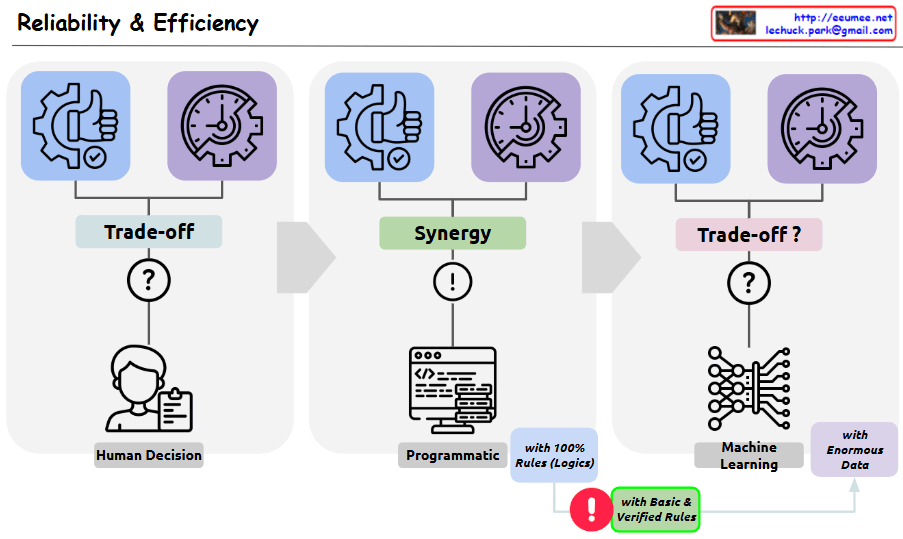
This image is a diagram showing the relationship between Reliability and Efficiency. Three different decision-making approaches are compared:

  1. First section – “Trade-off”:
    • Shows Human Decision making
    • Indicates there is a trade-off relationship between reliability and efficiency
    • Displays a question mark (?) symbol representing uncertainty
  2. Second section – “Synergy”:
    • Shows a Programmatic approach
    • Labeled as using “100% Rules (Logic)”
    • Indicates there is synergy between reliability and efficiency
    • Features an exclamation mark (!) symbol representing certainty
  3. Third section – “Trade-off?”:
    • Shows a Machine Learning approach
    • Labeled as using “Enormous Data”
    • Questions whether the relationship between reliability and efficiency is again a trade-off
    • Displays a question mark (?) symbol representing uncertainty

Importantly, the “Basic & Verified Rules” section at the bottom presents a solution to overcome the indeterminacy (probabilistic nature and resulting trade-offs) of machine learning. It emphasizes that the rules forming the foundation of machine learning systems should be simple and clearly verifiable. By applying these basic and verified rules, the uncertainty stemming from the probabilistic nature of machine learning can be reduced, suggesting an improved balance between reliability and efficiency.

with Claude

Human, Data,AI

The Key stages in human development:

  1. The Start (Humans)
  • Beginning of human civilization and knowledge accumulation
  • Formation of foundational civilizations
  • Human intellectual capacity and creativity as key drivers
  • The foundation for all future developments
  1. The History Log (Data)
  • Systematic storage and management of accumulated knowledge
  • Digitalization of information leading to quantitative and qualitative growth
  • Acceleration of knowledge sharing and dissemination
  • Bridge between human intelligence and artificial intelligence
  1. The Logic Calculation (AI)
  • Logical computation and processing based on accumulated data
  • New dimensions of data utilization through AI technology
  • Automated decision-making and problem-solving through machine learning and deep learning
  • Represents the current frontier of human technological achievement

What’s particularly noteworthy is the exponential growth curve shown in the graph. This exponential pattern indicates that each stage builds upon the achievements of the previous one, leading to accelerated development. The progression from human intellectual activity through data accumulation and management, ultimately leading to AI-driven innovation, shows a dramatic increase in the pace of advancement.

This developmental process is significant because:

  • Each stage is interconnected rather than independent
  • Previous stages form the foundation for subsequent developments
  • The rate of progress increases exponentially over time
  • Each phase represents a fundamental shift in how we process and utilize information

This timeline effectively illustrates how human civilization has evolved from basic knowledge creation to data management, and finally to AI-powered computation, with each stage marking a significant leap in our technological and intellectual capabilities.

With Claude

Quantum is human-like

With a Claude’s Help
This image illustrates a comparison between key quantum physics characteristics and human society, titled “Quantum likes humans.”

It presents three main quantum properties:

  1. Superposition
  • Quantum: 0 and 1 exist at the same time, with many (0|1) q-bits existing simultaneously
  • Human society parallel: Many people exist in mankind at the same time
  1. Entanglement
  • Quantum: All (0|1) q-bits are connected, even from a distance
  • Human society parallel: All people are connected
  1. Interference
  • Quantum: Can adjust overall probability through one q-bit
  • Human society parallel: One could influence the group (humans)

The image is structured with:

  • Left column: Quantum-related icons/symbols
  • Middle: Blue boxes with quantum physics concepts and their descriptions in gray boxes
  • Right: Green boxes showing human society analogies with simple stick figure illustrations

Each concept is visualized to make complex quantum principles more relatable by drawing parallels with human social dynamics.

This visualization effectively simplifies complex quantum mechanics concepts by relating them to familiar human social behaviors and relationships, making the concepts more accessible to a general audience.

The Era of True Artificial Intelligence: Bridging Human and Machine Learning  

AI has now reached a level that can truly be called Artificial Intelligence. This is especially evident in the era of Machine Learning (ML). Humans learn through experiences—essentially data—and make judgments and take actions based on them. These actions are not always perfect or correct, but through continuous learning and experience, they strive for better outcomes, which inherently reflects a probabilistic and statistical perspective.

Similarly, ML learns from massive datasets to identify rules and minimize errors. However, it cannot achieve 100% perfection because it cannot learn all possible data, which is essentially infinite. Despite this, recent advancements in infrastructure and access to vast amounts of data have enabled AI to reach accuracy levels of 90% to 99.99%, appearing almost perfect.

Nevertheless, there still remains the elusive 0.00…1% of uncertainty, stemming from the fundamental limitation of incomplete data learning. Ultimately, AI is not so different from humans in how it learns and makes probabilistic decisions. For this reason, we can truly call it Artificial Intelligence.

WHY I LOVE A COMPUTER.

Democracy and the constitution are like the fundamental principle of “1+1=10” in computer calculations. If these fundamentals are not respected, the results derived from immense computing power will ultimately be nothing more than illusions.

“1+1=10” 이어야 한다. 이 믿음이 사람들, 사회에서도 이루어지길 바란다.
물론 컴퓨터로 담아내지 못한, 또 담아낼 수도 없는 무언가 있다는 것은 잘알고 있다.
하지만, 알고 있는 것, 지켜야 하는 것, 지향해야 하는 것.. 그것은 확실히 지켜져야 한다.

정치라는 것의 아무런 관심도 없었고, 잘못된 정보로 인한 부끄러웠던 나의 과거가 존재한다. 하지만 1+1=10 이 아닌 현상을 너무 극명하게 느끼게 되면서.. 그 정치라는 것에 대해 관심을 가지게 되었다. 그리고 바랬다…누구에게나 공정한 “1+1=10” 세상이 되면 좋겠다고..
그리고 내가 그나마 알고 있는 컴퓨터 기술로 그 방향에 도움이 되면 좋겠다는 생각을 하게 된것 같다.

비트코인을 첨 알고 매력을 느꼈고. 지금은 WEB3 에 관심을 가질수 밖에 없는 이유이기도 하고.. 물론 사람의 욕심은 끝이 없고 무한할 것이다. 하지만 욕심은 문제가 아니다. 문제는 적어도 우리가 지켜온 “1+1=10” 이라는 지금까지 만들어온 기본인 Democracy 와 Constitution 은 지켜야 할 것 아닌가.. 그래야 발전을 꿈꾸고 그 위에서 사람의 욕심을 채워가야 하지 않을까 싶다.