Sovereign AI Foundation Model

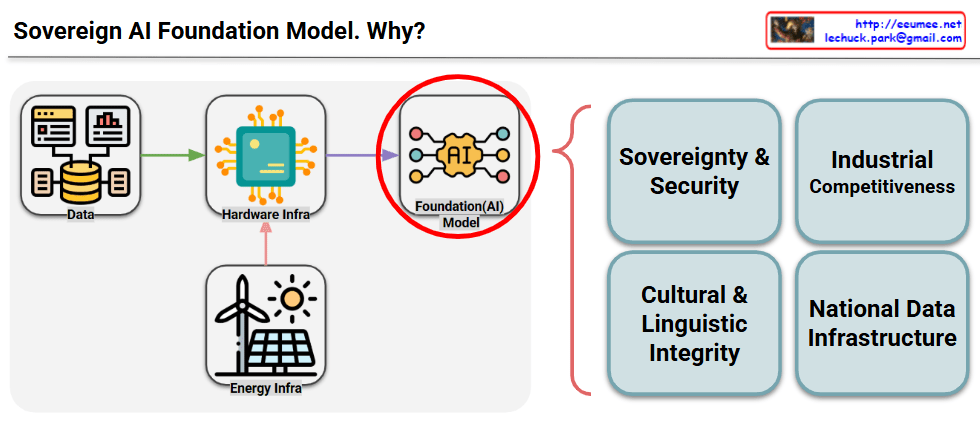
This diagram illustrates the concept of “Sovereign AI Foundation Model” and explains why it’s necessary.

Structure Analysis

Left Side (Infrastructure Elements):

  • Data
  • Hardware Infrastructure (Hardware Infra)
  • Energy Infrastructure (Energy Infra)

These three elements are connected to the central Foundation AI Model.

Why Sovereign AI is Needed (Four boxes on the right)

  1. Sovereignty & Security
    • Securing national AI technology independence
    • Data security and technological autonomy
    • Digital Sovereignty, National Security, Avoid Tech-Colonization, Data Jurisdiction, On-Premise Control.
  2. Industrial Competitiveness
    • Strengthening AI-based competitiveness of national industries
    • Gaining advantages in technological hegemony competition
    • Ecosystem Enabler, Beyond ‘Black Box’, Deep Customization, Innovation Platform, Future Industries.
  3. Cultural & Linguistic Integrity
    • Developing AI models specialized for national language and culture
    • Preserving cultural values and linguistic characteristics
    • Cultural Context, Linguistic Nuance, Mitigate Bias, Preserve Identity, Social Cohesion.
  4. National Data Infrastructure
    • Systematic data management at the national level
    • Securing data sovereignty
    • Data Standardization, Break Data Silos, High-Quality Structured Data, AI-Ready Infrastructure, Efficiency & Scalability.

Key Message

This diagram systematically presents why each nation should build independent AI foundation models based on their own data, hardware, and energy infrastructure, rather than relying on foreign companies’ AI models. It emphasizes the necessity from the perspectives of technological sovereignty, competitiveness, cultural identity, and data independence.

The diagram essentially argues that nations need to develop their own AI capabilities to maintain control over their digital future and protect their national interests in an increasingly AI-driven world.

WIth Claude

AI Core Internals (1+4)

This image is a diagram titled “AI Core Internals (1+4)” that illustrates the core components of an AI system and their interconnected relationships.

The diagram contains 5 main components:

  1. Data – Located in the top left, represented by database and document icons.
  2. Hardware Infra – Positioned in the top center, depicted with a CPU/chipset icon with radiating connections.
  3. Foundation(AI) Model – Located in the top right, shown as an AI network node with multiple connection points.
  4. Energy Infra – Positioned at the bottom, represented by wind turbine and solar panel icons.
  5. User Group – On the far right, depicted as a collection of diverse people icons in various colors.

The arrows show the flow and connections between components:

  • From Data to Hardware Infrastructure
  • From Hardware Infrastructure to the AI Model
  • From the AI Model to end users
  • From Energy Infrastructure to Hardware Infrastructure (power supply)

This diagram visually explains how modern AI systems integrate data, computing hardware, AI models, and energy infrastructure to deliver services to end users. It effectively demonstrates the interdependent ecosystem required for AI operations, highlighting both the technical components (data, hardware, models) and the supporting infrastructure (energy) needed to serve diverse user communities.

With Claude

Foundation Model

From Claude with some prompting
This image depicts a high-level overview of a foundation model architecture. It consists of various components including a knowledge base, weight database (parameters), vector database (relative data), tuning module for making answers, inference module for generating answers, prompt tools, and an evaluation component for benchmarking.

The knowledge base stores structured information, while the weight and vector databases hold learnable parameters and relative data representations, respectively. The tuning and inference modules utilize these components to generate responses or make predictions. Prompt tools assist in forming inputs, and the evaluation component assesses the model’s performance.

This architectural diagram illustrates the core building blocks and data flow of a foundation model system, likely used for language modeling, knowledge representation, or other AI applications that require integrating diverse data sources and capabilities.