Add with power

Add with Power: 8-Bit Binary Addition and Energy Transformation

Core Mechanism:

  1. Input: Two 8-energy binary states (both rows ending with 1)
  2. Computation Process: 1+1 = 2 (binary overflow occurs)
  3. Result:
    • Output row’s last bit changed to 0
    • Part of energy converted to heat

Key Components:

  • Two input rows with 8 binary “energies”
  • Computing symbol (+) representing addition
  • A heat generation (?) box marked x8
  • Resulting output row with modified energy state

Fundamental Principle: “All energies must be maintained with continuous energies for no error (no changes without Computing)”

This diagram illustrates:

  • Binary addition process
  • Energy conservation and transformation
  • Information loss during computation
  • Relationship between computation, energy, and heat generation

The visual representation shows how a simple 8-bit addition triggers energy transfer, with overflow resulting in heat production and a modified binary state.

WIth Claude
AI Oops!!

with a ChatGPT’s help
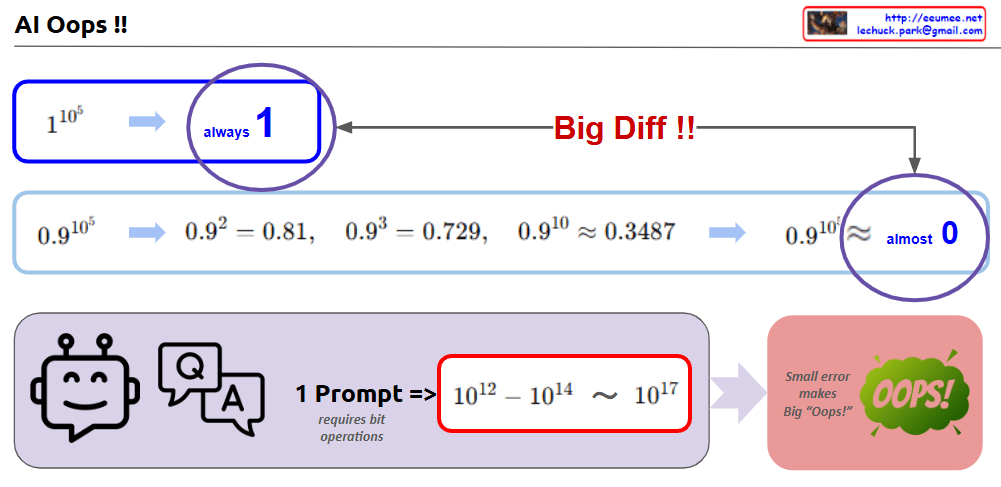
This image highlights how small errors in AI or computational operations can lead to significant differences or problems. Here’s a sentence-based explanation:


  1. Small changes lead to big differences
    • 1^10⁵: This consistently equals 1, no matter how many iterations are performed.
    • 0.9^10⁵: On the other hand, this gradually decreases and approaches 0, creating a significant difference.
      • For example:
        • 0.92=0.810.9^2 = 0.810.92=0.81,
        • 0.93=0.7290.9^3 = 0.7290.93=0.729,
        • 0.910≈0.34870.9^{10} ≈ 0.34870.910≈0.3487,
        • 0.9105≈almost00.9^{10^5} ≈ almost 00.9105≈almost0.
  2. The “Oops” in AI or calculations
    • A single incorrect computation or prompt can result in a massive amount of processing (from 10^12 to 10^17 bit operations).
    • This demonstrates how a small error can lead to a big “Oops!” in the overall system.

Summary:
The image visually explains the importance of precision and how minor computational inaccuracies can cascade into significant consequences, especially in AI or large-scale calculations.

More abstracted Data & Bigger Error possibility

From Claude with some prompting
This image illustrates the data processing, analysis, and machine learning application process, emphasizing how errors can be amplified at each stage:

  1. Data Flow:
    • Starts with RAW data.
    • Goes through multiple ETL (Extract, Transform, Load) processes, transforming into new forms of data (“NEW”) at each stage.
    • Time information is incorporated, developing into statistical data.
    • Finally, it’s processed through machine learning techniques, evolving into more sophisticated new data.
  2. Error Propagation and Amplification:
    • Each ETL stage is marked with a “WHAT {IF.}” and a red X, indicating the possibility of errors.
    • Errors occurring in early stages propagate through subsequent stages, with their impact growing progressively larger, as shown by the red arrows.
    • The large red X at the end emphasizes how small initial errors can have a significant impact on the final result.
  3. Key Implications:
    • As the data processing becomes more complex, the quality and accuracy of initial data become increasingly crucial.
    • Thorough validation and preparation for potential errors at each stage are necessary.
    • Particularly for data used in machine learning models, initial errors can be amplified, severely affecting model performance, thus requiring extra caution.

This image effectively conveys the importance of data quality management in data science and AI fields, and the need for systematic preparation against error propagation. It highlights that as data becomes more abstracted and processed, the potential impact of early errors grows, necessitating robust error mitigation strategies throughout the data pipeline.