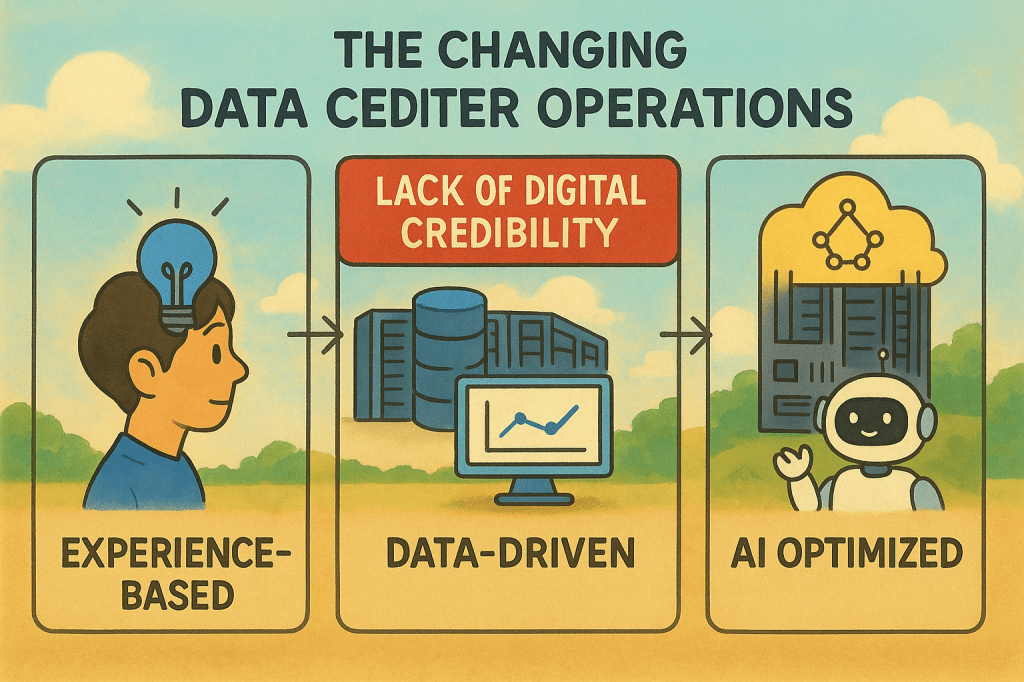
Data center operations are shifting from experience-driven practices toward data-driven and AI-optimized systems. However, a fundamental challenge persists: the lack of digital credibility.
Insufficient data quality: Incomplete monitoring data and unreliable hardware reduce trust.
Limited digital expertise of integrators: Many providers focus on traditional design/operations, lacking strong datafication and automation capabilities.
Absence of verification frameworks: No standardized process to validate or certify collected data and analytical outputs.
These gaps are amplified by the growing scale and complexity of data centers and the expansion of GPU adoption, making them urgent issues that must be addressed for the next phase of digital operations.
with a Claude’s Help This image shows a diagram illustrating the process flow of an AI Persona system. It demonstrates five stages progressing from left to right:
Life Logging:
Records daily activities such as listening to music and conversations
Data appears to be collected through mobile devices
Digitization:
Converting and processing collected data into digital format
Shown with settings and document icons
AI Learning:
Stage where AI learns from the digitized data
Represented by a circuit network icon
AI Agent:
Formation of an AI agent based on learned data
Symbolized by an icon showing the integration of AI and human elements
Digital World:
Final stage where the AI persona operates in the digital world
Represented by a global network icon
The diagram effectively illustrates the complete process of how human activities and characteristics are digitized, transformed into AI, and ultimately utilized in the digital world. Each step is clearly labeled and represented with relevant icons that help visualize the transformation from real-world data to digital AI persona.
The image appears to be part of a technical presentation or documentation, as indicated by the email address visible in the top right corner. The flow is presented in a clear, linear fashion with connecting arrows showing the progression between each stage. C
From Claude with some prompting Traditional View: AI’s probability-based decisions are seen in contrast to human’s logical, “100% certain” decisions, and this difference could be perceived as problematic.
New Insight: In reality, the concept of human’s “100% certainty” itself might be an illusion. Human judgments are also based on limited data and experiences, making them inherently probabilistic in nature.
Finding Common Ground: Both humans and AI make decisions based on incomplete information. Even human’s logical certainty ultimately stems from restricted data, making it fundamentally probability-based.
Paradigm Shift: This perspective suggests that AI’s probabilistic approach isn’t a flaw but rather a more accurate modeling of human decision-making processes. What we believe to be “100% certainty” is actually a high-probability estimation based on limited information.
Implications: This prompts a reevaluation of the perceived gap between AI and human decision-making styles. AI’s probabilistic approach might not be inferior to human logic; instead, it may more accurately reflect our cognitive processes.
This viewpoint encourages us to see AI’s probabilistic tendencies not as a problem, but as a tool providing deeper insights into human thought processes. It invites us to reconsider how AI and humans collaborate, opening new possibilities to complementarily leverage the strengths of both sides.
The image and your interpretation together challenge the notion that human reasoning is purely logical and certain. Instead, they suggest that both human and AI decisions are fundamentally based on probabilities derived from limited data. This realization can foster a more harmonious and effective partnership between humans and AI, recognizing that our decision-making processes may be more similar than previously thought.
From DALL-E with some prompting This image visually represents “3 Key Strategies for DC Operation.”
Transform
Digitalization: Transitioning data centers to digital technology.
KPI (Key Performance Indicators)
PUE (Power Usage Effectiveness) & Monitoring
Automation
Data API Service
Use
Data Platform: Establishing platforms for data management and utilization.
Standardization
Platform
Continuous Upgrade
New!!
Verify
AI: Validating efficiency and performance of data centers through AI.
Real AI
Early Warning
Energy Operation
These three strategies are interconnected with three objectives: “Experience to Digital,” “Continuous Innovation,” and “AI DC Now!!” This illustrates that the operation of data centers is moving towards impacting humans through digitalization, innovation, and the application of AI technology, driving transformation across the industry.
The image depicts the concept of applying AI to real-world applications. It presents a flow from the human experience to digital transformation, then to AI, and finally applying AI to real-world scenarios. Here’s a breakdown of the components:
Human: Represents the human experience which is the source of data.
Experience to Digital: Indicates the process of translating human experiences into digital data.
Digital: Refers to the digital representation of data, shown as binary code.
Standard/Platform: Suggests that data and processes are standardized on a platform, allowing for the creation of new services easily.
AI: Depicts artificial intelligence as a technology or tool.
Accelerator to Real: Refers to the application of AI as an accelerator, making processes more precise and scalable, and applying them to real-world scenarios.
The overarching theme is “AI to REAL,” indicating a transition from abstract or digital concepts to practical, tangible applications in the real world. AI is seen as an accelerator that can enhance and expedite the implementation of digital solutions into everyday experiences, grounded in a standardized platform for ease of development and deployment.
From DALL-E with some prompting The image explores how human decision-making has evolved from data analysis to probabilistic judgments. Initially, rules derived from data led to definitive decisions, but with the advent of AI, we have returned to probabilistic decision-making. The phrases at the top suggest that the real world may be inherently probabilistic and that humans still lack complete knowledge of the quantum realm.


 Lechuck Park