Getting digital “1” from real world

Bringing a digital “1” from the real world is far from simple.

  1. The need for complete control over “1”
    If a specific analog value is converted into a digital “1,” it must be clearly defined and controlled, as analog values are always subject to change. Determining the exact boundary of what qualifies as “1” is critical.
  2. Influence of external factors
    The analog world is full of external factors, such as temperature and humidity, which can affect digital values. Maintaining “1” consistently as desired in such an environment is a challenging task.
  3. Clear definition of “1”
    The value represented as “1” in digital form must have a clear definition from a human perspective. It should be universally understandable and explainable as “1.”
  4. Risks in AI environments
    In the realm of AI, where vast amounts of data are processed into complex outputs, even a single incorrect “1” can have significant and potentially dangerous consequences.

Ensuring and maintaining a digital “1” involves numerous challenges and complexities.

Finding Rules

From Claude with some prompting
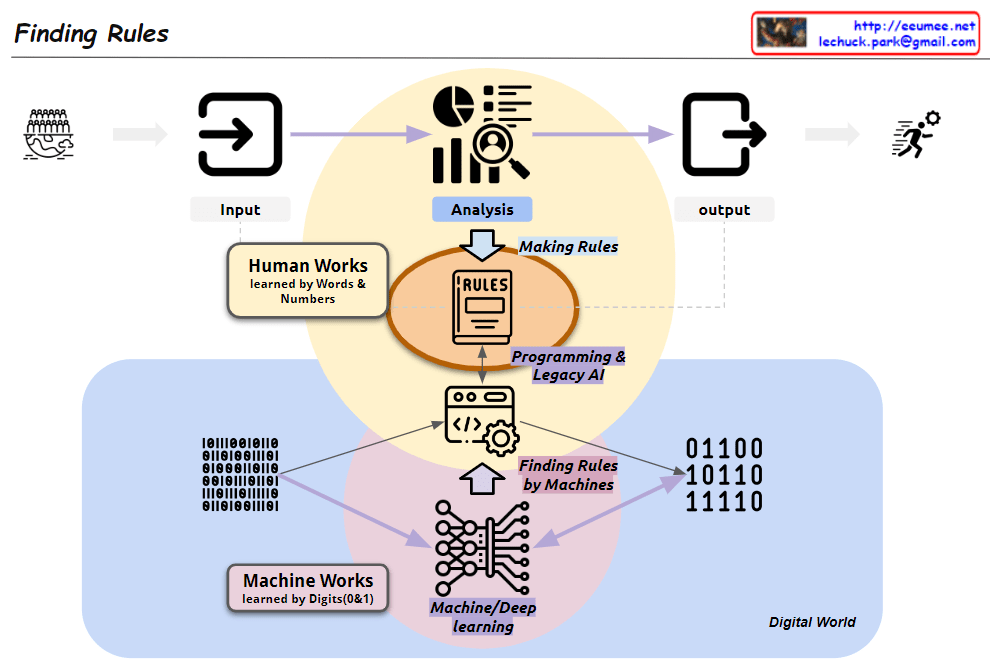
This image, titled “Finding Rules,” illustrates the contrast between two major learning paradigms:

  1. Traditional Human-Centric Learning Approach:
    • Represented by the upper yellow circle
    • “Human Works”: Learning through human language and numbers
    • Humans directly analyze data and create rules
    • Leads to programming and legacy AI systems
  2. Machine Learning (ML) Approach:
    • Represented by the lower pink circle
    • “Machine Works”: Learning through binary digits (0 and 1)
    • Based on big data
    • Uses machine/deep learning to automatically discover rules
    • “Finding Rules by Machines”: Machines directly uncover patterns and rules

The diagram showcases a paradigm shift:

  • Two coexisting methods in the process from input to output
  • Transition from human-generated rules to machine-discovered rules
  • Emphasis on data processing in the “Digital World”

Key components:

  • Input and Output: Marking the start and end of the process
  • Analysis: Central to both approaches
  • Rules: Now discoverable by both humans and machines
  • Programming & Legacy AI: Connected to the human-centric approach
  • Machine/Deep Learning: Core of the ML approach

This visualization effectively demonstrates the evolution in data analysis and rule discovery brought about by advancements in artificial intelligence and machine learning. It highlights the shift from converting data into human-readable formats for analysis to leveraging vast amounts of binary data for machine-driven rule discovery.

Unexplainable

From DALL-E with some prompting
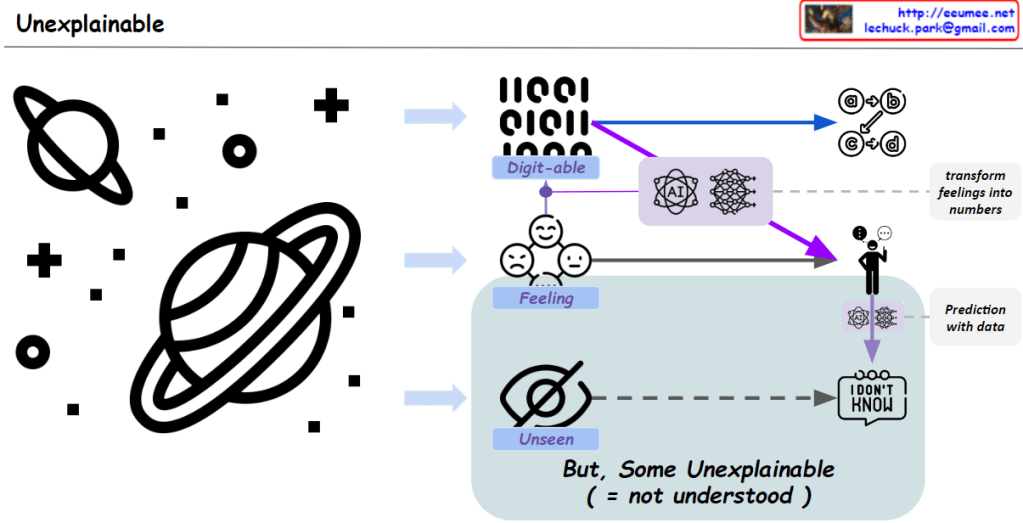
The image intends to explain two critical perspectives of AI/ML. First, it illustrates that while traditionally digitalized data was defined by rules, AI/ML enables us to judge human ‘feelings’ as data based on a more extensive dataset. Second, AI/ML allows for the prediction of the future using data; however, some parts of these significant advancements remain unexplainable and difficult for humans to comprehend fully. This interpretation suggests that while AI aims to quantify and use non-visible elements like emotions for predictions through data standardization and optimized processing, there are aspects that cannot be fully articulated or understood.

Digital = Energy

From DALL-E with some prompting
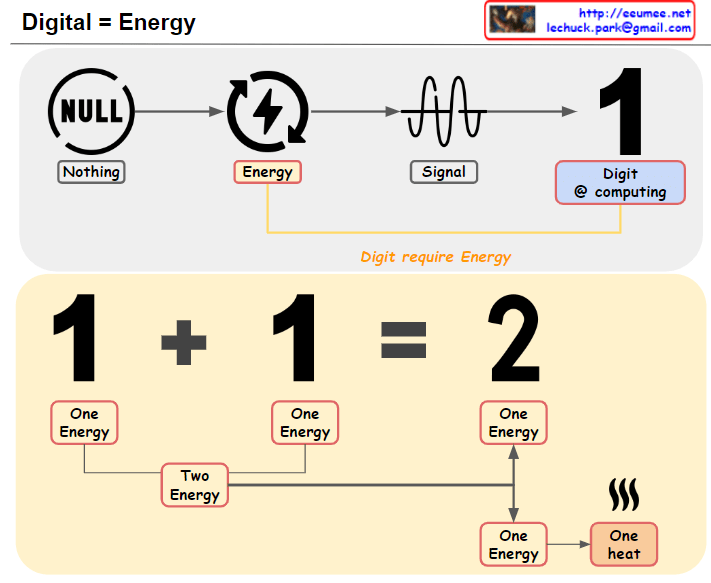
this image illustrates the concept that “Digital equals Energy.” The first row shows the transformation from ‘NULL’, which represents nothingness, into a signal through energy, and then into a digital ‘1’ for computing. The second row demonstrates that digital operations require energy by showing that adding ‘1’ and ‘1’ results in ‘2’, with each ‘1’ requiring a unit of energy and the process generating heat, indicating energy loss.