Large Scale Network Driven Design(2) Multi-Plane Fat-Tree & Low Latency

Comprehensive Interpretation: Large Scale Network Driven Design

This document outlines the technical blueprint for “Network Co-Design,” explaining how network architecture must evolve to support massive AI workloads (specifically LLMs) by balancing Bandwidth and Latency.

Here is the breakdown from an architect’s perspective:

1. Structural Efficiency: MPFT & MRFT (The “Green” Section)

This section answers the question: “How do we efficiently cluster thousands of GPUs?”

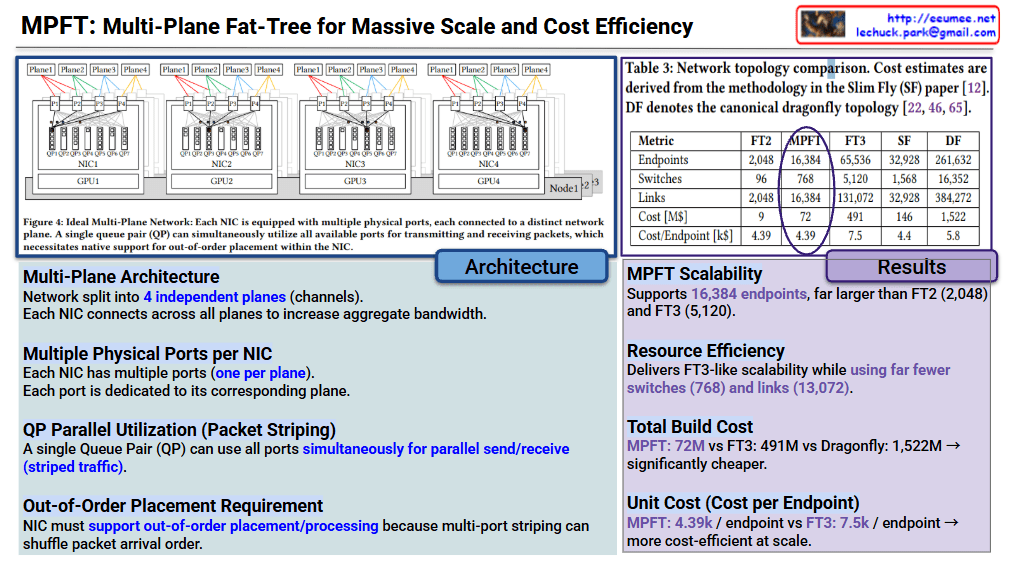
  • Massive Scalability: It proposes a Multi-Plane Fat-Tree (MPFT) structure using 400G InfiniBand (IB) switches, theoretically capable of scaling up to 16,384 GPUs. This mirrors the scale of NVIDIA SuperPods.
  • Multi-Rail Architecture (MRFT): MRFT utilizes two distinct network planes. Think of this as adding a second level to a highway to double the lanes. It achieves higher bandwidth efficiency compared to traditional 2-tier Fat-Tree designs.
  • Software Optimization (NCCL): The hardware (MRFT) is fully utilized by NCCL (NVIDIA Collective Communications Library). NCCL acts as the traffic controller, ensuring the expanded physical bandwidth is saturated efficiently.
  • Latency Reduction (Packet Striping): The QP & Priority section highlights a critical mechanism where a single Queue Pair (QP) stripes packets across multiple ports simultaneously. This parallel transmission significantly reduces latency.
  • Current Bottlenecks: The design acknowledges limitations, such as InfiniBand’s lack of native support for out-of-order packet placement and the time overhead incurred during inter-plane communication (requires internal forwarding).

2. The Core of Performance: Low Latency & MoE (The “Blue” Section)

This section answers the question: “Why is low latency (and InfiniBand) non-negotiable?”

  • Sensitivity of MoE Models: Modern Mixture of Experts (MoE) models rely heavily on “Expert Parallelism,” which triggers frequent All-to-all communication. If the network lags even by hundreds of microseconds, the entire system performance degrades fataly.
  • RoCE vs. InfiniBand: The document draws a clear line. While RoCE (RDMA over Converged Ethernet) is cost-effective, InfiniBand (IB) is the superior choice for low-latency environments essential for AI training/inference.
  • Surprising Latency Metrics: It highlights a specific scenario: for small data transfers (e.g., 64 Bytes), InfiniBand can be faster than intra-node NVLink (specifically during Cross Leaf communication), proving its dominance in minimizing end-to-end latency.

Summary

  1. Scalable Architecture: The Multi-Plane (MPFT) and Multi-Rail (MRFT) Fat-Tree designs, optimized with NCCL, maximize bandwidth efficiency to support massive clusters of up to 16k GPUs.
  2. Latency Criticality: Modern AI workloads like Mixture of Experts (MoE) are hypersensitive to delay, making InfiniBand the preferred choice over RoCE due to its superior handling of All-to-all communication.
  3. Co-Design Strategy: Achieving peak AI performance requires a “Network Co-Design” approach where high-speed hardware (400G IB) and software protocols (Packet Striping) are tightly integrated to minimize end-to-end latency.

#AINetworking #DataCenterArchitecture #InfiniBand #NCCL #LowLatency #HPC #GPUScaling #MoE #NetworkDesign #AIInfrastructure #DeepseekV3

WIth Gemini

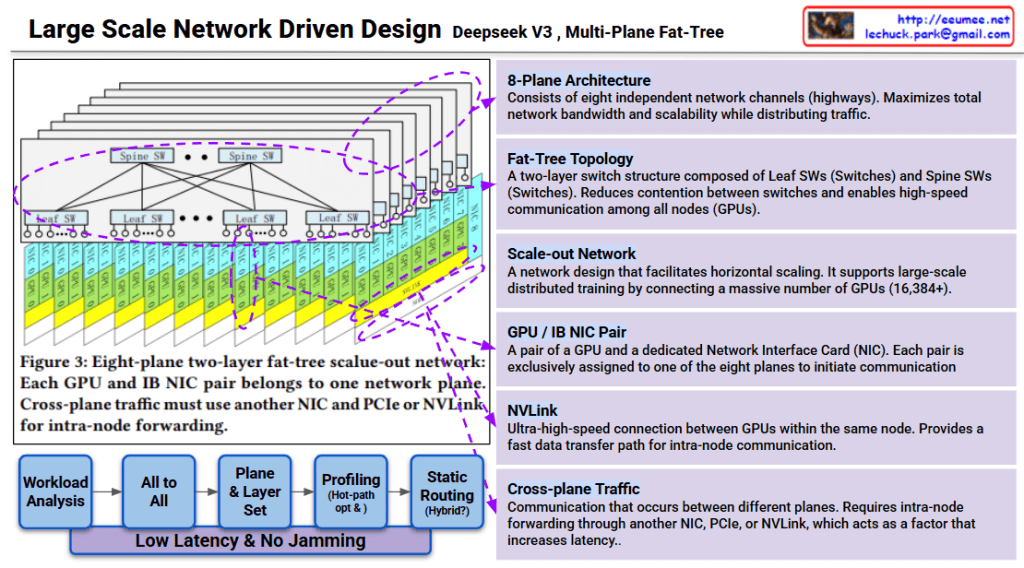
Large Scale Network Driven Design ( Deepseek V3)

Deepseek v3 Large-Scale Network Architecture Analysis

This image explains the Multi-Plane Fat-Tree network structure of Deepseek v3.

Core Architecture

1. 8-Plane Architecture

  • Consists of eight independent network channels (highways)
  • Maximizes network bandwidth and distributes traffic for enhanced scalability

2. Fat-Tree Topology

  • Two-layer switch structure:
    • Leaf SW (Leaf Switches): Directly connected to GPUs
    • Spine SW (Spine Switches): Interconnect leaf switches
  • Enables high-speed communication among all nodes (GPUs) while minimizing switch contention

3. GPU/IB NIC Pair

  • Each GPU is paired with a dedicated Network Interface Card (NIC)
  • Each pair is exclusively assigned to one of the eight planes to initiate communication

Communication Methods

NVLink

  • Ultra-high-speed connection between GPUs within the same node
  • Fast data transfer path used for intra-node communication

Cross-plane Traffic

  • Occurs when communication happens between different planes
  • Requires intra-node forwarding through another NIC, PCIe, or NVLink
  • Primary factor that increases latency

Network Optimization Process

The workflow below minimizes latency and prevents network congestion:

  1. Workload Analysis
  2. All to All (analyzing all-to-all communication patterns)
  3. Plane & Layer Set (plane and layer assignment)
  4. Profiling (Hot-path opt K) (hot-path optimization)
  5. Static Routing (Hybrid) (hybrid static routing approach)

Goal: Low latency & no jamming

Scalability

This design is a scale-out network for large-scale distributed training supporting 16,384+ GPUs. Each plane operates independently to maximize overall system throughput.


3-Line Summary

Deepseek v3 uses an 8-plane fat-tree network architecture that connects 16,384+ GPUs through independent communication channels, minimizing contention and maximizing bandwidth. The two-layer switch topology (Spine and Leaf) combined with dedicated GPU-NIC pairs enables efficient traffic distribution across planes. Cross-plane traffic management and hot-path optimization ensure low-latency, high-throughput communication for large-scale AI training.

#DeepseekV3 #FatTreeNetwork #MultiPlane #NetworkArchitecture #ScaleOut #DistributedTraining #AIInfrastructure #GPUCluster #HighPerformanceComputing #NVLink #DataCenterNetworking #LargeScaleAI

With Claude

Insights into DeepSeek-V3

This image presents an insights overview of DeepSeek-V3, highlighting its key technical innovations and architectural features.

Core Technical Components

1. MLA (Multi-Head Latent Attention)

  • Focuses on memory efficiency
  • Processes attention mechanisms through latent representations to reduce memory footprint

2. MoE (Mixture-of-Experts)

  • Enables cost-effective scaling
  • Activates only relevant experts for each input, reducing computational overhead while maintaining performance

3. FP8 Mixed-Precision Training

  • Achieves efficient computation
  • Combines FP8 and FP32 precision levels strategically

4. MTP (Multi-Token Prediction)

  • Enables faster autoregressive inference
  • Predicts multiple tokens simultaneously (“look ahead two or three letters instead of one at a time”)

5. Multi-Plane Network Topology

  • Provides scalable, efficient cluster networking
  • Acts like a multi-lane highway to prevent bottlenecks

Right Panel Technical Details

KV Cache Compression (latent space)

  • Handles long contexts with low memory and fast decoding

Aux-loss-free Load Balancing + Expert Parallel (All-to-All)

  • Reduces FLOPs/costs while maintaining training/inference performance

Weights/Matmul in FP8 + FP32 Accumulation

  • Computes in lightweight units but sums precisely for critical totals (lower memory, bandwidth, compute, stable accuracy)

Predict Multiple Tokens at Once During Training

  • Delivers higher speed and accuracy boosts in benchmarks

2-tier Fat-Tree × Multiple Planes (separated per RDMA-NIC pair)

  • Provides inter-plane congestion isolation, resilience, and reduced cost/latency

Summary

DeepSeek-V3 represents a comprehensive optimization of large language models through innovations in attention mechanisms, expert routing, mixed-precision training, multi-token prediction, and network architecture. These techniques collectively address the three critical bottlenecks: memory, computation, and communication. The result is a highly efficient model capable of scaling to massive sizes while maintaining cost-effectiveness and performance.

#DeepSeekV3 #LLM #MixtureOfExperts #EfficientAI #ModelOptimization #MultiTokenPrediction #FP8Training #LatentAttention #ScalableAI #AIInfrastructure

With Claude