The Limitation of the AI

From Claude with some prompting
This image illustrates the process of creating a “human-like AI” through the stages of “Big Data -> Learning -> Good AI.”

The first stage is “Big Data,” which serves as the foundation for AI training. It requires collecting vast amounts of accurate and reliable data from various sources.

The second stage is “Learning,” where the big data is fed into deep learning algorithms and neural network models for training. This process requires immense computing power and optimized AI models.

The third stage yields a “Good AI” capable of tasks like data classification and processing as a result of the learning process.

However, the image suggests that the goal goes beyond creating an AI with “Many Numbers” and “Classification” abilities. The ultimate aim is to develop an AI that reaches “Human-Like” levels of intelligence and capability.

Crucially, the entire process is underpinned by the availability of “Accurate & Reliable DATA.” No matter how advanced the algorithms and computing power, if the data itself lacks quality and trustworthiness, achieving a truly “Human-Like AI” will be extremely challenging.

Therefore, the key message conveyed by this image is that the quality and reliability of data will be the critical factor determining the competitiveness of AI systems in the future. Securing accurate and trustworthy data is emphasized as the fundamental requirement for realizing human-level artificial intelligence.

GPU works for

From ChatGPT with some prompting
The image is a schematic representation of GPU applications across three domains, emphasizing the GPU’s strength in parallel processing:

Image Processing: GPUs are employed to perform parallel updates on image data, which is often in matrix form, according to graphical instructions, enabling rapid rendering and display of images.

Blockchain Processing: For blockchain, GPUs accelerate the calculation of new transaction hashes and the summing of existing block hashes. This is crucial in the race of mining, where the goal is to compute new block hashes as efficiently as possible.

Deep Learning Processing: In deep learning, GPUs are used for their ability to process multidimensional data, like tensors, in parallel. This speeds up the complex computations required for neural network training and inference.

A common thread across these applications is the GPU’s ability to handle multidimensional data structures—matrices and tensors—in parallel, significantly speeding up computations compared to sequential processing. This parallelism is what makes GPUs highly effective for a wide range of computationally intensive tasks.

Network Monitoring with AI

from DALL-E with some prompting
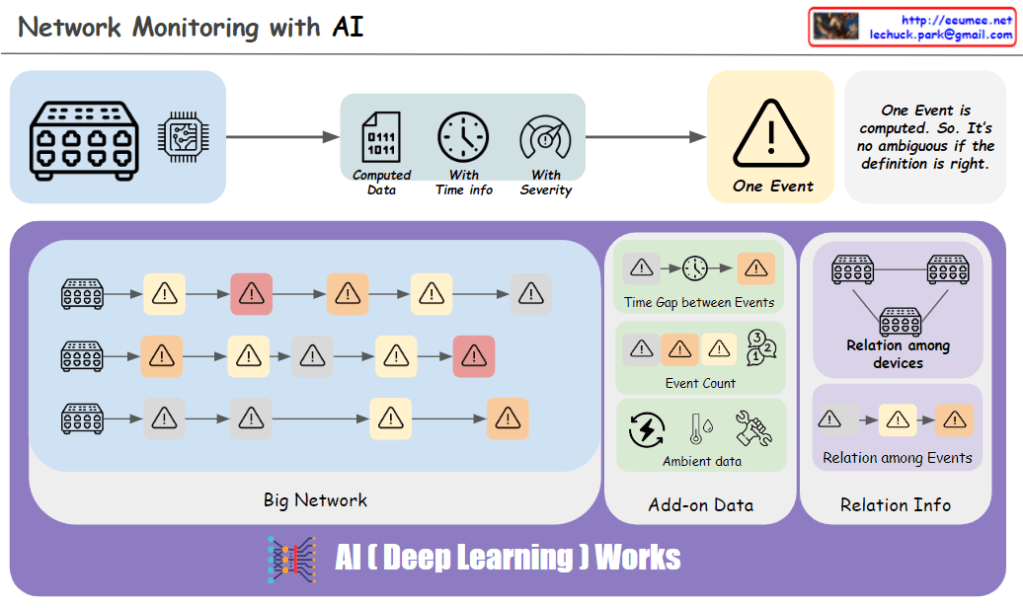
The image portrays a network monitoring system enhanced by AI, specifically utilizing deep learning. It shows a flow from the network infrastructure to the identification of an event, characterized by computed data with time information and severity. The “One Event” is clearly defined to avoid ambiguity. The system identifies patterns such as the time gap between events, event count, and relationships among devices and events, which are crucial for a comprehensive network analysis. AI deep learning algorithms work to process additional data (add-on data) and ambient data to detect anomalies and support predictive maintenance within the network.

Difference

From DALL-E with some prompting
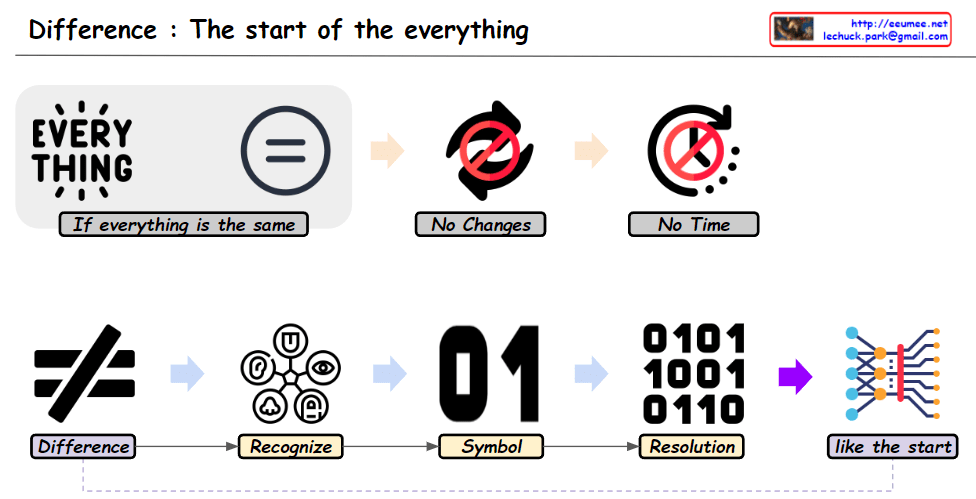
The image represents how AI approaches differences using infinite computing power, akin to recognizing the initial differences that sparked evolution. It shows that without variation (“EVERYTHING” icon), there is no concept of change or time, but differences lead to recognition (“Recognition”), which evolves into symbolization (“Symbol”) and understanding through resolution (“Resolution”). As complexities grow, so does our interpretative capacity, and now AI retraces the evolutionary journey back to the beginning. Through the human process of creating numbers and adding complex interpretations, AI now comprehends the initial differences that started it all.

Requires for DL

From DALL-E with some prompting
The image outlines the importance of data in the era of deep learning (DL). It starts with “Data,” representing various sources and types, which feeds into “Deep Learning,” depicted by a neural network diagram. The process leads to “Result,” symbolized by charts and graphs indicating the output or findings. The central message, “Data determines the results,” stresses that the quality of data significantly impacts the outcome of deep learning processes. Below, “Data Verification” suggests the need for ensuring data accuracy, which ties into the cycle of “UPDATE” and “Analysis,” highlighting an iterative process to refine and improve deep learning applications. The phrase “What to deal with DL” hints at the challenges and considerations in managing and utilizing deep learning effectively.

Rule-Driven Vs Data-Driven

From the Bard with some prompting

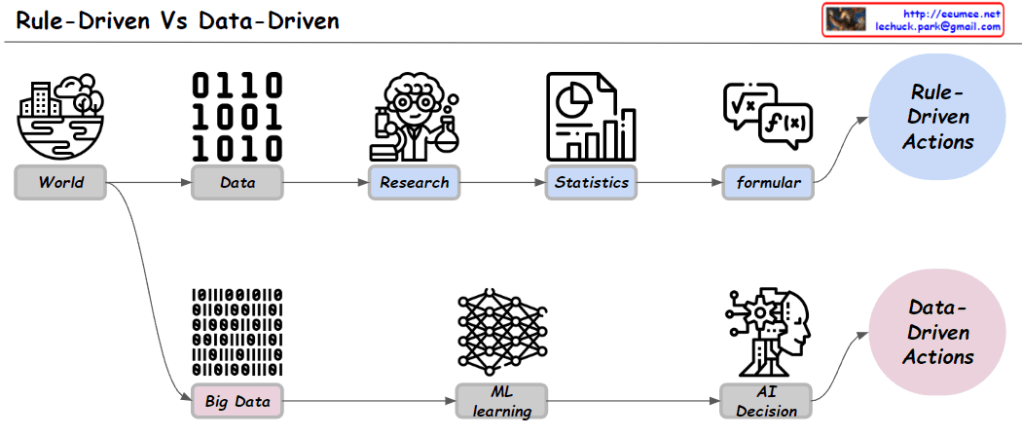
Rule-based and data-driven systems are two different approaches to artificial intelligence (AI).

Data-driven systems make decisions based on data. For example, a data-driven system could be used to recommend products to customers based on their purchase history.

Here is a summary of the key differences between rule-based and data-driven systems:

  • Decision-making process: Rule-based systems use if-then rules, while data-driven systems use data.
  • Examples: Rule-based systems can be used for simple tasks, such as turning on a fan. Data-driven systems can be used for more complex tasks, such as recommending products to customers.
  • Strengths: Rule-based systems are simple and easy to understand. Data-driven systems are accurate.
  • Weaknesses: Rule-based systems can be difficult to adapt to new situations. Data-driven systems can be inaccurate if data is insufficient.

In conclusion, rule-based systems are simple and easy to understand, but they can be difficult to adapt to new situations. Data-driven systems are accurate, but they can be inaccurate if data is insufficient.

AI 3 Types

From DALL-E with some prompting
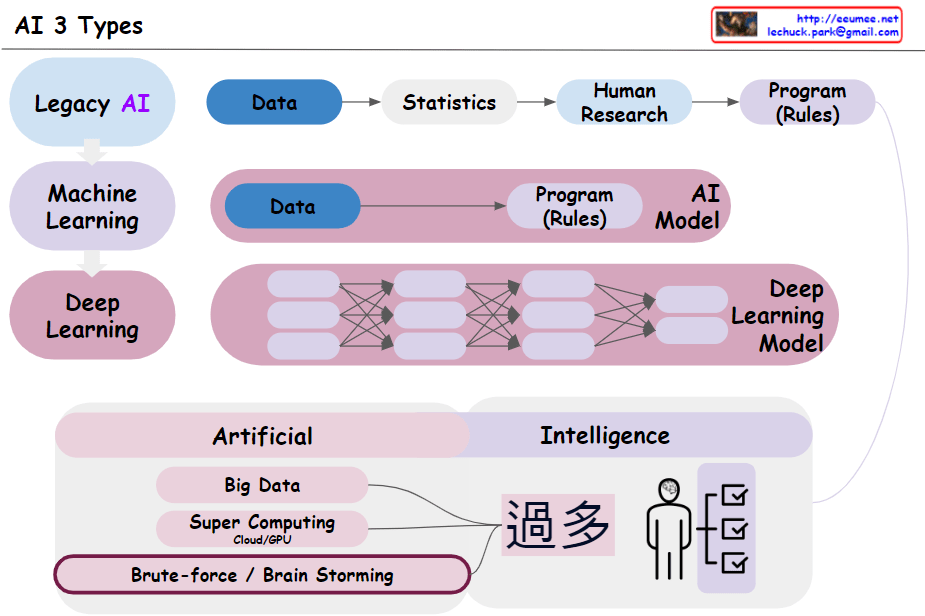
The image depicts the three stages of AI forming artificial intelligence through repeated classification tasks based on data:

  1. Legacy AI derives statistics from data and transforms them into rule-based programs through human research.
  2. Machine Learning evolves these rules into AI models capable of executing more complex functions.
  3. Deep Learning uses deep neural networks to process data and create complex models that perform cognitive tasks.

In this process, AI leverages extensive data for repetitive classification tasks, and the result is what we refer to as ‘intelligence.’ However, this intelligence is not an emulation of human thought processes but rather a product of data processing and algorithms, which qualifies it as ‘artificial intelligence.’ This underlines that the ‘artificial’ in AI corresponds to intelligence derived artificially rather than naturally through human cognition.