Data Center Service Types

From the Bard with some prompting

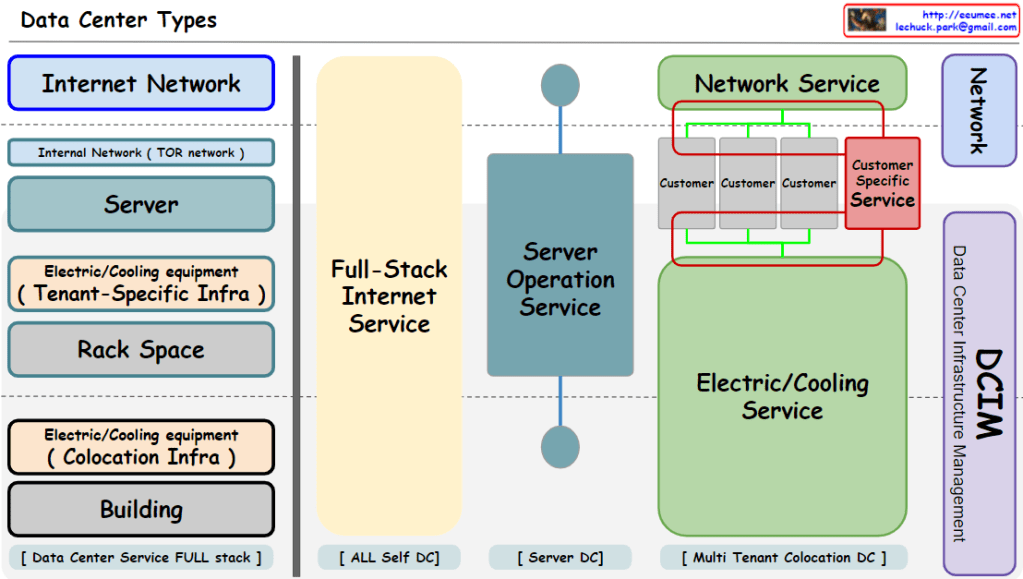
Data Center Types Diagram

This diagram shows four main types of data centers:

  • Full-stack data centers provide a comprehensive solution for all of a customer’s IT infrastructure. This includes servers, networks, storage, security, and operational services.
  • In-house data centers are owned and managed by the customer. This includes servers, networks, storage, security, and operational services.
  • Server data centers provide only servers. This includes servers, networks, and operational services.
  • Multi-tenant colocation data centers are shared by multiple customers. This includes servers, networks, and operational services.

This diagram shows the various factors that should be considered when selecting a data center. It is important to choose the type that is best suited to the customer’s needs and budget.

Digitalization of the data center

From DALL-E with some prompting
The image represents the digital transformation process in data center operations. The top section labeled ‘AI/DT Services’ showcases a variety of Artificial Intelligence and Digital Transformation services including predictive analytics, energy management, reliability, automation, and customer engagement. These services contribute to establishing service standards and ensure the services stay updated through continuous improvements.

The middle section, ‘Data Processing,’ covers the processes involved in data collection, transformation (ETL), and visualization. These processes are responsible for data control, verification through the network, and feeding into an analysis platform.

The bottom section, ‘DC Facility,’ illustrates the fundamental infrastructure of a data center, including power supply, cooling systems, security, CCTV, and fire detection, which are essential for the efficient operation of a data center.

All three sections are underpinned by a ‘Data-Driven Process’ and suggest a transition from legacy processes to modern, data-centric operations through ‘Digital Trans’ (presumably short for Digital Transformation).

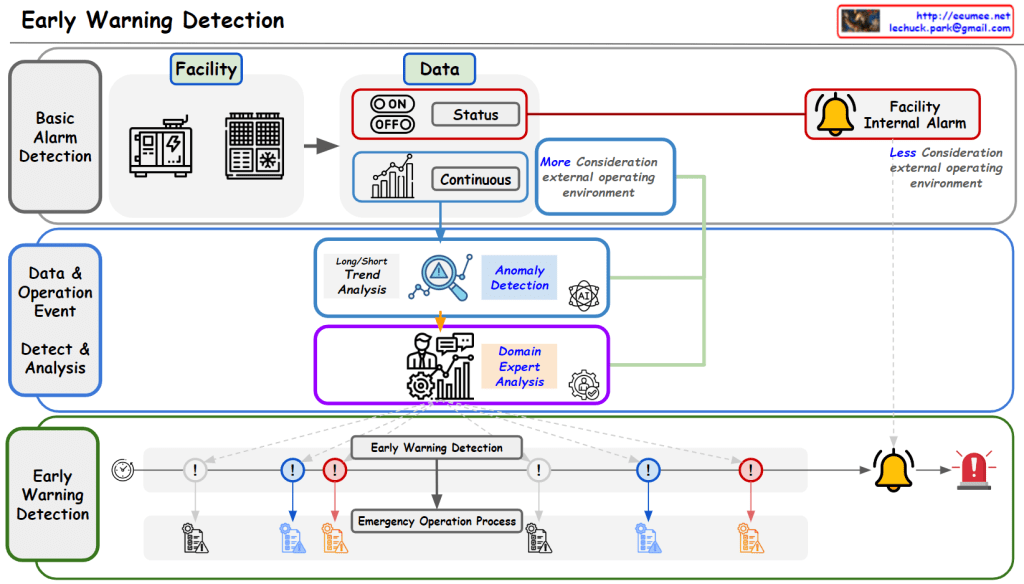
Alarm with AI ( Development )

From DALL-E with some prompting
This image illustrates the implementation of an advanced alert system in facilities, extending beyond basic equipment alarms to incorporate data-driven anomaly detection, potentially utilizing AI technologies. The system engages domain experts to analyze data patterns, identifying deviations and planning for event-based responses. These events are systematized with defined levels such as alarms or warnings, and corresponding emergency operation processes are established. By considering the external operating environment, this comprehensive system enhances facility stability and operational efficiency.