Overcome the Infinite

Overcome the Infinite – Game Interface Analysis

Overview

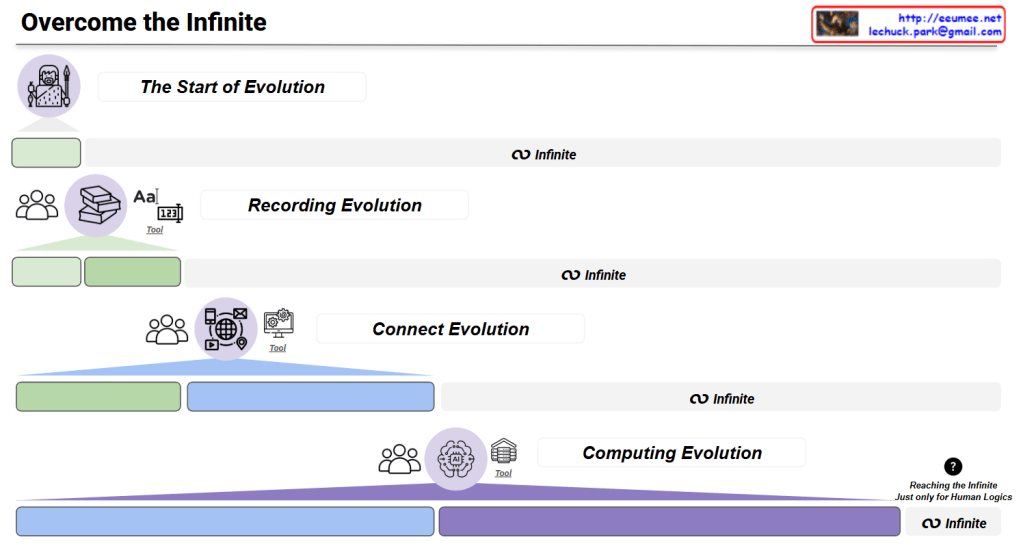
This image presents a philosophical game interface titled “Overcome the Infinite” that chronicles the evolutionary journey of human civilization through four revolutionary stages of innovation.

Game Structure

Stage 1: The Start of Evolution

  • Icon: Primitive human figure
  • Description: The beginning of human civilization and consciousness

Stage 2: Recording Evolution

  • Icon: Books and writing materials
  • Innovation: The revolution of knowledge storage through numbers, letters, and books
  • Significance: Transition from oral tradition to written documentation, enabling permanent knowledge preservation

Stage 3: Connect Evolution

  • Icon: Network/internet symbols with people
  • Innovation: The revolution of global connectivity through computers and the internet
  • Significance: Worldwide information sharing and communication breakthrough

Stage 4: Computing Evolution

  • Icon: AI/computing symbols with data centers
  • Innovation: The revolution of computational processing through data centers and artificial intelligence
  • Significance: The dawn of the AI era and advanced computational capabilities

Progress Indicators

  • Green and blue progress bars show advancement through each evolutionary stage
  • Each stage maintains the “∞ Infinite” symbol, suggesting unlimited potential at every level

Philosophical Message

“Reaching the Infinite Just only for Human Logics” (Bottom right)

This critical message embodies the game’s central philosophical question:

  • Can humanity truly overcome or reach the infinite through these innovations?
  • Even if we approach the infinite, it remains constrained within the boundaries of human perception and logic
  • Represents both technological optimism and humble acknowledgment of human limitations

Theme

The interface presents a contemplative journey through human technological evolution, questioning whether our innovations truly bring us closer to transcending infinite boundaries, or merely expand the scope of our human-limited understanding.

With Claude

Usage Evolutions : The Evolution of Human Tools and Knowledge Sharing

With a Claude’s Help
This diagram illustrates how humanity’s methods of sharing and expanding knowledge have evolved alongside the development of tools throughout history.

The Four Stages of Evolution

1. Experience-Based Era

  • Tool: Direct Human Experience
  • Characteristics: Knowledge sharing through face-to-face interactions based on personal experience
  • Limited scope of knowledge transfer and collaboration

2. Literature-Based Era

  • Tool: Books and Documents
  • Characteristics: Documentation of experiences and knowledge
  • Knowledge transfer possible across time and space

3. Internet-Based Era

  • Tool: Internet and Digital Platforms
  • Characteristics: Real-time information sharing and two-way communication
  • Formation of networks where multiple users simultaneously influence each other

4. AI-Based Era

  • Tool: Artificial Intelligence
  • Characteristics: Creation of new digital worlds through AI
  • Revolutionary expansion of knowledge creation, processing, and sharing

Key Characteristics of Evolution Process

  1. Increase in Data (More Data)
  • Exponential growth in the amount of information accumulated through each stage
  1. Enhanced Connectivity (More Connected)
  • Expansion of knowledge sharing networks
  • Dramatic increase in speed and scope of information transfer
  1. Increased Need for Verification (More Requires of Verification)
  • Growing demand for information reliability and accuracy
  • Heightened importance of data verification

This evolutionary process demonstrates more than just technological advancement; it shows fundamental changes in how humanity uses tools to expand and share knowledge. The emergence of new tools at each stage has enabled more effective and widespread knowledge sharing than before, becoming a key driving force in accelerating the development of human civilization.

This progression represents a continuous journey from individual experience-based learning to AI-enhanced global knowledge sharing, highlighting how each tool has revolutionized our ability to communicate, learn, and innovate as a species.

The evolution also underscores the increasing complexity and sophistication of our knowledge-sharing mechanisms, while emphasizing the growing importance of managing and verifying the ever-expanding volume of information available to us.

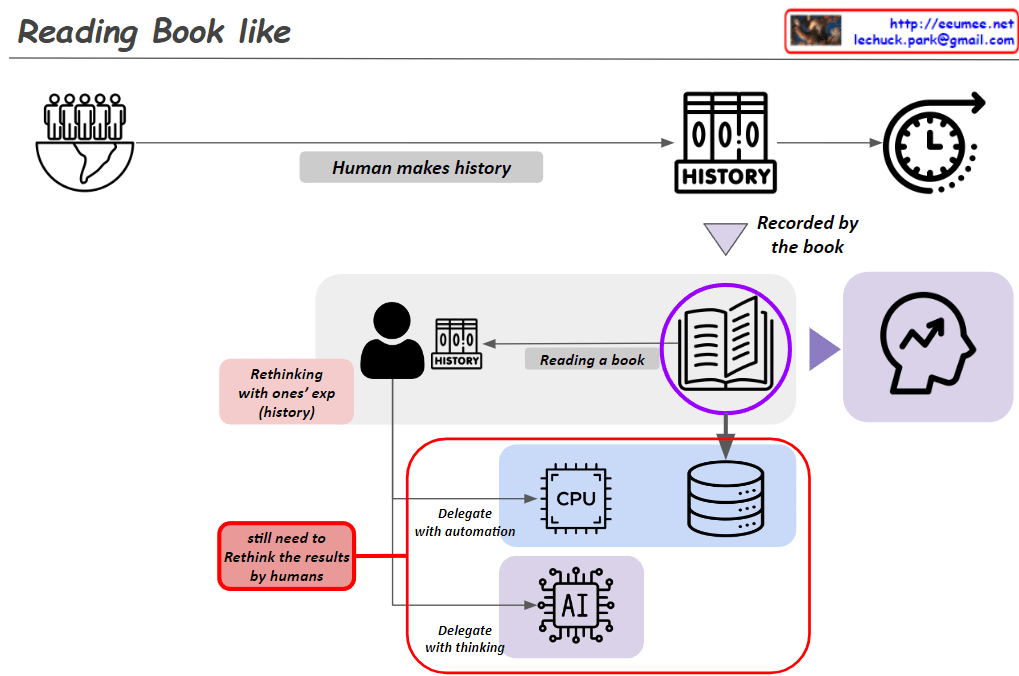
Reading book like

This diagram illustrates the process of learning history and technological advancement, highlighting the crucial role of humans:

  1. Creation and Recording of History:
    • Humans make history, which is recorded and transmitted through books.
  2. Knowledge Acquisition and Personal Growth:
    • Individuals learn history through books and reinterpret it by combining it with their own experiences.
  3. Technological Advancements and Utilization:
    • Automation of calculations through CPU
    • Delegation of some thinking processes to AI
  4. The Pivotal Role of Humans – Rethinking:
    • The key message is “still need to Rethink the results by humans”
    • This emphasizes that humans must critically evaluate and reinterpret the results obtained through technology
    • Through the process of rethinking, humans gain deeper understanding, new insights, and continue to develop
  5. Continuous Development Cycle:
    • Human rethinking generates new ideas and perspectives, which in turn become part of the history-making process

In conclusion, this diagram underscores that despite technological progress, human cognitive abilities, especially rethinking, are essential for individual and societal development. While humans use technology as a tool, the final interpretation and meaning-making remain uniquely human abilities, achieved through critical thinking and reinterpretation.

LLM Book (beyond AI)

From DALL-E with some prompting
This image conceptualizes an interactive ‘LLM Book (ChatGPT Book)’ where a reader can enhance and expand the content through interaction with the central ChatGPT icon. This interaction enriches the data, which is secured by copyright protection linked to binary code. The process can be configured using the ChatGPT builder, suggesting that this approach is not limited to books but can also apply to personal technical records or other knowledge content. Overall, the image demonstrates how interactive content creation and copyright security can be integrated, highlighting the role of AI tools like ChatGPT in content enrichment and improvement.