Linux with ML

From Claude with some prompting
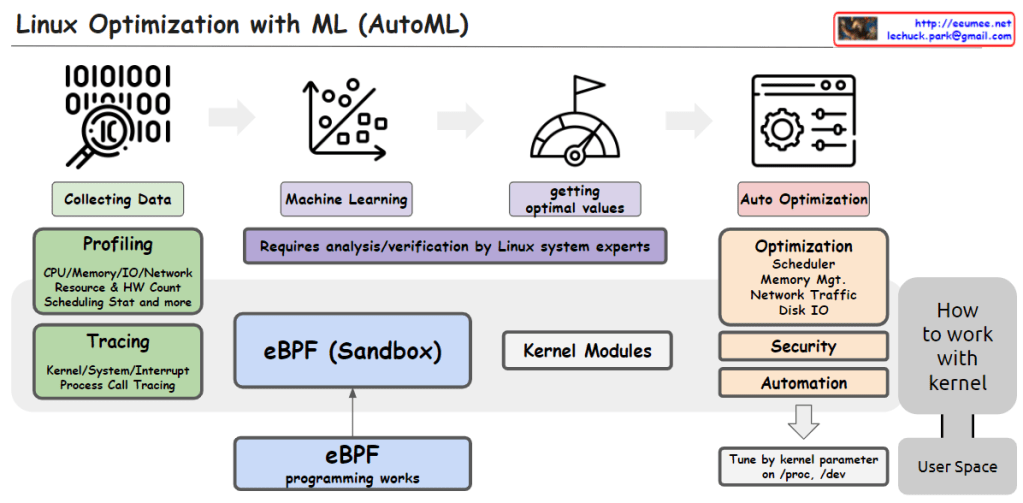
This image illustrates the process of utilizing Machine Learning (ML) and AutoML techniques for system optimization in Linux.

It starts with collecting data through profiling techniques that gather statistics on CPU, memory, I/O, network resource usage, hardware counters, scheduling information, etc. Tracing is also employed to capture kernel/system/interrupt events and process call traces.

The collected data is then used to train machine learning models. This step requires analysis and verification by Linux system experts.

The trained models help determine optimal values, which are then applied to optimize various system components such as the scheduler, memory management, network traffic, and disk I/O. Optimization can also target security and automation aspects.

The eBPF (Enhanced Berkeley Packet Filter) sandbox, situated in the center, allows safe execution within the kernel, enabling eBPF programs to interact with the kernel.

Kernel modules provide another way to implement optimization logic and integrate it directly into the kernel.

Finally, kernel parameters can be tuned from user space to perform optimizations.

In summary, the image depicts an AutoML-based process that leverages data collection, machine learning modeling, deriving optimal values, eBPF, kernel modules, and parameter tuning to automate system optimization in Linux across various kernel subsystems like the scheduler, memory management, network, and disk I/O.C

New BIZ ?

From DALL-E with some prompting
This diagram explains the process of finding new business opportunities from the perspective of digital transformation. The first step, ‘Digitization,’ involves converting real-world information into digital data while ensuring data quality. The next step, ‘Digitalization,’ extends the use of digital data to enhance automated processes. By executing these two steps, new opportunities can be discovered, and through ‘Digital Transformation,’ these discoveries can be converted into actual innovations. Overall, this process presents a methodology for leveraging digital technology to innovate business models and create new value.

Digtalization

From the Bard with some prompting

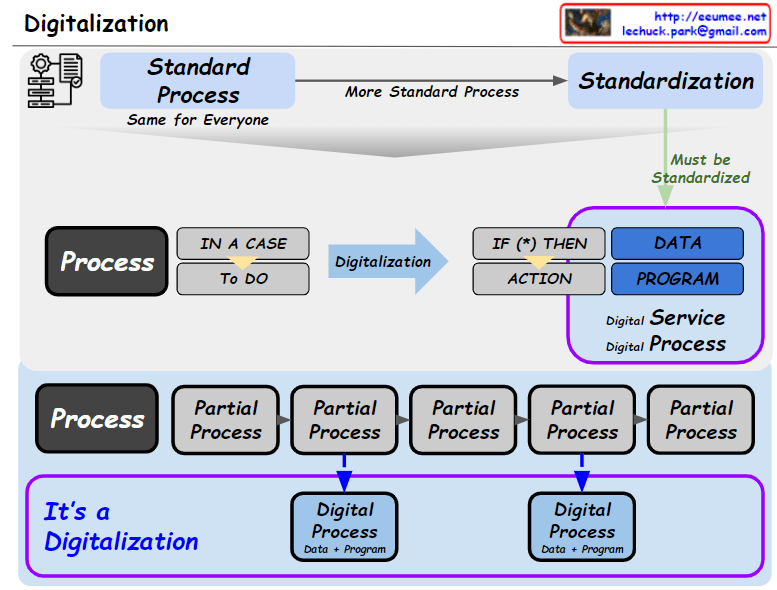
The digitalization process is the process of converting analog information into digital form. This can be done for a variety of purposes, such as storing data, processing information, or transmitting data.

Digitalization process diagram

The digitalization process can be divided into five main steps:

  1. Data collection: This is the process of gathering the data that needs to be digitized. Data can be collected from a variety of sources, such as paper documents, files, images, or videos.
  2. Data preprocessing: This is the process of cleaning and formatting the data so that it can be analyzed. This may include tasks such as converting data formats, removing duplicates, or filling in missing values.
  3. Data structuring: This is the process of organizing the data in a logical way. This may involve storing the data in a database, or organizing it into tables or tree structures.
  4. Data analysis: This is the process of extracting meaning from the data. This may involve tasks such as identifying patterns, developing predictive models, or making decisions.
  5. Data visualization: This is the process of presenting the data in a way that is easy to understand. This may involve using charts, graphs, or maps to visualize the data.

The digitalization process can be used in a variety of industries. For example, it is used in manufacturing to track production data, in finance to analyze financial transactions, in healthcare to store medical records, and in government to track public records.**


IF/THEN with AI/DT

From DALL-E with some prompting
The image depicts the evolution of decision-making processes from manual to automated, facilitated by AI and Digital Transformation (DT). Initially, decisions were made by humans based on specific conditions (IF condition THEN action). This manual approach did not involve computing. With DT, the process becomes automated through computing, making it faster and more efficient. The transition to AI and Machine Learning (ML) marks a further evolution where decisions are not just automated but are also data-driven, increasing accuracy and the ability to adapt to complex situations. The visual suggests a shift from human-based decision-making to a more sophisticated, automated, and intelligent system of processing and action-taking, indicative of modern advancements in technology.