Digital Op.

Digital Operation Framework

Left Side – Fundamental Operating Characteristics:

  • Operation: Basic operational system
  • Stable: Stable operation
  • Efficient: Efficient operation
  • Trade-off exists between these two characteristics

Center – Digital Transformation:

  • “By Digital”: Core of change through digital technology
  • Win-Win: Achieving both stability and efficiency simultaneously through digitalization

Right Side – Implementation Directions (Updated Interpretation):

  1. Base Mission – Safe Operation
    • Predictive Operation
    • Automation
    • → Building a safe operational environment
  2. How-to Mission – Digitalization
    • Cost Down
    • → Specific implementation methods through digital technology
  3. Critical Mission – Operating/Energy Cost Reduction
    • Labor (workforce management)
    • Energy (energy management)
    • → Key areas for cost reduction

Core Message (Updated)

This framework demonstrates how digital technology can resolve the traditional trade-off between stability and efficiency. The approach is to establish safe operations as the foundation, utilize digitalization as the implementation method, and ultimately achieve reduction in both operating costs and energy costs.

The diagram shows a strategic pathway where digital transformation enables organizations to move beyond the traditional stability-efficiency dilemma toward a comprehensive cost optimization model.

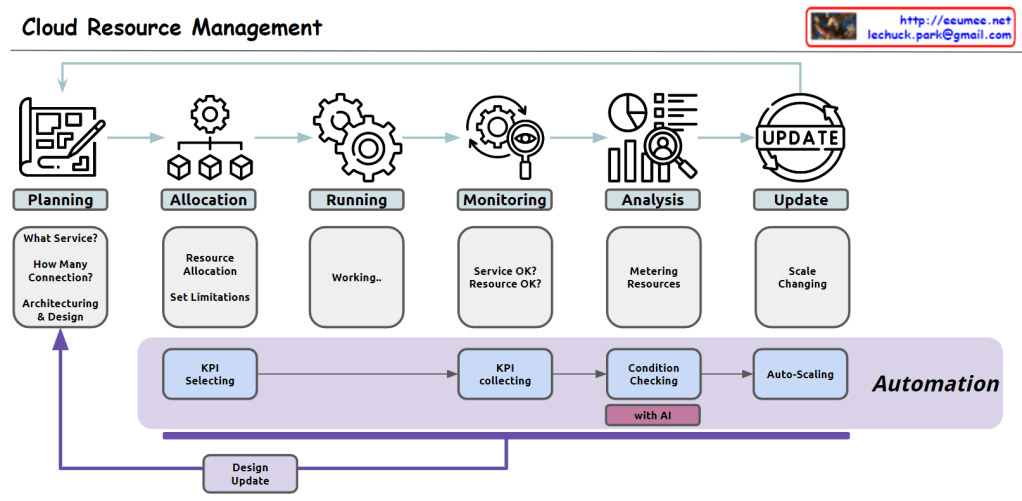
Cloud Resource Management

From Claude with some prompting
Here’s the comprehensive overview of cloud resource management in English:

  1. Planning:
    • Service selection: Determining appropriate cloud computing service types (e.g., virtual machines, containers, serverless)
    • Capacity forecasting: Estimating required resource scale based on expected traffic and workload
    • Architecture design: Designing system structure considering scalability, availability, and security
    • Infrastructure definition tool selection: Choosing tools for defining and managing infrastructure as code
  2. Allocation:
    • Resource provisioning: Creating and configuring necessary cloud resources using defined infrastructure code
    • Resource limitation setup: Configuring usage limits for CPU, memory, storage, network bandwidth, etc.
    • Access control configuration: Building a granular permission management system based on users, groups, and roles
  3. Running:
    • Application deployment management: Deploying and managing services through container orchestration tools
    • Automated deployment pipeline operation: Automating the process from code changes to production environment reflection
  4. Monitoring:
    • Real-time performance monitoring: Continuous collection and visualization of system and application performance metrics
    • Log management: Operating a centralized log collection, storage, and analysis system
    • Alert system setup: Configuring a system to send immediate notifications when performance metrics exceed thresholds
  5. Analysis:
    • Resource usage tracking: Analyzing cloud resource usage patterns and efficiency
    • Cost optimization analysis: Evaluating cost-effectiveness relative to resource usage and identifying areas for improvement
    • Performance bottleneck analysis: Identifying causes of application performance degradation and optimization points
  6. Update:
    • Dynamic resource adjustment: Implementing automatic scaling mechanisms based on demand changes
    • Zero-downtime update strategy: Applying methodologies for deploying new versions without service interruption
    • Security and patch management: Building automated processes for regularly checking and patching system vulnerabilities

Automation process:

  1. Key Performance Indicator (KPI) definition: Selecting key metrics reflecting system performance and business goals
  2. Data collection: Establishing a real-time data collection system for selected KPIs
  3. Intelligent analysis: Detecting anomalies and predicting future demand based on collected data
  4. Automatic optimization: Implementing a system to automatically adjust resource allocation based on analysis results

This approach enables efficient management of cloud resources, cost optimization, and continuous improvement of service stability and scalability.

Automation System

From Claude with some prompting
This image illustrates an Automation process, consisting of two main parts:

  1. Upper section:
    • Shows a basic automation process consisting of Condition and Action.
    • Real Data (Input) and Real Plan (Output) are fed into a Software System.
  2. Lower section:
    • Depicts a more complex automation process.
    • Alternates between manual operations (hand holding hammer icon) and software systems (screen with gear icon).
    • This represents the integration of manual tasks and automated systems.
    • Key features of the process:
      • Use of Accurate Verified Data
      • 24/7 Stable System operation
      • Continuous Optimization
    • Results: More Efficient process with Cost & Resource reduction

The hammer icon represents manual interventions, working in tandem with automated software systems to enhance overall process efficiency. This approach aims to achieve optimal results by combining human involvement with automation systems.

The image demonstrates how automation integrates real-world tasks with software systems to increase efficiency and reduce costs and resources.

Why digitalization?

From Claude with some prompting
The image depicts the effects of digitalization in three distinct stages:

Stage 1: Long-Term Accumulated Efficiency Gains Initially, efforts towards digitalization, such as standardization, automation, system and data-based work, may not yield visible results for a considerable amount of time. However, during this period, continuous improvement and optimization gradually lead to an accumulation of efficiency gains.

Stage 2: Eventual Leaps Once the efforts from Stage 1 reach a critical point, significant performance improvements and innovative breakthroughs occur, backed by the experience and learning acquired. The previously accumulated data and process improvement know-how enable these sudden leaps forward.

Stage 3: Extensive Huge Upturn with Big Data & AI Through digitalization, big data is built, and when combined with artificial intelligence technologies, unprecedented and massive levels of performance can be achieved. Data-driven predictions and automated decision-making enable disruptive value creation across a wide range of domains.

Therefore, while the initial stage of digital transformation may seem to yield minimal visible gains, persevering with continuous efforts will allow the accumulation of experience and data, eventually opening up opportunities for rapid innovation and large-scale growth. The key is to maintain patience and commitment, as the true potential of digitalization can be unlocked through the combination of data and advanced technologies like AI.

Trend & Prediction

From Claude with some prompting
The image presents a “Trend & Predictions” process, illustrating a data-driven prediction system. The key aspect is the transition from manual validation to automation.

  1. Data Collection & Storage: Digital data is gathered from various sources and stored in a database.
  2. Manual Selection & Validation: a. User manually selects which metric (data) to use b. User manually chooses which AI model to apply c. Analysis & Confirmation using selected data and model
  3. Transition to Automation:
    • Once optimal metrics and models are confirmed in the manual validation phase, the system learns and switches to automation mode. a. Automatically collects and processes data based on selected metrics b. Automatically applies validated models c. Applies pre-set thresholds to prediction results d. Automatically detects and alerts on significant predictive patterns or anomalies based on thresholds

The core of this process is combining user expertise with system efficiency. Initially, users directly select metrics and models, validating results to “educate” the system. This phase determines which data is meaningful and which models are accurate.

Once this “learning” stage is complete, the system transitions to automation mode. It now automatically collects, processes data, and generates predictions using user-validated metrics and models. Furthermore, it applies preset thresholds to automatically detect significant trend changes or anomalies.

This enables the system to continuously monitor trends, providing alerts to users whenever important changes are detected. This allows users to respond quickly, enhancing both the accuracy of predictions and the efficiency of the system.

Abstraction/Overlay with Software-defined

From Claude with some prompting
This image illustrates the concept of abstraction and overlay using software-defined systems. At the top, it shows hardware represented by servers, software as a user interface, and control as a cursor icon. Below, it demonstrates that complex hardware becomes more abstracted through software-defined systems.

The software layer acts as an overlay that simplifies and abstracts the underlying complex hardware infrastructure. This logical abstraction enables automated control and management of the hardware resources through software interfaces.

The image conveys how software-defined approaches decouple the control and management functions from the physical hardware, enabling more flexibility, scalability, and automation in managing IT infrastructure. The progression from hardware to software, and then to logical abstraction and automated control, highlights the benefits of software-defined systems in modern computing environments.

Automation

From Claude with some prompting
This image visually illustrates the automation process and emphasizes its long-term potential and impact. While automation may appear to be a small improvement at the present moment, the image highlights that with an accurate and systematic configuration, continuous utilization of automation over an extended period can lead to significant growth and advancement.

Initially, the computed output exhibits a gradual upward curve labeled “Small Up at making time.” However, as indicated by “Must be accurate,” precision is a prerequisite for realizing the full potential of automation. If accuracy is ensured, the sharp upward trend depicted as “Finally Big UP after a long time (if accurate)” can be achieved over the long run.

Therefore, the image suggests that although automation may seem like a small step currently, with precise and sustained implementation, it has the potential to yield substantial gains and achievements over time.