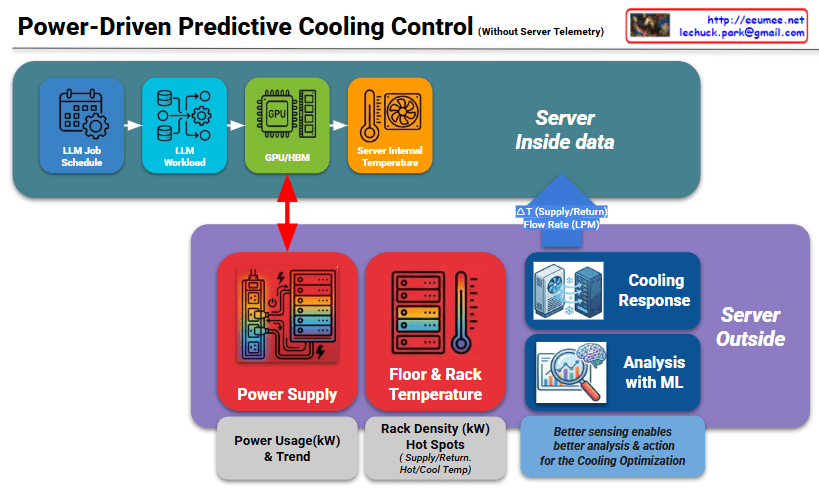
Power-Driven Predictive Cooling Control (Without Server Telemetry)

For a Co-location (Colo) service provider, the challenge is managing high-density AI workloads without having direct access to the customer’s proprietary server data or software stacks. This second image provides a specialized architecture designed to overcome this “data blindness” by using infrastructure-level metrics.


1. The Strategy: Managing the “Black Box”

In a co-location environment, the server internal data—such as LLM Job Schedules, GPU/HBM telemetry, and Internal Temperatures—is often restricted for security and privacy reasons. This creates a “Black Box” for the provider. The architecture shown here shifts the focus from the Server Inside to the Server Outside, where the provider has full control and visibility.

2. Power as the Primary Lead Indicator

Because the provider cannot see when an AI model starts training, they must rely on Power Supply telemetry as a proxy.

  • The Power-Heat Correlation: As indicated by the red arrow, there is a near-instantaneous correlation between GPU activity and power draw ($kW$).
  • Zero-Inference Monitoring: By monitoring Power Usage & Trends at the PDU (Power Distribution Unit) level, the provider can detect a workload spike the moment it happens, often several minutes before the heat actually migrates to the rack-level sensors.

3. Bridging the Gap with ML Analysis

Since the provider is missing the “More Proactive” software-level data, the Analysis with ML component becomes even more critical.

  • Predictive Modeling: The ML engine analyzes power trends to forecast the thermal discharge. It learns the specific “power signature” of AI workloads, allowing it to initiate a Cooling Response (adjusting Flow Rate in LPM and $\Delta T$) before the ambient temperature rises.
  • Optimization without Intrusion: This allows the provider to maintain a strict SLA (Service Level Agreement) and optimize PUE (Power Usage Effectiveness) without requiring the tenant to install agents or share sensitive job telemetry.

Comparison for Co-location Providers

FeatureIdeal Model (Image 1)Practical Colo Model (Image 2)
VisibilityFull-stack (Software to Hardware)Infrastructure-only (Power & Air/Liquid)
Primary MetricLLM Job Queue / GPU TempPower Trend ($kW$) / Rack Density
Tenant PrivacyLow (Requires data sharing)High (Non-intrusive)
Control PrecisionExtremely HighHigh (Dependent on Power Sampling Rate)

Summary

  1. For Co-location providers, this architecture solves the lack of server-side visibility by using Power Usage ($kW$) as a real-time proxy for heat generation.
  2. By monitoring Power Trends at the infrastructure level, the system can predict thermal loads and trigger Cooling Responses before temperature sensors even react.
  3. This ML-driven approach enables high-efficiency cooling and PUE optimization while respecting the strict data privacy and security boundaries of multi-tenant AI data centers.

Hashtags

#Colocation #DataCenterManagement #PredictiveCooling #AICooling #InfrastructureOptimization #PUE #LiquidCooling #MultiTenantSecurity

With Gemini
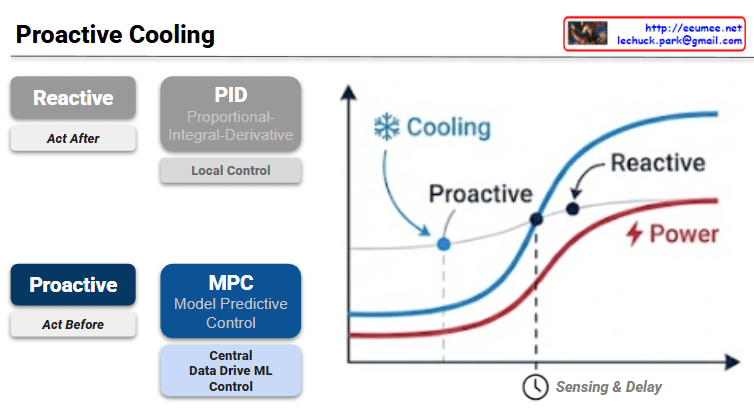
Proactive Cooling

The provided image illustrates the fundamental shift in data center thermal management from traditional Reactive methods to AI-driven Proactive strategies.


1. Comparison of Control Strategies

The slide contrasts two distinct approaches to managing the cooling load in a high-density environment, such as an AI data center.

FeatureReactive (Traditional)Proactive (Advanced)
PhilosophyAct After: Responds to changes.Act Before: Anticipates changes.
MechanismPID Control: Proportional-Integral-Derivative.MPC: Model Predictive Control.
ScopeLocal Control: Focuses on individual units/sensors.Central ML Control: Data-driven, system-wide optimization.
LogicFeedback-based (error correction).Feedforward-based (predictive modeling).

2. Graph Analysis: The “Sensing & Delay” Factor

The graph on the right visualizes the efficiency gap between these two methods:

  • Power (Red Line): Represents the IT load or power consumption which generates heat.
  • Sensing & Delay: There is a temporal gap between when a server starts consuming power and when the cooling system’s sensors detect the temperature rise and physically ramp up the fans or chilled water flow.
  • Reactive Cooling (Dashed Blue Line): Because it “acts after,” the cooling response lags behind the power curve. This often results in thermal overshoot, where the hardware momentarily operates at higher temperatures than desired, potentially triggering throttling.
  • Proactive Cooling (Solid Blue Line): By using Model Predictive Control (MPC), the system predicts the impending power spike. It initiates cooling before the heat is fully sensed, aligning the cooling curve more closely with the power curve to maintain a steady temperature.

3. Technical Implications for AI Infrastructure

In modern data centers, especially those handling fluctuating AI workloads (like LLM training or high-concurrency inference), the “Sensing & Delay” in traditional PID systems can lead to significant energy waste and hardware stress. MPC leverages historical data and real-time telemetry to:

  1. Reduce PUE (Power Usage Effectiveness): By avoiding over-cooling and sudden spikes in fan power.
  2. Improve Reliability: By maintaining a constant thermal envelope, reducing mechanical stress on chips.
  3. Optimize Operational Costs: Through centralized, intelligent resource allocation.

Summary

  1. Proactive Cooling utilizes Model Predictive Control (MPC) and Machine Learning to anticipate heat loads before they occur.
  2. Unlike traditional PID systems that respond to temperature errors, MPC eliminates the Sensing & Delay lag by acting on predicted power spikes.
  3. This shift enables superior energy efficiency and thermal stability, which is critical for high-density AI data center operations.

#DataCenter #AICooling #ModelPredictiveControl #MPC #ThermalManagement #EnergyEfficiency #SmartInfrastructure #PUEOptimization #MachineLearning

With Gemini

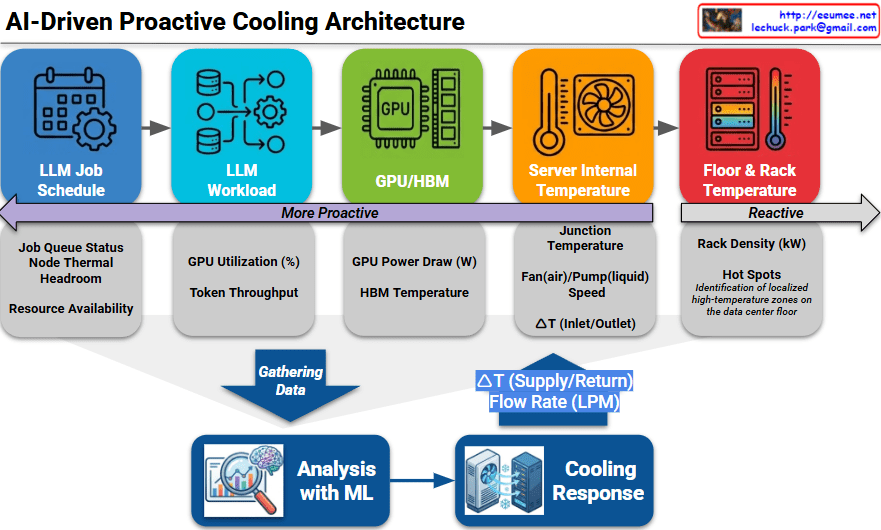
AI-Driven Proactive Cooling Architecture

The provided image illustrates an AI-Driven Proactive Cooling Architecture, detailing a sophisticated pipeline that transforms operational data into precise thermal management.


1. The Proactive Data Hierarchy

The architecture categorizes data sources along a spectrum, moving from “More Proactive” (predicting future heat) to “Reactive” (measuring existing heat).

  • LLM Job Schedule (Most Proactive): This layer looks at the job queue, node thermal headroom, and resource availability. It allows the system to prepare for heat before the first calculation even begins.
  • LLM Workload: Monitors real-time GPU utilization (%) and token throughput to understand the intensity of the current processing task.
  • GPU / HBM: Captures direct hardware telemetry, including GPU power draw (Watts) and High Bandwidth Memory (HBM) temperatures.
  • Server Internal Temperature: Measures the junction temperature, fan/pump speeds, and the $\Delta T$ (temperature difference) between server inlet and outlet.
  • Floor & Rack Temperature (Reactive): The traditional monitoring layer that identifies hot spots and rack density (kW) once heat has already entered the environment.

2. The Analysis and Response Loop

The bottom section of the diagram shows how this multi-layered data is converted into action:

  • Gathering Data: Telemetry from all five layers is aggregated into a central repository.
  • Analysis with ML: A Machine Learning engine processes this data to predict thermal trends. It doesn’t just look at where the temperature is now, but where it will be in the next few minutes based on the workload.
  • Cooling Response: The ML insights trigger physical adjustments in the cooling infrastructure, specifically controlling the $\Delta T$ (Supply/Return) and Flow Rate (LPM – Liters Per Minute) of the coolant.

3. Technical Significance

By shifting the control logic “left” (toward the LLM Job Schedule), data centers can eliminate the thermal lag inherent in traditional systems. This is particularly critical for AI infrastructure, where GPU power consumption can spike almost instantaneously, often faster than traditional mechanical cooling systems can ramp up.


Summary

  1. This architecture shifts cooling from a reactive sensor-based model to a proactive workload-aware model using AI/ML.
  2. It integrates data across the entire stack, from high-level LLM job queues down to chip-level GPU power draw and rack temperatures.
  3. The ML engine predicts thermal demand to dynamically adjust coolant flow rates and supply temperatures, significantly improving energy efficiency and hardware longevity.

#AICooling #DataCenterInfrastructure #ProactiveCooling #GPUManagement #LiquidCooling #LLMOps #ThermalManagement #EnergyEfficiency #SmartDC

With Gemini