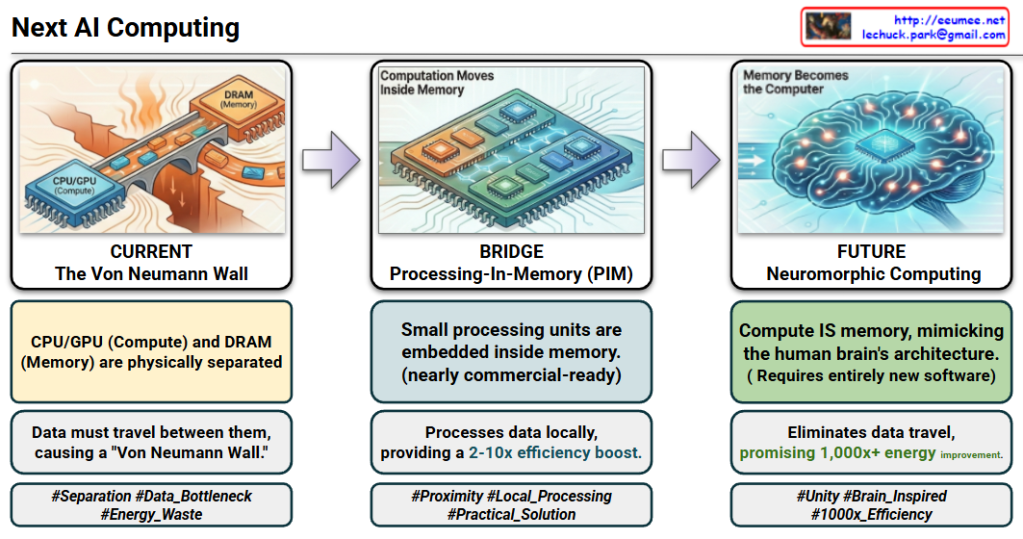
The provided images illustrate the architectural shift in AI computing from the traditional “Separation” model to a “Unified” brain-inspired model, focusing on overcoming energy inefficiency and data bottlenecks.
1. CURRENT: The Von Neumann Wall (Separation)
Status: The industry standard today.
Structure: Computation (CPU/GPU) and Memory (DRAM) are physically separate.
Problem: Constant data movement between components creates a “Von Neumann Wall” (bottleneck).
Efficiency: Extremely wasteful; 60-80% of energy is consumed just moving data, not processing it.
PUE Improvement: Power Usage Effectiveness (overall power efficiency metric)
Key Message
This diagram emphasizes that for successful AI implementation:
Technical Foundation: Both Data/Chips (Computing) and Power/Cooling (Infrastructure) are necessary
Tight Integration: These two axes are not separate but must be firmly connected like a chain and optimized simultaneously
Implementation Technologies: Specific advanced technologies for stability and optimization in each domain must provide support
The central link particularly visualizes the interdependent relationship where “increasing computing power requires strengthening energy and cooling in tandem, and computing performance cannot be realized without infrastructure support.”
Summary
AI systems require two inseparable pillars: Computing (Data/Chips) and Infrastructure (Power/Cooling), which must be tightly integrated and optimized together like links in a chain. Each pillar is supported by advanced technologies spanning from AI model optimization (FlashAttention, Quantization) to next-gen hardware (GB200, TPU) and sustainable infrastructure (SMR, Liquid Cooling, AI-driven optimization). The key insight is that scaling AI performance demands simultaneous advancement across all layers—more computing power is meaningless without proportional energy supply and cooling capacity.

 Lechuck Park