Flight LLM ( by FPGA )

Flight LLM (FPGA) Analysis

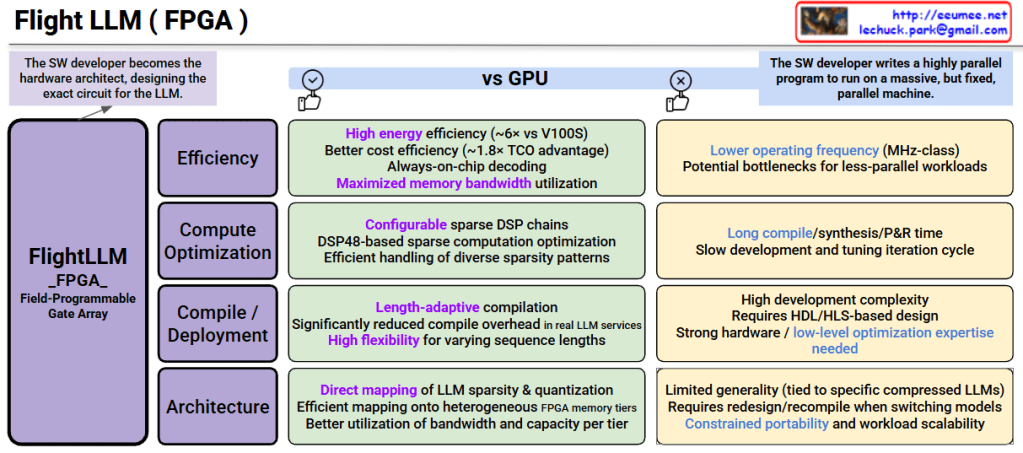
This image is a technical document comparing “FlightLLM,” an FPGA-based LLM (Large Language Model) accelerator, with GPUs.

FlightLLM_FPGA Characteristics

Core Concept: An LLM inference accelerator utilizing Field-Programmable Gate Array, where SW developers become hardware architects, designing the exact circuit for the LLM.

Advantages vs Disadvantages Compared to GPU

✓ FPGA Advantages (Green Boxes)

1. Efficiency

  • High energy efficiency (~6x vs V100S)
  • Better cost efficiency (~1.8x TCO advantage)
  • Always-on-chip decoding
  • Maximized memory bandwidth utilization

2. Compute Optimization

  • Configurable sparse DSP(Digital Signal Processor) chains
  • DSP48-based sparse computation optimization
  • Efficient handling of diverse sparsity patterns

3. Compile/Deployment

  • Length-adaptive compilation
  • Significantly reduced compile overhead in real LLM services
  • High flexibility for varying sequence lengths

4. Architecture

  • Direct mapping of LLM sparsity & quantization
  • Efficient mapping onto heterogeneous FPGA memory tiers
  • Better utilization of bandwidth and capacity per tier

✗ FPGA Disadvantages (Orange Boxes)

1. Operating Frequency

  • Lower operating frequency (MHz-class)
  • Potential bottlenecks for less-parallel workloads

2. Development Time

  • Long compile/synthesis/P&R time
  • Slow development and iteration cycle

3. Development Complexity

  • High development complexity
  • Requires HDL/HLS-based design
  • Strong hardware/low-level optimization expertise needed

4. Portability Constraints

  • Limited generality (tied to specific compressed LLMs)
  • Requires redesign/recompile when switching models
  • Constrained portability and workload scalability

Key Trade-offs Summary

FPGAs offer superior energy and cost efficiency for specific LLM workloads but require significantly higher development expertise and have lower flexibility compared to GPUs. They excel in massive, fixed parallel workloads but struggle with rapid model iteration and portability.


FlightLLM leverages FPGAs to achieve 6x energy efficiency and 1.8x cost advantage over GPUs through direct hardware mapping of LLM operations. However, this comes at the cost of high development complexity, requiring HDL/HLS expertise and long compilation times. FPGAs are ideal for production deployments of specific LLM models where efficiency outweighs the need for flexibility and rapid iteration.

#FPGA #LLM #AIAccelerator #FlightLLM #HardwareOptimization #EnergyEfficiency #MLInference #CustomHardware #AIChips #DeepLearningHardware

With Claude

New For AI

Analysis of “New For AI” Diagram

This image, titled “New For AI,” systematically organizes the essential components required for building AI systems.

Structure Overview

Top Section: Fundamental Technical Requirements for AI (Two Pillars)

Left Domain – Computing Axis (Turquoise)

  1. Massive Data
    • Processing vast amounts of data that form the foundation for AI training and operations
  2. Immense Computing
    • Powerful computational capacity to process data and run AI models

Right Domain – Infrastructure Axis (Light Blue)

3. Enormous Energy
Large-scale power supply to drive AI computing

  1. High-Density Cooling
    • Effective heat removal from high-performance computing operations

Central Link 🔗

Meaning of the Chain Link Icon:

  • For AI to achieve its performance, Computing (Data/Chips) and Infrastructure (Power/Cooling) don’t simply exist in parallel
  • They must be tightly integrated and optimized to work together
  • Symbolizes the interdependent relationship where strengthening only one side cannot unlock the full system’s potential

Bottom Section: Implementation Technologies (Stability & Optimization)

Learning & Inference/Reasoning (Learning and Inference Optimization)

Technologies to enhance AI model performance and efficiency:

  • Evals/Golden Set: Model evaluation and benchmarking
  • Safety Guardrails, RLHF-DPO: Safety assurance and human feedback-based learning
  • FlashAttention: Memory-efficient attention mechanism
  • Quant(INT8/FP8): Computational optimization through model quantization
  • Speculative/MTP Decoding: Inference speed enhancement techniques

Massive Parallel Computing (Large-Scale Parallel Computing)

Hardware and network technologies enabling massive computation:

  • GB200/GB300 NVL72: NVIDIA’s latest GPU systems
  • HBM: High Bandwidth Memory
  • InfiniBand, NVlink: Ultra-high-speed interconnect technologies
  • AI factory: AI-dedicated data centers
  • TPU, MI3xx, NPU, DPU: Various AI-specialized chips
  • PIM, CxL, UvLink: Memory-compute integration and next-gen interfaces
  • Silicon Photonics, UEC: Optical communication technologies

More Energy, Energy Efficiency (Energy Supply and Efficiency)

Technologies for stable and efficient power supply:

  • Smart Grid: Intelligent power grid
  • SMR: Small Modular Reactor (stable large-scale power source)
  • Renewable Energy: Renewable energy integration
  • ESS: Energy Storage System (power stabilization)
  • 800V HVDC: High-voltage direct current transmission (loss minimization)
  • Direct DC Supply: Direct DC supply (eliminating conversion losses)
  • Power Forecasting: AI-based power demand prediction and optimization

High Heat Exchange & PUE (Heat Exchange and Power Efficiency)

Securing cooling system efficiency and stability:

  • Liquid Cooling: Liquid cooling (higher efficiency than air cooling)
  • CDU: Coolant Distribution Unit
  • D2C: Direct-to-Chip cooling
  • Immersing: Immersion cooling (complete liquid immersion)
  • 100% Free Cooling: Utilizing external air (energy saving)
  • AI-Driven Cooling Optimization: AI-based cooling optimization
  • PUE Improvement: Power Usage Effectiveness (overall power efficiency metric)

Key Message

This diagram emphasizes that for successful AI implementation:

  1. Technical Foundation: Both Data/Chips (Computing) and Power/Cooling (Infrastructure) are necessary
  2. Tight Integration: These two axes are not separate but must be firmly connected like a chain and optimized simultaneously
  3. Implementation Technologies: Specific advanced technologies for stability and optimization in each domain must provide support

The central link particularly visualizes the interdependent relationship where “increasing computing power requires strengthening energy and cooling in tandem, and computing performance cannot be realized without infrastructure support.”


Summary

AI systems require two inseparable pillars: Computing (Data/Chips) and Infrastructure (Power/Cooling), which must be tightly integrated and optimized together like links in a chain. Each pillar is supported by advanced technologies spanning from AI model optimization (FlashAttention, Quantization) to next-gen hardware (GB200, TPU) and sustainable infrastructure (SMR, Liquid Cooling, AI-driven optimization). The key insight is that scaling AI performance demands simultaneous advancement across all layers—more computing power is meaningless without proportional energy supply and cooling capacity.


#AI #AIInfrastructure #AIComputing #DataCenter #AIChips #EnergyEfficiency #LiquidCooling #MachineLearning #AIOptimization #HighPerformanceComputing #HPC #GPUComputing #AIFactory #GreenAI #SustainableAI #AIHardware #DeepLearning #AIEnergy #DataCenterCooling #AITechnology #FutureOfAI #AIStack #MLOps #AIScale #ComputeInfrastructure

With Claude