With AI

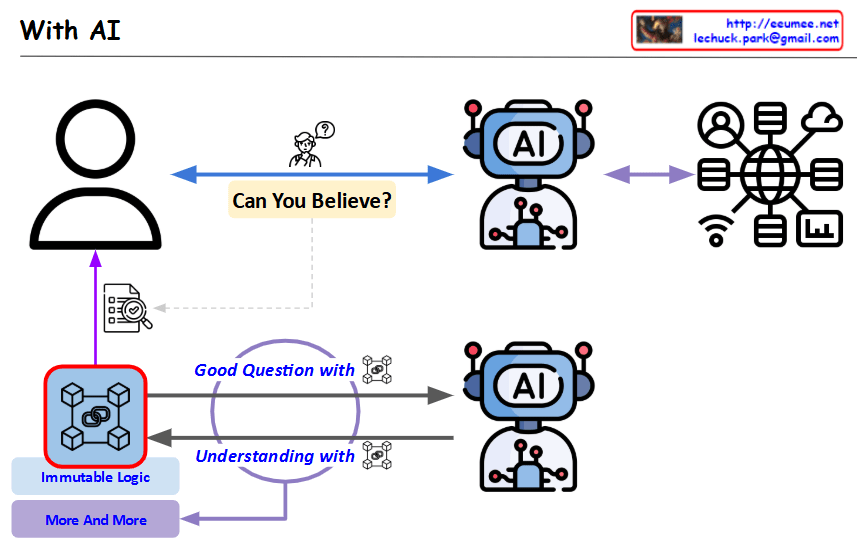
This diagram illustrates the effective collaboration method with AI:

Key Components:

  1. Upper Section: User-AI-Network Connection
  • “Can You Believe?” emphasizes the need to verify and not blindly trust the outputs of AI that has learned from the internet and vast amounts of data
  • While AI has access to extensive networks/data, verification of this information’s reliability is essential
  1. Lower Section: Logical Foundation and Development
  • “Immutable Logic” forms the foundation
  • Through this logical foundation, “Good Questions” and “Understanding” with AI occur in a cyclical process
  • “More And More” represents continuous development through this process

Core Message:

  • When utilizing AI, the most crucial element is the user’s own solid logical foundation
  • Verify and evaluate AI outputs based on this immutable logic
  • Continuously develop one’s own logic and knowledge through verified information and understanding
  • While AI is a powerful tool, its outputs must be logically verified by the user

This presents an approach not of simply using AI, but of critically evaluating AI outputs through one’s logical foundation and growing together through this process.

The diagram emphasizes that successful interaction with AI requires:

  • Having your own robust logical framework
  • Critical evaluation of AI-provided information
  • Using verified insights to enhance your own understanding
  • Maintaining a balanced approach where AI serves as a tool for growth rather than an unquestioned authority

This creates a virtuous cycle where both the user’s logical foundation and their ability to effectively utilize AI continuously improve.

With Claude

Human, Data,AI

The Key stages in human development:

  1. The Start (Humans)
  • Beginning of human civilization and knowledge accumulation
  • Formation of foundational civilizations
  • Human intellectual capacity and creativity as key drivers
  • The foundation for all future developments
  1. The History Log (Data)
  • Systematic storage and management of accumulated knowledge
  • Digitalization of information leading to quantitative and qualitative growth
  • Acceleration of knowledge sharing and dissemination
  • Bridge between human intelligence and artificial intelligence
  1. The Logic Calculation (AI)
  • Logical computation and processing based on accumulated data
  • New dimensions of data utilization through AI technology
  • Automated decision-making and problem-solving through machine learning and deep learning
  • Represents the current frontier of human technological achievement

What’s particularly noteworthy is the exponential growth curve shown in the graph. This exponential pattern indicates that each stage builds upon the achievements of the previous one, leading to accelerated development. The progression from human intellectual activity through data accumulation and management, ultimately leading to AI-driven innovation, shows a dramatic increase in the pace of advancement.

This developmental process is significant because:

  • Each stage is interconnected rather than independent
  • Previous stages form the foundation for subsequent developments
  • The rate of progress increases exponentially over time
  • Each phase represents a fundamental shift in how we process and utilize information

This timeline effectively illustrates how human civilization has evolved from basic knowledge creation to data management, and finally to AI-powered computation, with each stage marking a significant leap in our technological and intellectual capabilities.

With Claude

With AI

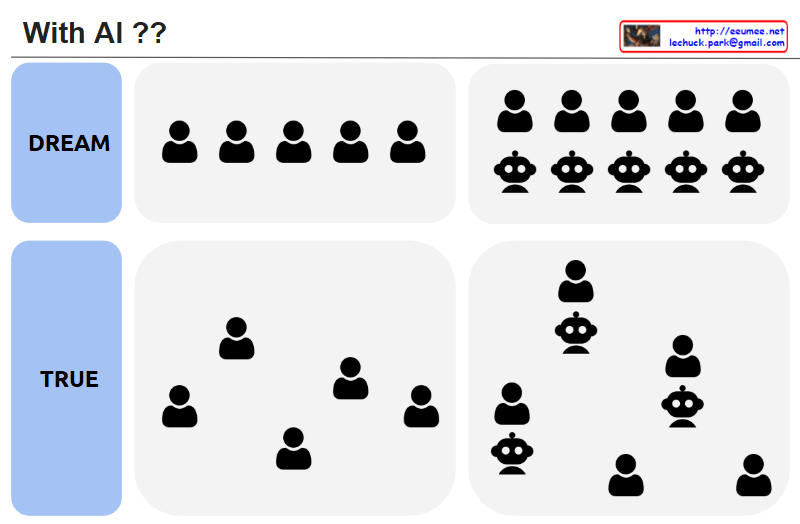
1. Image Structure

The image is divided into “DREAM” (ideal) and “TRUE” (reality), contrasting human society and AI integration scenarios.

2. Human Society Representation

Ideal (DREAM)

  • All human icons positioned at the same height
  • Symbolizes perfect social equality
  • Presents a utopian vision without hierarchical or power differences

Reality (TRUE)

  • Human icons placed irregularly at different heights
  • Reflects the inevitable existence of social hierarchy and power structures
  • Suggests that perfect equality is difficult to achieve in reality

3. AI and Human Relationship

Ideal (DREAM)

  • AI icons aligned uniformly below human icons
  • Represents AI under complete human control
  • Expresses the expectation that humans can perfectly control AI as a tool

Reality (TRUE)

  • AI and human icons randomly placed at various heights
  • Some AI icons positioned higher than humans
  • Indicates that AI may surpass human capabilities or authority in certain domains

4. Key Messages

  1. Perfect equality in human society remains an ideal, while reality always contains some form of hierarchy.
  2. The expectation of complete control over AI may be unrealistic, as AI can potentially exceed human capabilities in specific areas.
  3. It’s important to acknowledge and understand the gap between ideals and reality.

5. Overall Implications

The image effectively visualizes the disconnect between our expectations and reality in both human social structures and AI integration. It suggests that while we may dream of perfect equality and control, the reality is more complex and unpredictable, requiring us to adapt our understanding and expectations accordingly.

With Claude

Page(Memory) Replacement with AI

With Claude
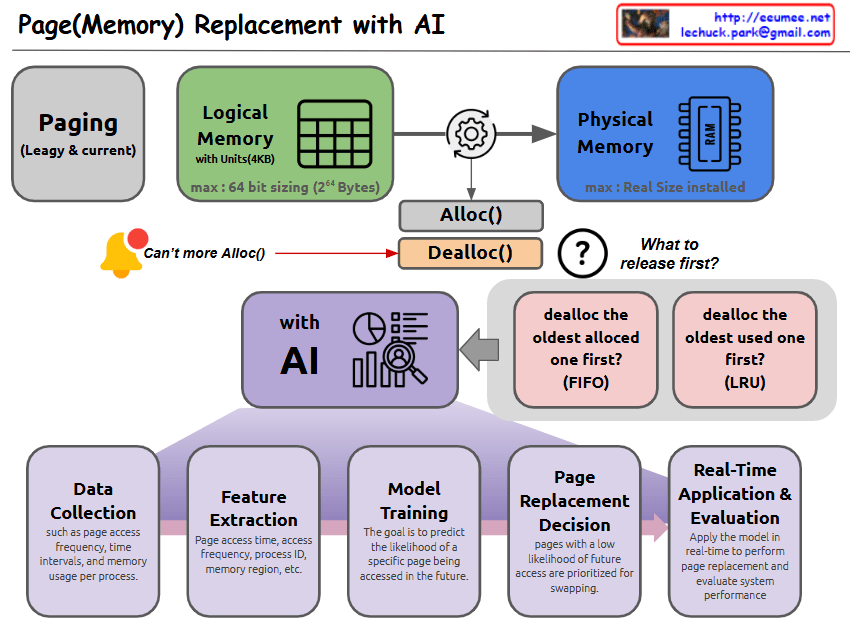
This image illustrates a Page (Memory) Replacement system using AI. Let me break down the key components:

  1. Top Structure:
  • Paging (Legacy & current): Basic paging system structure
  • Logical Memory: Organized in 4KB units, maximum 64-bit sizing (2^64 Bytes)
  • Physical Memory: Limited to the actual installed memory size
  1. Memory Allocation:
  • Shows Alloc() and Dealloc() functions
  • When no more allocation is possible, there’s a question about deallocation strategy:
    • FIFO (First In First Out): Deallocate the oldest allocated memory first
    • LRU (Least Recently Used): Deallocate the oldest used memory first
  1. AI-based Page Replacement Process:
  • Data Collection: Gathers information about page access frequency, time intervals, and memory usage patterns
  • Feature Extraction: Analyzes page access time, access frequency, process ID, memory region, etc.
  • Model Training: Aims to predict the likelihood of specific pages being accessed in the future
  • Page Replacement Decision: Pages with a low likelihood of future access are prioritized for swapping
  • Real-Time Application & Evaluation: Applies the model in real-time to perform page replacement and evaluate system performance

This system integrates traditional page replacement algorithms with AI technology to achieve more efficient memory management. The use of AI helps in making more intelligent decisions about which pages to keep in memory and which to swap out, based on learned patterns and predictions.

Analysis Evolutions and ..

With Claude
this image that shows the evolution of data analysis and its characteristics at each stage:

Analysis Evolution:

  1. 1-D (One Dimensional): Current Status analysis
  2. Time Series: Analysis of changes over time
  3. n-D Statistics: Multi-dimensional correlation analysis
  4. ML/DL (Machine Learning/Deep Learning): Huge-dimensional analysis including exceptions

Bottom Indicators’ Changes:

  1. Data/Computing/Complexity:
  • Marked as “Up and Up” and increases “Dramatically” towards the right
  1. Accuracy:
  • Left: “100% with no other external conditions”
  • Right: “not 100%, up to 99.99% from all data”
  1. Comprehensibility:
  • Left: “Understandable/Explainable”
  • Right: “Unexplainable”
  1. Actionability:
  • Left: “Easy to Action”
  • Right: “Difficult to Action require EXP” (requires expertise)

This diagram illustrates the trade-offs in the evolution of data analysis. As analysis methods progress from simple one-dimensional analysis to complex ML/DL, while the sophistication and complexity of analysis increase, there’s a decrease in comprehensibility and ease of implementation. It shows how more advanced analysis techniques, while powerful, require greater expertise and may be less transparent in their decision-making processes.

The progression also demonstrates how modern analysis methods can handle increasingly complex data but at the cost of reduced explainability and the need for specialized knowledge to implement them effectively.

Deepseek

With Claude
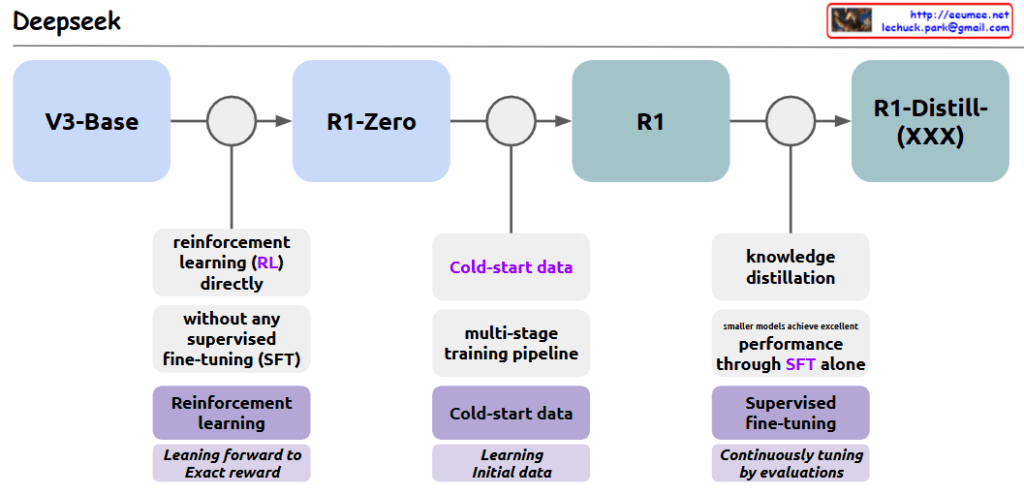
The evolution pipeline of the Deepseek model consists of three major stages:

Stage 1: V3-Base → R1-Zero

  • Direct application of Reinforcement Learning (RL)
  • Proceeds without Supervised Fine-tuning (SFT)
  • Adopts learning approach toward exact reward
  • Performs basic data classification tasks

Stage 2: R1-Zero → R1

  • Utilizes cold-start data for learning
  • Implements multi-stage training pipeline
  • Conducts foundational learning with initial data
  • Applies systematic multi-stage learning process

Stage 3: R1 → R1-Distill-(XXX)

  • Model optimization through knowledge distillation
  • Smaller models achieve excellent performance through SFT alone
  • Continuous model tuning through evaluations
  • Performance enhancement through learning with other models

This pipeline demonstrates a comprehensive approach to model development, incorporating various advanced AI training techniques and methodologies to achieve optimal performance at each stage.