3 Key on the AI era

This diagram illustrates the 3 Core Technological Components of AI World and their surrounding challenges.

AI World’s 3 Core Technological Components

Central AI World Components:

  1. AI infra (AI Infrastructure) – The foundational technology that powers AI systems
  2. AI Model – Core algorithms and model technologies represented by neural networks
  3. AI Agent – Intelligent systems that perform actual tasks and operations

Surrounding 3 Key Challenges

1. Data – Left Area

Data management as the raw material for AI technology:

  • Data: Raw data collection
  • Verified: Validated and quality-controlled data
  • Easy to AI: Data preprocessed and optimized for AI processing

2. Optimization – Bottom Area

Performance enhancement of AI technology:

  • Optimization: System optimization
  • Fit to data: Data fitting and adaptation
  • Energy cost: Efficiency and resource management

3. Verification – Right Area

Ensuring reliability and trustworthiness of AI technology:

  • Verification: Technology validation process
  • Right?: Accuracy assessment
  • Humanism: Alignment with human-centered values

This diagram demonstrates how the three core technological elements – AI Infrastructure, AI Model, and AI Agent – form the center of AI World, while interacting with the three fundamental challenges of Data, Optimization, and Verification to create a comprehensive AI ecosystem.

With Claude
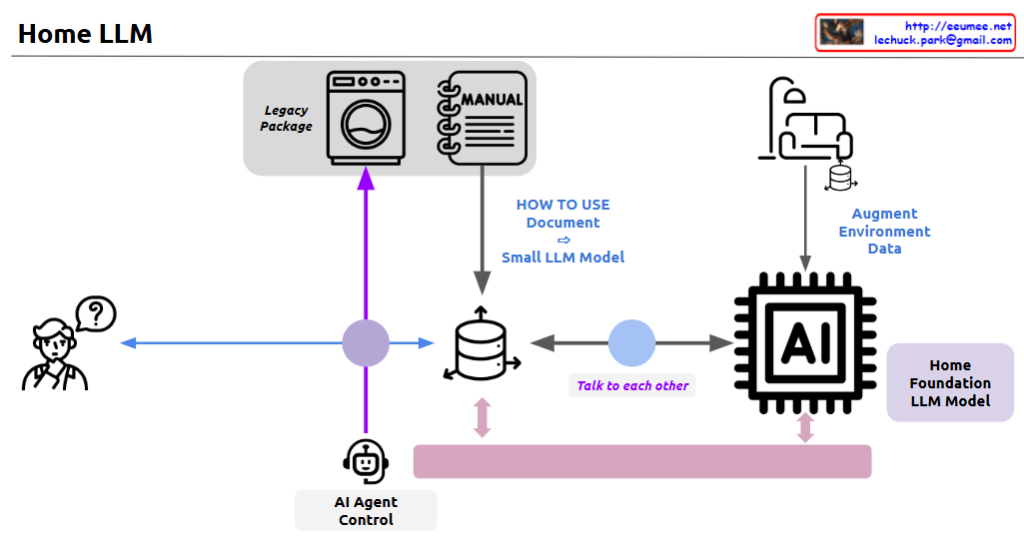
Home LLM

This image shows the architecture of a “Home LLM” system, illustrating an innovative change in how home appliances are used.

Key points:

  1. Evolution from Traditional Approach: While traditional electronics came as ‘product + paper manual’ packages, this new system replaces manuals with small LLM models.
  2. Home Foundation Model: Homes are equipped with a main LLM model (“Home Foundation LLM Model”) that learns from environmental data.
  3. Knowledge Exchange: Product-specific small LLM models and the home foundation model exchange data and learning outcomes with each other.
  4. User Interface: Users can easily interact through the LLM by asking questions and giving commands, making product usage much more intuitive and convenient.
  5. AI Agent Control: Additionally, AI agents automatically optimize the control of these products, increasing efficiency.

This system presents a smart home architecture that fundamentally improves the user experience of electronic products by integrating AI and LLM technologies in the home environment.

With Claude

AI persona

with a Claude’s Help
This image shows a diagram illustrating the process flow of an AI Persona system. It demonstrates five stages progressing from left to right:

  1. Life Logging:
  • Records daily activities such as listening to music and conversations
  • Data appears to be collected through mobile devices
  1. Digitization:
  • Converting and processing collected data into digital format
  • Shown with settings and document icons
  1. AI Learning:
  • Stage where AI learns from the digitized data
  • Represented by a circuit network icon
  1. AI Agent:
  • Formation of an AI agent based on learned data
  • Symbolized by an icon showing the integration of AI and human elements
  1. Digital World:
  • Final stage where the AI persona operates in the digital world
  • Represented by a global network icon

The diagram effectively illustrates the complete process of how human activities and characteristics are digitized, transformed into AI, and ultimately utilized in the digital world. Each step is clearly labeled and represented with relevant icons that help visualize the transformation from real-world data to digital AI persona.

The image appears to be part of a technical presentation or documentation, as indicated by the email address visible in the top right corner. The flow is presented in a clear, linear fashion with connecting arrows showing the progression between each stage. C

My own AI agent

From DALL-E with some prompting
This image appears to be a conceptual diagram of an individual’s AI agent, divided into several parts:

  1. Personal Area: There’s a user icon with arrows labeled ‘Control’ and ‘Sensing All’. This suggests the user can direct the AI agent and the AI is capable of gathering comprehensive information from its environment.
  2. Micro & Macro Infinite World: This part features illustrations that seem to represent microorganisms, plants, butterflies, etc., indicating that the AI collects data from both microscopic and macroscopic environments.
  3. Personalized Resource: The icon resembling a human brain could represent personalized services or data tailored to the user.
  4. Cloud Infra: The cloud infrastructure is presumably responsible for data processing and storage.
  5. Cloud Service: Depicted as a server providing various services, connected to the cloud infrastructure.
  6. Internet Connected: A globe icon with various network points suggests that the AI agent is connected to global information and knowledge via the internet.

Overall, the diagram illustrates a personalized AI agent that collects information under the user’s control, processes it through cloud infrastructure and services, and ultimately contributes to collective intelligence through an internet connection.