‘IF THEN’ with AI

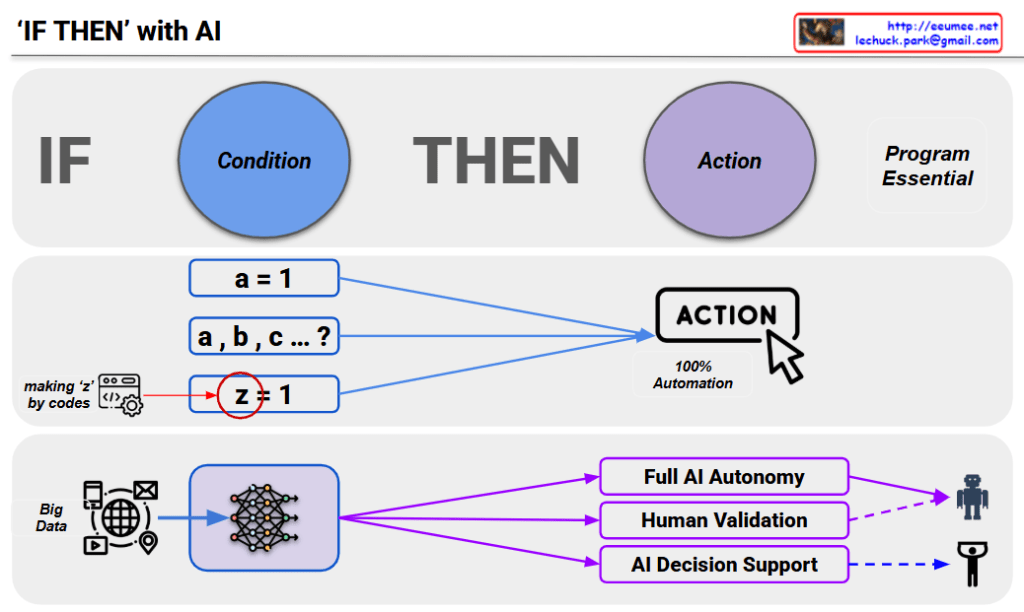
This image is a diagram titled “IF-THEN with AI” that explains conditional logic and automation levels in AI systems.

Top Section: Basic IF-THEN Structure

  • IF (Condition): Conditional part shown in blue circle
  • THEN (Action): Execution part shown in purple circle
  • Marked as “Program Essential,” emphasizing it as a core programming element

Middle Section: Evolution of Conditional Complexity

AI is ultimately a program, and like humans who wanted to predict by sensing data, making judgments, and taking actions based on those criteria. IF-THEN is essentially prediction – the foundation of programming that involves recognizing situations, making judgments, and taking actions.

Evolution stages of data/formulas:

  • a = 1: Simple value
  • a, b, c … ?: Processing multiple complex values simultaneously
  • Z ≠ 1: A condition that finds the z value through code on the left and compares it to 1 (highlighted with red circle, with annotation “making ‘z’ by codes”)

Now we input massive amounts of data and analyze with AI, though it has somewhat probabilistic characteristics.

Bottom Section: Evolution of AI Decision-Making Levels

Starting from Big Data through AI networks, three development directions:

  1. Full AI Autonomy: Complete automation that evolved to “Fine, just let AI handle it”
  2. Human Validation: Stage where humans evaluate AI judgments and incorporate them into operations
  3. AI Decision Support: Approach where humans initially handle the THEN action

Key Perspective: While these three development directions exist, there’s a need for judgment regarding decisions based on the quality of data used in analysis/judgment. This diagram shows that it’s not just about automation levels, but that data quality-based reliability assessment is a crucial consideration.

Summary

This diagram illustrates the evolution from simple conditional programming to complex AI systems, emphasizing that AI fundamentally operates on IF-THEN logic for prediction and decision-making. The key insight is that regardless of automation level, the quality of input data remains critical for reliable AI decision-making processes.

With Claude

Nice Action

This “Nice Action” diagram illustrates how decision-making processes work similarly for both humans and AI:

  1. Dual Structure of All Choices: Every decision inherently consists of elements of certainty and uncertainty.
  2. Certainty Expansion Strategy: The first step “① Expansion ‘Certain’ First” demonstrates the strategy of maximizing the use of already certain information. This establishes a foundation for decision-making based on known facts.
  3. Uncertainty Upgrade: The second step “② Upgrade Possibility to near 100%” represents the process of increasing the probability of uncertain elements to bring them as close as possible to certainty. While complete certainty cannot be achieved for all elements, obtaining sufficiently high probability enhances the reliability of decisions.
  4. Similarity to Machine Learning and AI: This decision-making model is remarkably similar to how modern machine learning and AI function. AI systems also operate based on certain data (learned patterns) and use probabilistic approaches for uncertain elements to derive optimal decisions.
  5. Transition to Action: Once sufficient certainty is established, the final “ACTION” step can be taken to implement the decision.

This diagram provides insight into how human intuitive decision-making and AI’s algorithmic approach fundamentally follow the same principle—maximizing certainty while managing uncertainty to an acceptable level. The “AI, too” notation explicitly emphasizes this similarity.

With Claude

Software Defined Power Distribution

With a Claude
the Software Defined Power Distribution (SDPD) system, including the added standards and protocols shown in the image:

  1. SDN Similarity
  • Like Software-Defined Networking controls network traffic, SDPD applies similar software-defined principles to power distribution
  1. Key Components
  • Real-time Monitoring: Power consumption and system status analysis using IoT sensors and AI
  • Centralized Control: Power distribution optimization through an integrated platform
  • Flexibility/Scalability: Software-based upgrades and expansion
  • Energy Efficiency: Data center power optimization and rapid fault response
  1. Standards and Protocols
  • IEC 61850: Substation automation communication standard
  • IEEE 2030.5: Smart energy profile standard
  • Modbus/DNP3: Industrial communication protocols
  • OpenADR: Automated demand response standard

Final Summary: Why Software Defined X (SDx) is necessary for power distribution

  • Modern power systems face increasing complexity and require real-time response capabilities
  • Data-driven decision making and automated control are essential
  • Software Defined approach (SDPD) provides:
    1. Real-time data collection/analysis for optimized power flow
    2. Rapid response and efficient management through centralized control
    3. Flexible system expansion and upgrades through software-based architecture
    4. Achievement of improved energy efficiency and reduced operational costs

The software-defined approach has become essential in the power sector, just as it has in networking, because it enables:

  • Intelligent resource allocation
  • Improved system visibility
  • Enhanced operational efficiency
  • Better fault tolerance and recovery
  • Cost-effective scaling and updates

This demonstrates why a data-centric, software-defined approach is crucial for modern power systems to achieve efficiency, reliability, and scalability.