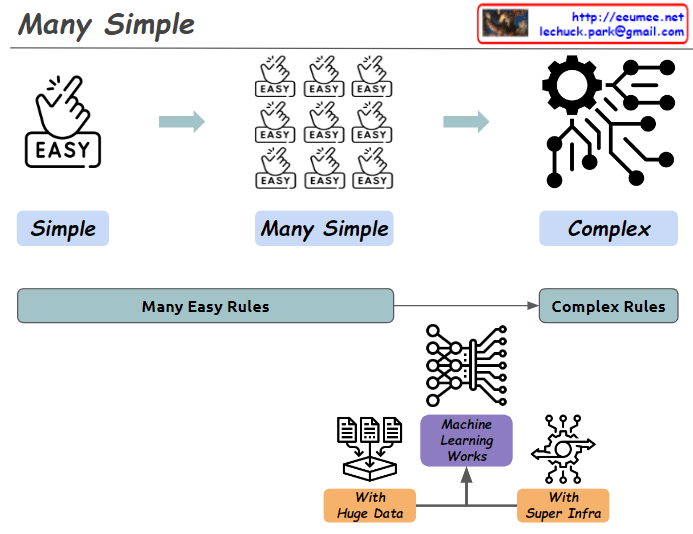
“Complex”: Depicts a system of intricate gears and connections.
Bottom diagram:
Shows the progression from “Many Easy Rules” to “Complex Rules”.
Centers around the concept of “Machine Learning Works”.
This is supported by “With Huge Data” and “With Super Infra”.
The image provides a simplified explanation of how machine learning operates. It visualizes the process of numerous simple rules being processed through massive amounts of data and powerful infrastructure to produce complex systems.
From Claude with some prompting “The image presents an intriguing perspective on Matter and Energy, which aligns with your interpretation. Let me break it down:
Equivalence of Matter and Energy: The image shows matter and energy as essentially the same concept, symbolized by the equation ‘Matter = Energy’. This aligns with Einstein’s famous equation E=mc².
Energy Units: The diagram depicts ‘Energy Units’ as having ‘Pulling Power’. This corresponds to your mention of gravity or attractive forces being inherent in these fundamental units.
Nature of Matter: Matter is represented as a ‘Packet of Energy’ or ‘Packet of Mass’. This supports your view that matter is essentially a highly concentrated form of energy.
Pulling Power: The image shows ‘Pulling Power’ both inside and outside the energy packet, which could represent internal binding forces and external gravitational forces.
Unified Concept: The overall message seems to be that matter is simply energy in a very condensed form, with each fundamental unit exhibiting some form of attractive force.
This approach shares similarities with some concepts in modern physics, particularly aspects of quantum mechanics and relativity theory. It emphasizes the fundamental connection between matter and energy, potentially offering a more unified understanding of the universe.
However, it’s important to note that while this is an interesting conceptual model, real-world physics involves more complex interactions and phenomena. Nevertheless, this perspective provides a thought-provoking philosophical and conceptual approach to understanding the relationship between matter and energy.”
From Claude with some prompting This image illustrates a flowchart about data and the learning process. Here’s a breakdown of the key elements:
The title “No More Data” is at the top of the image.
“Data in” section includes:
Experience: represented by a history icon
Number: shown as dice with 1, 2, 3
Text: represented by “IT” letters
Book: depicted by a book icon
Internet: symbolized by a global network icon
These data sources feed into a “Learning & Learning” process, leading to a learning output represented by an icon resembling artificial intelligence or a brain.
There’s a stage labeled “No More Data”, followed by the question “And the Next ??”
Finally, there’s a lightbulb icon suggesting “New Creation?”
This diagram visualizes the process from data input to learning, and then poses the question of what happens when there’s no more data. It suggests the possibility of new creation as the next step. The flowchart prompts consideration of what follows after the learning phase when data input ceases, and whether this could lead to novel creation.
From Claude with some prompting This image depicts a diagram of the “DC op Platform” (Data Center Operations Platform). The main components are as follows:
On the left, there’s “DC Op Env.” (Data Center Operations Environment), which consists of three main parts:
DCIM (Data Center Infrastructure Management)
Auto Control
Facility These three elements undergo a “Standardization” process.
In the center, there are two “Standardization” server icons, representing the standardization process of the platform.
On the right, there’s the “Data Center Op. Platform”, which comprises three main components:
Service Development
Integrated operations
Server Room Digital Twin
Arrows show how the standardized elements connect to these three main components.
This diagram visually illustrates how the data center operations environment evolves through a standardization process into an integrated data center operations platform.
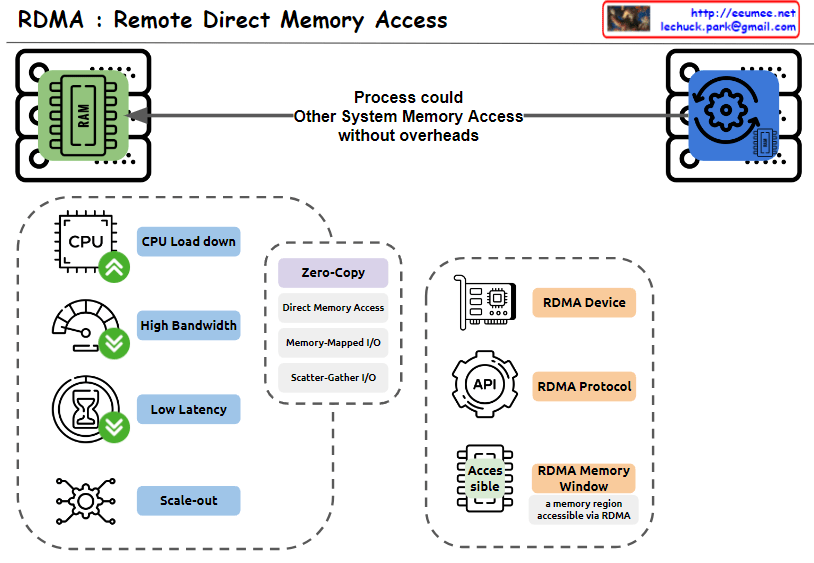
From Claude with some prompting This image explains RDMA (Remote Direct Memory Access). Here’s an interpretation in English:
The top of the image shows that RDMA allows one system to access the memory of another system without overheads.
The bottom left box lists the main advantages of RDMA:
CPU Load down
High Bandwidth
Low Latency
Scale-out
The central box describes key features of RDMA:
Zero-Copy
Direct Memory Access
Memory-Mapped I/O
Scatter-Gather I/O
The bottom right box lists RDMA-related components:
RDMA Device
RDMA Protocol
RDMA Memory Window (defined as “a memory region accessible via RDMA”)
The image provides a concise overview of RDMA technology, highlighting its main features and benefits. It illustrates how RDMA enables efficient, direct memory access between systems, reducing CPU load and improving performance in terms of bandwidth and latency.
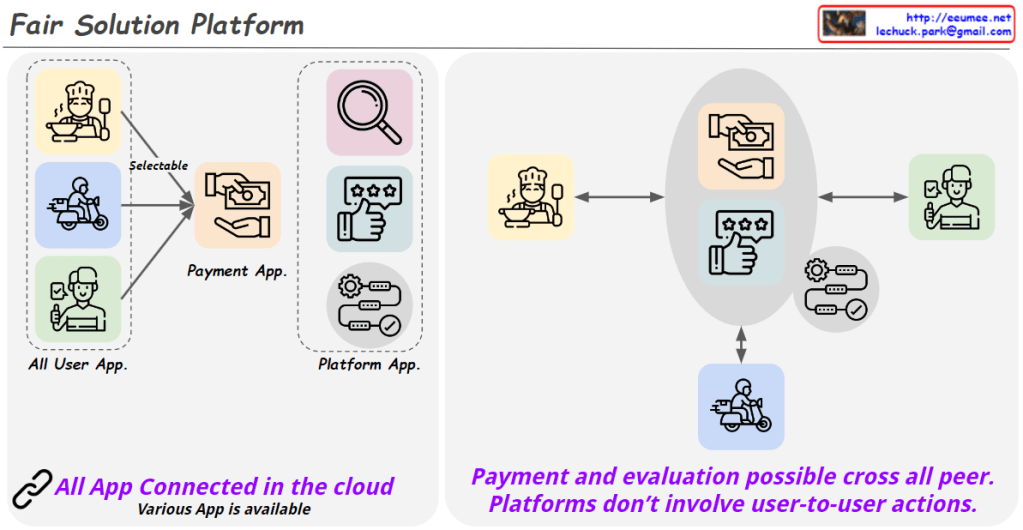
From Claude with some prompting The “Fair Solution Platform” is designed with the following key concepts:
User Empowerment:
All users (chefs, delivery personnel, customers, etc.) can directly choose which service apps to use for actual interactions (ordering, payment, delivery, evaluation, etc.).
Platform Neutrality:
The platform provider does not interfere with direct user-to-user interactions.
Instead, it creates an environment where various apps can connect and be provided.
Connectivity and Diversity:
All apps are connected through the cloud.
The platform fosters an ecosystem where diverse apps can be offered.
Additional Features:
Provides functionality to search for services and activity results conducted on the platform.
Fair Cost Structure:
The platform only charges fees related to its role as a platform.
Terms of transactions between users are decided directly by the parties involved.
User Rights Protection:
This model aims to safeguard the rights of actual producers and consumers.
It facilitates direct transactions with minimal intermediary intervention.
The platform aims to maximize user autonomy, maintain platform neutrality, and create a fair trading environment. By doing so, it seeks to overcome the limitations of traditional platform models and create a more equitable and efficient service ecosystem.


 Lechuck Park