
But we are not..

The Computing for the Fair Human Life.
But we are not..
From DALL-E with some prompting
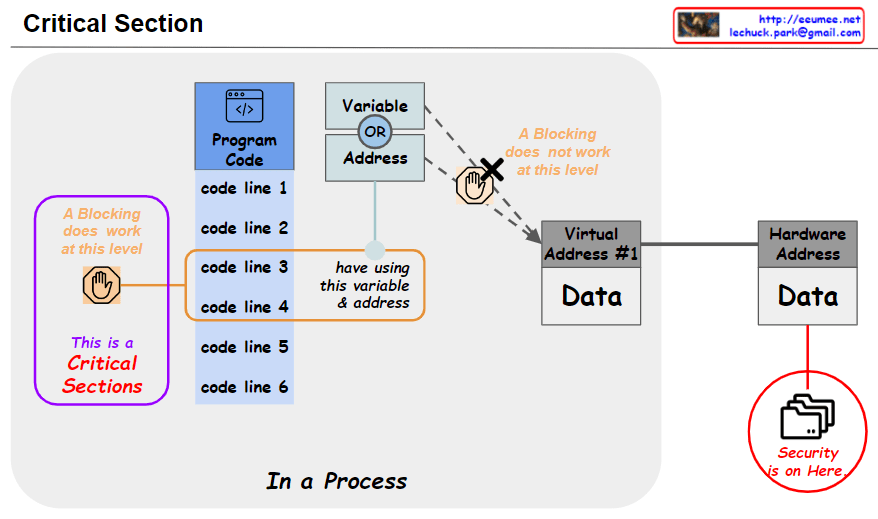
The provided image delineates the concept of a “Critical Section” in process execution, where certain areas of the program code are designated as sensitive or exclusive zones to prevent concurrent access. This is not merely a matter of securing a memory location but rather about managing access to specific code blocks that interact with shared variables or addresses.
In the diagram, the “Critical Sections” are highlighted to signify that these blocks of code are where ‘blocking’ occurs, allowing only one thread or process to operate on the shared resources at a time, thus ensuring data integrity and preventing race conditions. The transition from code lines to data, through variable addresses and virtual address mapping to the actual data in hardware, suggests a layered approach to security and access control.
Moreover, the image hints at the abstraction layers from a virtual address space to the physical hardware address, underlining the importance of security protocols at each layer. These critical sections act as a checkpoint not only to enforce sequential access to shared resources but also to facilitate a systematic flow of operations, from programming syntax to system calls, and from understanding the computer architecture to the actual hardware operations. This systematic control is crucial for maintaining security and operational efficiency in digital systems.

From DALL-E with some prompting
The image illustrates various aspects of GPU technology. Firstly, ‘Multi Input’ and ‘Direct Memory Access’ signify that GPUs efficiently receive data from multiple sources and optimize memory access. PCIe NVMe represents the hardware interface for fast data transfer.
Secondly, ‘Multi Computing’ and ‘Parallel Processing’ highlight the core capabilities of GPUs, which can process multiple operations simultaneously. ‘Nano Superconductivity no loss power’ suggests the use of nano-technology and superconductivity for efficient power transmission without energy loss.
Thirdly, the cooling system of the GPU is essential for managing heat and maintaining performance, indicating the importance of cooling technologies in high-performance computing to keep GPU temperatures stable.
Finally, ‘AI output’ shows that all these technologies are ultimately employed for processing data and outputting results for artificial intelligence applications.
This diagram provides an overview of the entire process of GPU technology, from data input through complex calculations and cooling systems, to the output for AI applications.

From DALL-E with some prompting
The image explores how human decision-making has evolved from data analysis to probabilistic judgments. Initially, rules derived from data led to definitive decisions, but with the advent of AI, we have returned to probabilistic decision-making. The phrases at the top suggest that the real world may be inherently probabilistic and that humans still lack complete knowledge of the quantum realm.

From DALL-E with some prompting
This diagram illustrates the journey from the basics of coding to the creation of digital solutions that meet the requirements of the real world. It begins with an understanding of the fundamental syntax of programming, progressing to knowledge of system calls, operating systems and kernels, computer architecture, and the workings of hardware. This technical acumen is combined with the roles of digital experts, programming experts, and system experts who transform client and business requirements into digital solutions. This process involves specific data models, system architecture and design, framework APIs, and database management. Overall, the diagram describes the comprehensive process of developing digital services, starting from coding and extending to advanced technical understanding in network architecture, engineering, and packet management.

From ChatGPT4 < image interpretation>
The image presents a problem statement and a solution approach for identifying special positions in a binary matrix from a programming challenge. The task is to find positions in the matrix where the value is ‘1’, and all other values in the same row and column are ‘0’. The solution involves three steps:
The code snippets provided outline the loops and conditions used to implement this logic in a programming language.

From DALL-E with some prompting
The image outlines the workflow and components of digital data services. It begins with data collection from various sources, which is then subjected to a verification process to ensure its integrity. The verified data is stored in a database and undergoes the ETL process (Extract, Transform, Load) to be formatted appropriately for analysis. This data is visualized to facilitate insightful analysis, which then feeds into an AI learning process. The outcomes of this analysis are applied in the service stage where established processes are confirmed and automation tools are implemented to deliver the final service. The AI model, refined by learning from the data, plays a critical role in enhancing the precision and efficiency of the service provided.

