JIT(for eBPF) at Linux K6

From DALL-E with some prompting
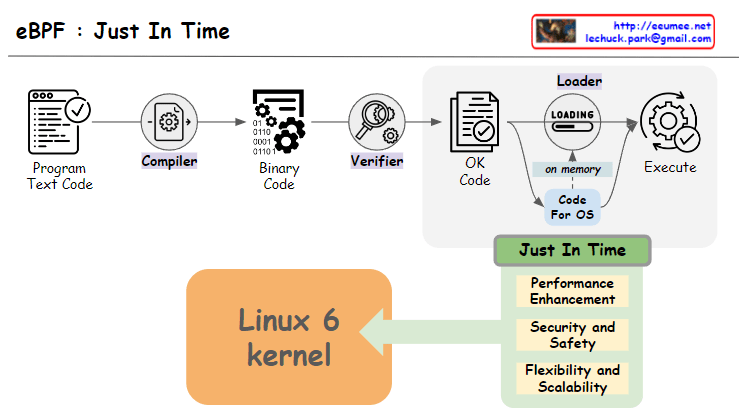
The image underscores the role of Just-In-Time (JIT) compilation in the execution process of eBPF (extended Berkeley Packet Filter) code within Linux Kernel 6. Text code is transformed into binary code via a compiler, followed by verification for security and stability. Once verified, the code is loaded into memory for execution. JIT compilation plays a crucial part in this process by optimizing the code in real-time for enhanced performance. eBPF and JIT compilation have been integrated into Linux Kernel 6, serving as fundamental features that bolster performance, security, flexibility,

Unchanging data

from DALL-E with some prompting
The image illustrates a process of monitoring typically unchanging data to detect system malfunctions. The ‘Traffic / User(s)’ data reflects the relative amount of traffic between two connected users, which generally remains constant. The heat generated by the CPU, as well as electrical elements like voltage and current, are also considered unchanging data in a stable state. A fault detection sensor sends an alert when anomalies are detected in these data points. The ‘Detect it!!’ sensor shows no changes under normal conditions but identifies deviations when an event occurs, enabling a response to potential issues.

maintain 1

From DALL-E with some prompting
The image contrasts the concept of maintaining the number “1” in the digital world versus the real world.

  • In the Digital World: The “1” represented in binary code is said to be very easy to maintain in the digital realm, implying that as long as there is electricity, the data “1” can be precisely preserved.
  • In the Real World: It questions the existence of a perfect “1,” showing values like 0.99999 and 1.00001 around the numerical representation of “1,” suggesting that maintaining an absolute “1” in the real world is challenging.
  • The phrases “Everything is Changed” and “Everything is Connected” at the bottom emphasize that in the real world, everything is subject to change and interconnected.

Overall, the image presents a philosophical inquiry into how the concept of “1” can be applied and interpreted differently between the digital and real worlds. While the digital world can uphold the accuracy and consistency of data, the real world embeds complexities and nuances within the concept of constancy.

Resource Management

From DALL-E with some prompting
The image provides an overview of data management and operational processes within a resource management system. Real resources contain immutable static data, while operational processes handle changeable static data, both supplemented by vital business, historical, and metric data. Notably, the changeable static data is central to operations and requires continuous updating and management for efficient system functioning. The entire process, inclusive of change management, focuses on optimizing operations while maintaining service stability.

AI-Driven Facility Operations Implementation

From DALL-E with some prompting
The image depicts the process of applying operational optimization to machinery using AI-driven data analysis. It emphasizes the necessity of incrementally and step-by-step implementing AI-suggested optimizations while considering operational stability. AI collects and analyzes machine data to propose optimizations, which are then tested and verified in stages before full operational implementation. This approach underlines the importance of minimizing operational risks while effectively deploying AI solutions

ICMP2

From DALL-E with some prompting
The image introduces the overarching functionality of the Internet Control Message Protocol (ICMP). ICMP serves to provide feedback when network equipment cannot further forward packets, explaining the reasons via messages indicating destination unreachable, time exceeded, parameter problems, among others. It also includes the redirect function, suggesting better routing paths between network devices, thus enhancing the overall network efficiency. Fundamentally, ICMP operates on a request and reply structure, which is essential for checking network status and diagnosing issues.

2 Way UP

From DALL-E with some prompting
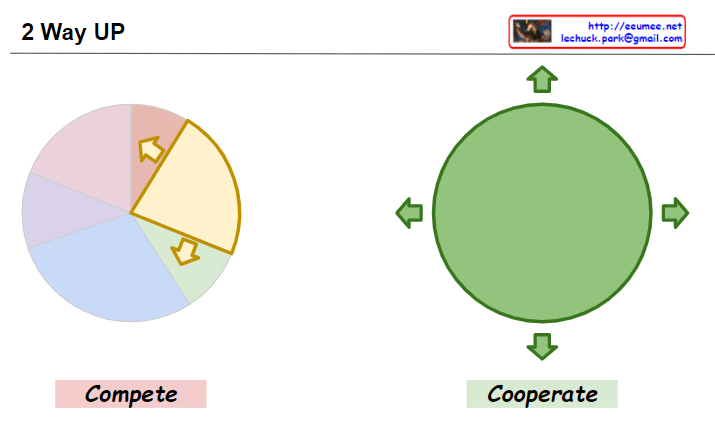
The image depicts two distinct approaches: competition and collaboration. The left circle represents a competitive environment where each colored segment indicates the process of gaining and taking performance from others, with upward arrows symbolizing individual growth through competition. In contrast, the green circle on the right symbolizes collaboration, where everyone works towards a unified goal, indicated by the green color, amplifying the overall performance. The illustration conveys that while competition divides success among individuals, collaboration enhances the collective benefit of the group.