From DALL-E with some prompting The image depicts the process of how knowledge and ideas are defined and how these definitions enable advanced thinking and discussions among people. Information obtained from observations and experiences is documented, and these records evolve into definitions such as words, rules, and formulas. These definitions create the foundation of knowledge, upon which discussions and the exchange of ideas build increasingly complex and advanced thoughts. Ultimately, this process leads to exponential development of knowledge, visualized as an ascending growth chart. Definitions act as the pivot enabling advanced thinking and discourse, leading to continuous learning and innovation.
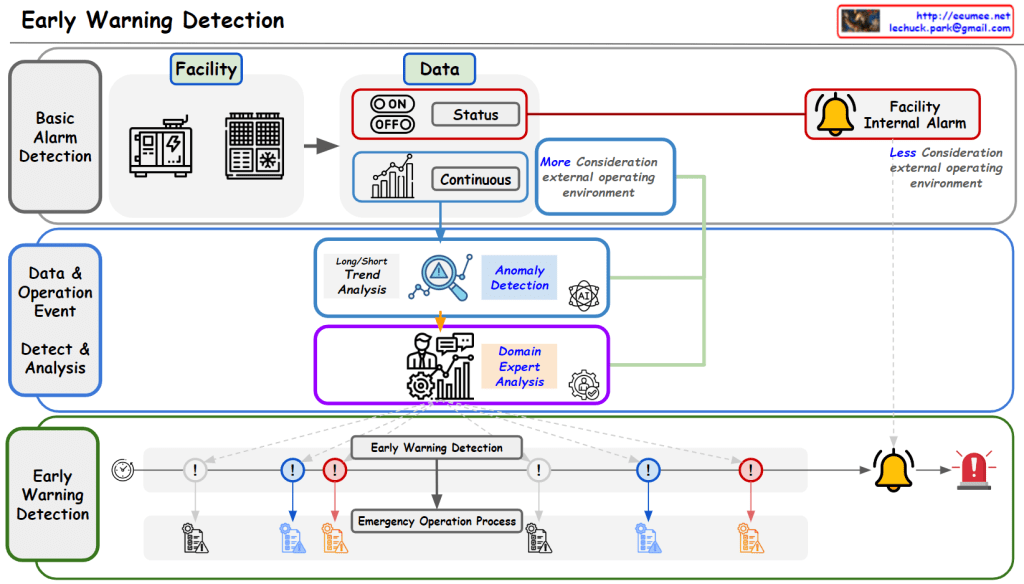
From DALL-E with some prompting This image illustrates the implementation of an advanced alert system in facilities, extending beyond basic equipment alarms to incorporate data-driven anomaly detection, potentially utilizing AI technologies. The system engages domain experts to analyze data patterns, identifying deviations and planning for event-based responses. These events are systematized with defined levels such as alarms or warnings, and corresponding emergency operation processes are established. By considering the external operating environment, this comprehensive system enhances facility stability and operational efficiency.
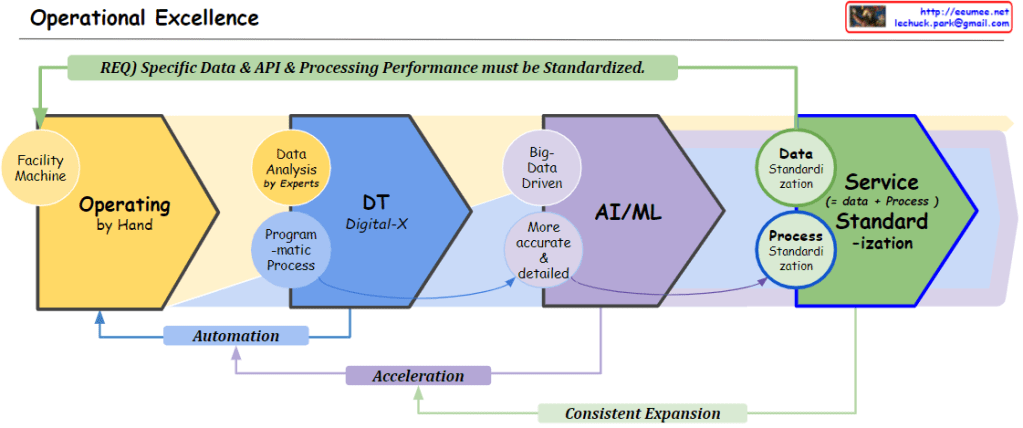
From DALL-E with some prompting The image delineates a progressive digital transformation process aimed at achieving operational efficiency. It comprises four main stages, each incorporating specific elements and influencing improvements in the preceding stages:
Manual Operation (Operating by Hand): This foundational stage involves the hands-on operation of facilities or machinery, focusing on the physical manipulation of equipment.
Digital Transformation (DT): Data derived from manual operations are analyzed by experts and digitized through programmatic processes. This stage fosters automation, enhancing the efficiency and optimization of processes.
AI/ML: The data processed through digital transformation are further analyzed with AI and machine learning technologies, driven by large-scale data to achieve more accurate and detailed insights. These analyses facilitate the acceleration and consistent expansion of processes and services.
Service Standardization: The final stage involves standardizing data and processes based on the insights from AI/ML analysis. Essential for delivering high-quality services, it necessitates a clear definition of necessary data, its integration, and performance parameters from facilities and machinery.
Each of these stages is interdependent, with the arrows at the bottom indicating a feedback loop to the previous stages. For instance, insights from AI/ML promote data standardization, which, in turn, contributes to the improvement of digital transformation and manual operations. This creates a cyclical mechanism where each phase reinforces the others, allowing for continuous enhancement of the overall system.
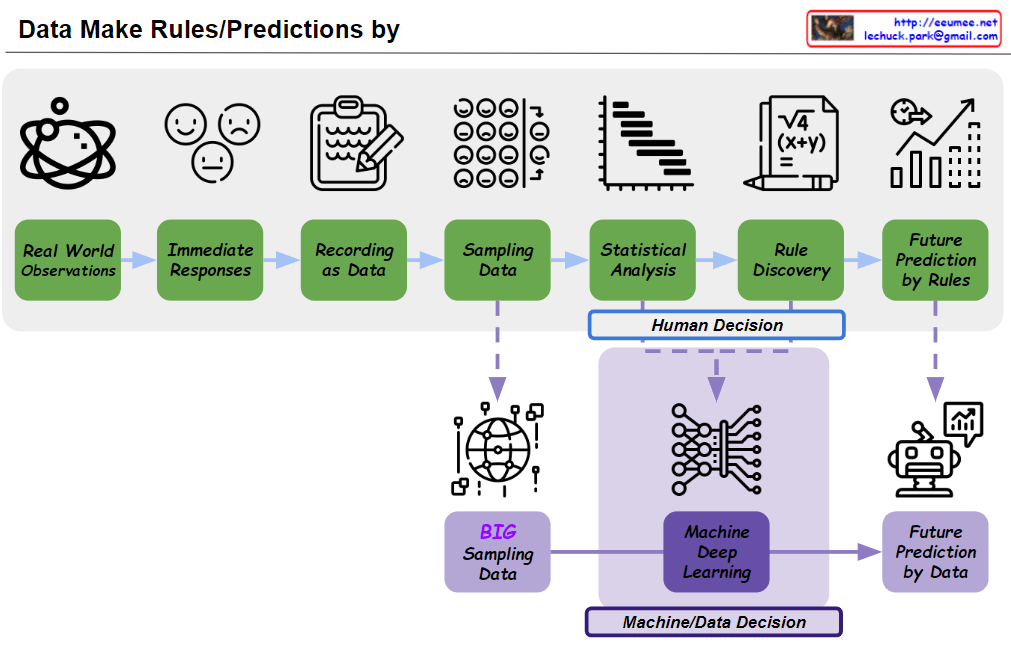
From DALL-E with some prompting The image depicts the evolution of the decision-making process from data collection to conclusion. Where decisions were once made entirely by humans before the advent of AI/ML, the progress in big data processing and machine learning/deep learning now allows machines or the data itself to make decisions. Initially, the process was human-centric, starting from real-world observations to data recording, followed by statistical analysis and rule discovery to predict the future. With advancements, we now extract large samples from large datasets and utilize deep learning to recognize complex patterns, leading to a machine-centric process that predicts the future based on data. This shift emphasizes the power of data and the significance of machine learning.
From DALL-E with some prompting The image illustrates a comparison between the costs associated with spinlocks and context switching. It contrasts the ‘waiting cost’ incurred when a process is on hold while another process monopolizes a CPU core, with the ‘switching cost’ that arises from transitioning between processes. Spinlocks represent the waiting cost as a process continually attempts to access the CPU, thereby avoiding unnecessary context switches and increasing efficiency. Particularly in multi-CPU environments, the system underscores the ability to handle multiple processes efficiently without the need for operating system-induced switching.
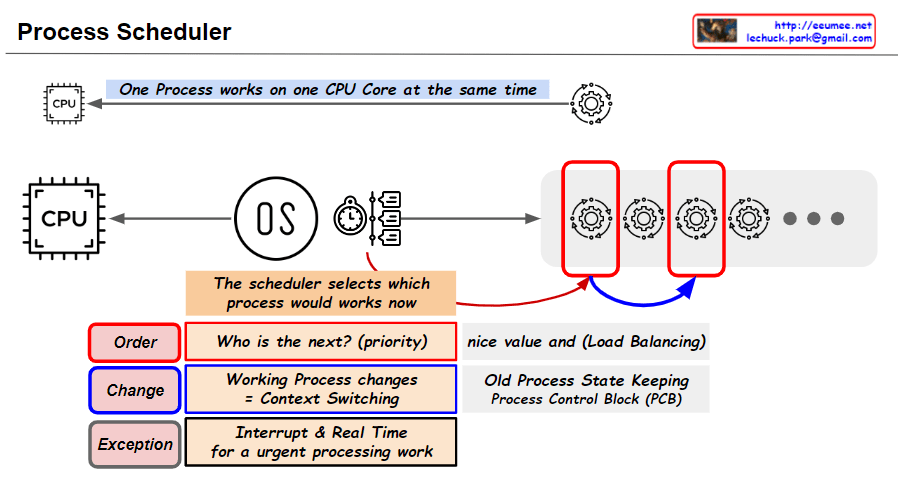
From DALL-E with some prompting The image highlights the essential mechanisms of process scheduling to share a single CPU core resource among multiple processes. The scheduler determines the order of processes to be executed based on priority and changes the current running process through context switching. Additionally, it promptly addresses exceptions requiring urgent processing through interrupts and real-time handling. This scheduling approach ensures efficient allocation of CPU resources and stable operation of the system.



 Lechuck Park