From the coding

From DALL-E with some prompting
This diagram illustrates the journey from the basics of coding to the creation of digital solutions that meet the requirements of the real world. It begins with an understanding of the fundamental syntax of programming, progressing to knowledge of system calls, operating systems and kernels, computer architecture, and the workings of hardware. This technical acumen is combined with the roles of digital experts, programming experts, and system experts who transform client and business requirements into digital solutions. This process involves specific data models, system architecture and design, framework APIs, and database management. Overall, the diagram describes the comprehensive process of developing digital services, starting from coding and extending to advanced technical understanding in network architecture, engineering, and packet management.

Leetcode 1582. Special Positions in a Binary Matrix

From ChatGPT4 < image interpretation>
The image presents a problem statement and a solution approach for identifying special positions in a binary matrix from a programming challenge. The task is to find positions in the matrix where the value is ‘1’, and all other values in the same row and column are ‘0’. The solution involves three steps:

  1. Interpretation: It involves identifying the type of ‘1’ cells that are unique in their row and column with no other ‘1’s in any of the four quadrant directions.
  2. Creating ‘1’ count maps: This step counts the number of ‘1’s in each row and column to create horizontal and vertical direction maps.
  3. Final count: It counts the cells that contain a ‘1’ and checks if there are no other ‘1’s in the corresponding horizontal and vertical directions.

The code snippets provided outline the loops and conditions used to implement this logic in a programming language.

Digital Service

From DALL-E with some prompting
The image outlines the workflow and components of digital data services. It begins with data collection from various sources, which is then subjected to a verification process to ensure its integrity. The verified data is stored in a database and undergoes the ETL process (Extract, Transform, Load) to be formatted appropriately for analysis. This data is visualized to facilitate insightful analysis, which then feeds into an AI learning process. The outcomes of this analysis are applied in the service stage where established processes are confirmed and automation tools are implemented to deliver the final service. The AI model, refined by learning from the data, plays a critical role in enhancing the precision and efficiency of the service provided.

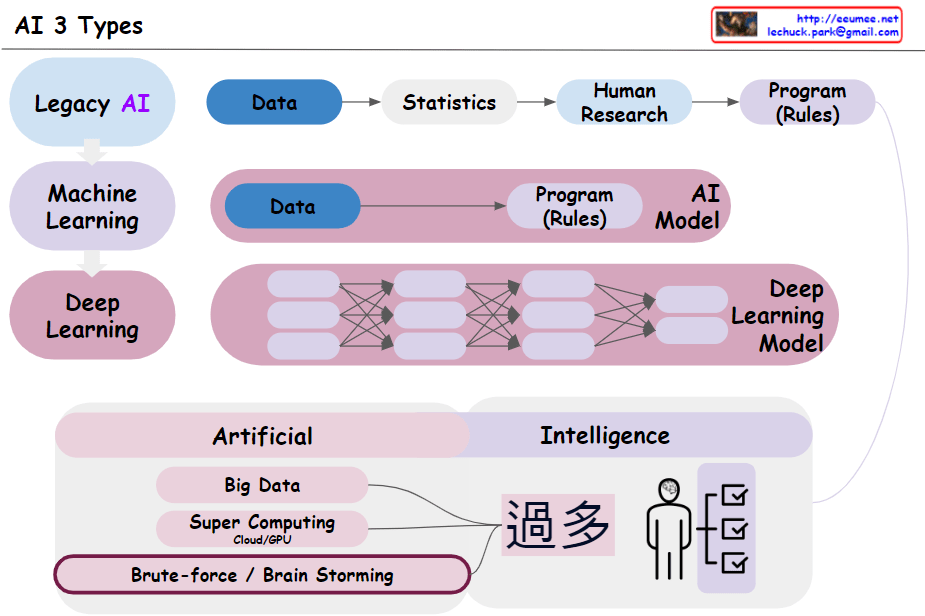
AI 3 Types

From DALL-E with some prompting
The image depicts the three stages of AI forming artificial intelligence through repeated classification tasks based on data:

  1. Legacy AI derives statistics from data and transforms them into rule-based programs through human research.
  2. Machine Learning evolves these rules into AI models capable of executing more complex functions.
  3. Deep Learning uses deep neural networks to process data and create complex models that perform cognitive tasks.

In this process, AI leverages extensive data for repetitive classification tasks, and the result is what we refer to as ‘intelligence.’ However, this intelligence is not an emulation of human thought processes but rather a product of data processing and algorithms, which qualifies it as ‘artificial intelligence.’ This underlines that the ‘artificial’ in AI corresponds to intelligence derived artificially rather than naturally through human cognition.

AI driven Machine Operation Optimization 

From DALL-E with some prompting
The image illustrates an AI-driven approach to machine operation optimization, with a detailed operation plan that incorporates expert risk assessments. The process is structured as follows:

  1. AI Guide:
    • AI recommends strategies for optimizing operations, including metrics like the number of operations, operating ratio, and load balancing.
  2. Operation Plan:
    • This section emphasizes the creation of a comprehensive operation plan that includes expert assessments of risk and importance in case of failures, alongside safety and emergency response strategies. It also suggests a methodical plan for incrementally applying AI to operations.
  3. Operation Risk and Step-by-Step Operation Expansion:
    • It involves managing operational risks identified by domain experts and the systematic expansion of operations using AI guidance. The gradual application of AI is based on expert risk assessments, leading to a refined approach to risk management and the transformation of operations towards AI-driven processes.

In summary, the key to successfully optimizing operations through AI involves leveraging the expertise of domain professionals to assess risks and guide the step-by-step implementation of AI strategies, ensuring operations are both efficient and secure. 

Digitization

From DALL-E with some prompting
The image illustrates the concept of digitization. It shows an analog signal being converted into a digital format, represented by a sequence of binary numbers. The process emphasizes the importance of accuracy and precision in digitization, noting that even small errors in digitizing the signal can lead to significant computing errors. Therefore, maintaining high accuracy and precision is marked as important to ensure the integrity of the huge computing tasks that rely on the digitized data.