Development

From DALL-E with some prompting
This image simplifies the development process into a cycle. On the left, the term ‘Development’ is associated with an icon featuring gears and arrows, indicating a repetitive process. To the right, there are three stages depicted: ‘Do it’, ‘Result’, and ‘Modify’. This illustrates the cycle of executing plans, reviewing the outcomes, and making necessary adjustments repeatedly throughout the development process. The key takeaway is that progress in development is ultimately measured by the number of modifications made. Essentially, the extent of advancement is contingent on recognizing failures and how frequently they are addressed and corrected.

Scaling

From DALL-E with prompting
This image visualizes the auto-scaling mechanisms within cloud computing. ‘Scale UP’ represents enhancing the resources of a single system, while ‘Scale DOWN’ indicates reducing resources. ‘Scale OUT’ depicts horizontal expansion by adding servers to the system, and ‘Scale IN’ illustrates horizontal contraction by removing unnecessary servers. These actions are automatically executed based on software requirements, virtualization technologies, cloud infrastructure, and performance analysis. This is essential for effectively adjusting cloud resources when application loads vary, maintaining performance, and managing costs.

Digitalization

From DALL-E with some prompting
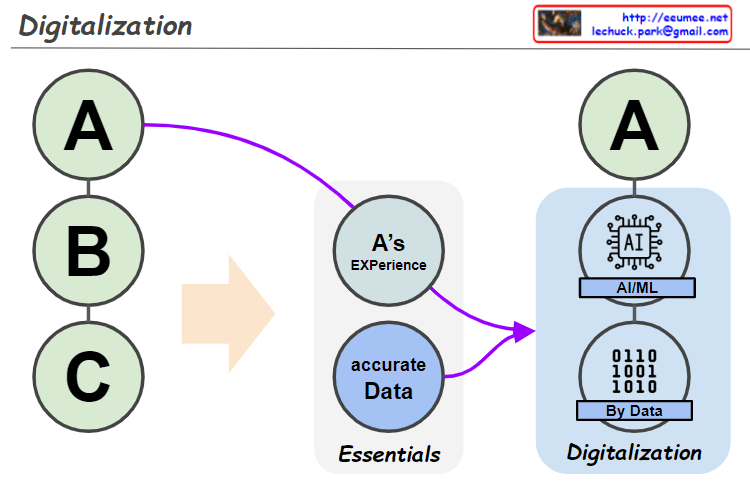
The image depicts three levels of experience, A, B, and C, highlighting that while A represents a high level of experience, levels B and C can be enhanced through digital transformation using data and AI technologies. This transformation underscores that the collection and analysis of accurate data are essential elements, as they lay the foundation for AI systems to perform sophisticated learning, thus improving operational efficiency and precision.

The integration of individual experiences and precise data is not merely a technical shift but also prompts significant changes in human resource management within organizations. By incorporating their expertise into digital platforms, employees can strengthen the organization’s knowledge base and contribute to their own professional development.

Ultimately, this digital transformation should be sustainable and maintain a human-centric approach, ensuring that the increase in operational efficiency through AI alleviates the workload on employees, fostering creativity and enhancing the organizational culture and values.


one step for the goal

From DALL-E with some prompting

The image symbolically represents the process of progressing towards achieving a goal.

The phrase “One Step for the Goal” suggests the beginning of a journey or process towards goal attainment.

  • On the left, there is a silhouette of a person taking a step forward.
  • Between the person and the goal (a target depicted on the right end), there is a blue line symbolizing the path towards achieving the goal.
  • Along the path, there are two symbols:
    • On the lower part, a small star-like symbol, which could represent an initial idea, step, or the moment something begins.
    • Above it, there’s a ghost-like symbol that could signify challenges or obstacles.

Putting these elements together, the image can be interpreted to show that an individual’s journey towards a goal involves overcoming challenges or obstacles that arise after the initial idea or motivation. The target represents the final goal, the path symbolizes the journey to that goal, and the overall image conveys the message that challenges are part of the road to success.

with AI

from DALL-E with some prompting
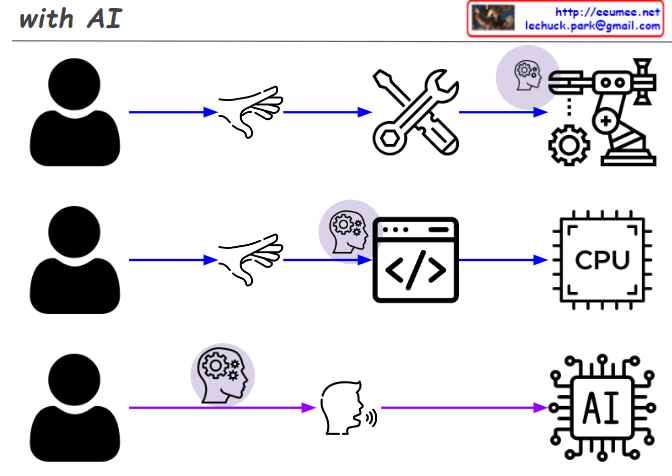
The image illustrates three ways in which humans interact with AI. In the first scenario, a person passes on information that leads another to use tools to operate a machine. In the second scenario, a person inputs programming code into a computer, and this information is processed by the CPU. The third scenario, which is particularly noteworthy, shows that human voice commands are directly processed by AI. Notably, the brain diagram highlighted within a blue circle indicates that human brain activity plays a significant role at the initial stage of AI interaction, with AI immediately interpreting and responding. This emphasizes the AI technology’s capability to understand and apply human thought processes in real-time.

OSPF & BGP

from DALL-E with some prompting
The image is an illustrative diagram explaining the interaction between two key protocols used in networking: OSPF (Open Shortest Path First) and BGP (Border Gateway Protocol).

  • In the center, we have a network labeled “AS (Autonomous System)” which is a collection of connected IP routing prefixes under the control of one or more network operators that presents a common, clearly defined routing policy to the internet.
  • Within the AS, the diagram shows a smaller network with purple lines connecting different nodes (routers), representing the OSPF protocol. OSPF is an interior gateway protocol used within an AS that distributes routing information between routers belonging to a single Autonomous System. The key features listed are:
    • “Sharing Link State (broadcast)” which means OSPF routers send link state advertisements to share the state of each directly connected link.
    • “with a Bandwidth” indicates that OSPF takes bandwidth into account when calculating the best route.
    • “Find Short Path (Dijkstra)” refers to OSPF using Dijkstra’s algorithm to find the shortest path through the network based on the cumulative cost of reaching each node.
  • On the right side of the diagram, there’s a larger network outlined in red, with blue lines connecting to a central node. This represents the BGP protocol, which is used between different ASes, especially at the borders. The features listed for BGP are:
    • “Border (of the AS) Gateway” which is the point where an AS connects to another AS.
    • “Sharing Routing Table between Border Gateways” means that BGP is responsible for exchanging routing information between autonomous systems, allowing them to see each other’s networks and determine the best paths.

The diagram uses solid lines to denote direct connections and dashed lines for indirect connections. The interplay between OSPF and BGP is critical for the overall functioning of the internet, with OSPF managing routes within an AS and BGP managing routes between ASes.

Digital Twin

From DALL-E with some prompting
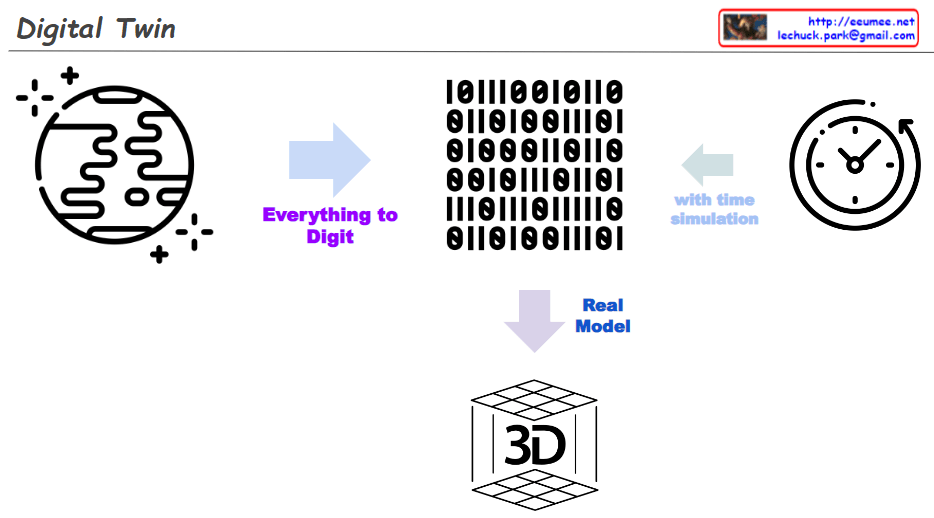
This image depicts a conceptual diagram for a “Digital Twin.”

  • In the top left, there’s an icon representing a physical object, resembling the Earth with dots and lines, indicating complexity and connectivity.
  • A rightward arrow from the object leads to a phrase “Everything to Digit,” suggesting the transformation of a physical object into digital data.
  • The top right block is filled with binary codes, representing digital information.
  • Next to this block, there’s an icon of a clock with the phrase “with time simulation,” indicating the process includes temporal changes or predictions over time.
  • An arrow points downward to the phrase “Real Model,” signifying the creation of a practical model from the digital information and simulations.
  • At the bottom, there’s a 3D cube labeled “3D,” symbolizing the digital twin’s realization as a three-dimensional model.

A digital twin is a virtual replica of a physical object or system, bridging the physical and digital worlds. It can be used for real-time analytics, system monitoring, troubleshooting, and predictive maintenance. The diagram visually represents the process of creating a digital twin, omitting personal or organizational contact information that is present in the image.