BGP Flow

From Gemini with some prompting
Example Presentation Script

  1. BGP Session Overview

Hello everyone. Today, we will delve into the details of the BGP session establishment process. BGP is an internet routing protocol that facilitates the exchange of routing information between different autonomous systems. Establishing a stable BGP session is critical for efficient traffic forwarding across the internet.

  1. TCP Connection Establishment

A BGP session commences with a TCP 3-way handshake on port 179. After establishing a reliable connection, the session proceeds to the Open message exchange phase to negotiate the fundamental parameters for the BGP session.

  1. Open Message Exchange and Keepalive Message Exchange

The Open message exchange establishes BGP parameters such as version, autonomous system number, and Hold Timer. Hold Timer defines the session’s inactivity timeout. Keepalive messages maintain the connection by periodically exchanging messages. If no Keepalive message is received within the Hold Time, the session terminates.

  1. Update Message Transmission and Path Selection

The core of the BGP session lies in the Update message transmission. Update messages contain new, modified, or withdrawn routing information. They include network, next hop, and path attribute information, enabling routing table updates and optimal path selection.

  1. Withdrawal Message and Loop Prevention

Obsolete routing information is announced through Withdrawal messages and subsequently removed from the routing table. AS path information prevents routing loops and allows each AS to control the exchanged routing information.

  1. Conclusion

The BGP session establishment process comprises TCP connection establishment, Open message exchange, Keepalive message exchange, Update message transmission, path selection, Withdrawal message, loop prevention, and policy enforcement. This process ensures a stable BGP session and facilitates efficient routing information exchange.

Data handing

From Gemini with some prompting
Image Interpretation: Using AI, Deep Learning, and Quantum Computing for Data Analysis to Drive Future Advancement

  1. Limitations of Data Interpretation: Human Effort and Computing

Humans have traditionally interpreted data through note-taking and computing.
However, human interpretation capabilities have reached their limits as data volumes have grown.

  1. AI, Deep Learning, and Quantum Computing: New Possibilities for Data Interpretation

Advances in Artificial Intelligence (AI), Deep Learning, and Quantum Computing technologies have opened up new possibilities for data interpretation.
These technologies can analyze data much faster and more accurately than humans.

  1. Next Step Advancement through Data Analysis

Data analysis using AI, Deep Learning, and Quantum Computing technologies can lead to advancements in the following areas:
Scientific Research: New drug development, new material development, environmental problem solving, etc.
Healthcare: Disease diagnosis and treatment, personalized healthcare services, etc.
Industry: Production efficiency improvement, new product development, new business model discovery, etc.
Society: Social problem-solving, policy decision support, safety and security reinforcement, etc.

  1. Conclusion: Data Analysis, the Key to the Future

Data analysis using AI, Deep Learning, and Quantum Computing technologies will be the key driver of future development.
Through data analysis, we can create a better future.

From DALL-E with some prompting
The image conceptualizes the evolution and advancement in data processing. Initially, data understandable at a human level is processed using traditional note-taking and computing methods. This is represented by a simple binary code and is processed using tools symbolized by the human brain and computers.

However, the emergence of larger and more complex datasets necessitated new tools that extend beyond human processing capabilities. As illustrated at the bottom of the image, an extended binary code represents the data that must be handled by advanced tools based on Artificial Intelligence (AI), Deep Learning, and Quantum Physics. This data format is interpretable by machines, specifically AI created by humans.

These advanced tools enable the meaningful analysis of complex data, leading to the “Analysis & Development” stage depicted on the right side of the image. This signifies how insights derived from the processing are used to solve real-world problems and drive new developments.

Therefore, this image is more than a description of data processing methods; it provides an overview of how modern technologies are managing massive datasets and how the resulting analyses can lead to tangible advancements and development goals.

Load balancing

From DALL-E with some prompting

Direct Analysis and Distribution:

Traffic flows directly from a group of users to a group of servers.
This traffic can be distributed based on static information such as TCP/IP headers, user IP/Port, etc., through a “Static hash map.”
Alternatively, “Dynamic Analysis Traffic” can be used to distribute the load based on throughput or service load.
These processes require guidelines on “How to Control” and “How to Analysis.”
Pre-connection Routing Change:

The CDN Load Balance (GLBS) operates differently based on User IP and Request URL.
It controls responses through “nice destination IP return” or “BGP advertisement Routing Control,”
Or distributes traffic through “Response redirect URL.”
All these processes are executed through a Control phase.

Anomaly IP Packet header

From Gemini with some prompting
Title: Anomaly Detection (IP Packet Header)

Overview:

The image illustrates the structure of an IP packet header and how to detect anomalous activities based on TCP/IP header information.

Key Elements:

  • IP Address: Identifies the server.
  • TCP/UDP Port: Used to send and receive packets.
  • Service Port Number: Port number used to connect to a specific service.
  • Service Area: IP address range where a specific service is provided.

Indicators of Anomalous Activity:

  • Unknown IP: Packets coming from unknown IP addresses.
  • Foreign IP: Packets coming from overseas IP addresses.
  • Unused Port: Packets sent to unused ports.
  • TCP/UDP Port == 0: Packets with TCP/UDP port number 0.
  • IP/TCP Checksum == 0: Packets with IP/TCP checksum 0.
  • Unused IP Protocol: Packets using unused protocols.
  • Too Large (IP.ttl): Packets with excessively large TTL values.
  • Too Many (TCP Syn): Excessive number of SYN packets.
  • Too Many (IP. fragmented): Excessive number of fragmented packets.

Leetcode 234.Palindrome Linked List

From DALL-E with some prompting
Scenario:

  • Linked-List: You can only read one element at the same time.
  • Memory Map: Allows direct access to all data.
  • Optimization: There are 2 key points to optimize:
    • Point 1: Find out the center of the list.
    • Point 2: Reverse the ordering of the second half of the list and compare it with the first half.
    The diagram illustrates two examples with nodes that show how you would first read all data (in the Linked-List), then direct access allows you to compare elements starting from the ends towards the center (in the Memory Map). For optimization, the steps include finding the center of the list, reversing the order of the second half of the list, and then comparing the two halves to determine if the list is a palindrome.

My own AI agent

From DALL-E with some prompting
This image appears to be a conceptual diagram of an individual’s AI agent, divided into several parts:

  1. Personal Area: There’s a user icon with arrows labeled ‘Control’ and ‘Sensing All’. This suggests the user can direct the AI agent and the AI is capable of gathering comprehensive information from its environment.
  2. Micro & Macro Infinite World: This part features illustrations that seem to represent microorganisms, plants, butterflies, etc., indicating that the AI collects data from both microscopic and macroscopic environments.
  3. Personalized Resource: The icon resembling a human brain could represent personalized services or data tailored to the user.
  4. Cloud Infra: The cloud infrastructure is presumably responsible for data processing and storage.
  5. Cloud Service: Depicted as a server providing various services, connected to the cloud infrastructure.
  6. Internet Connected: A globe icon with various network points suggests that the AI agent is connected to global information and knowledge via the internet.

Overall, the diagram illustrates a personalized AI agent that collects information under the user’s control, processes it through cloud infrastructure and services, and ultimately contributes to collective intelligence through an internet connection.

How to see the back

From DALL-E with some prompting
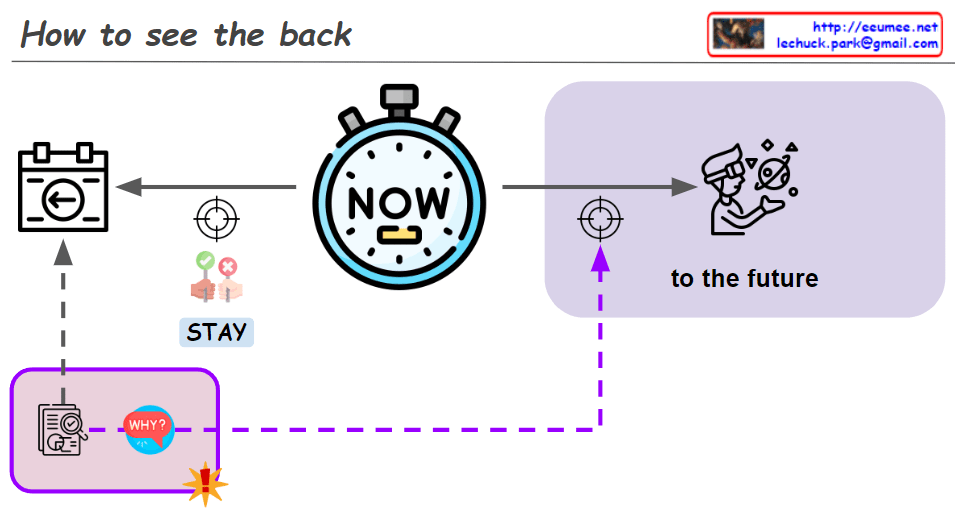
The modified image displays a diagram titled “How to see the back” which seems to represent a conceptual understanding of time. At the center, there is a stopwatch labeled “NOW,” indicating the present moment. A line extends from the stopwatch to the left toward a camera icon, representing the past. From the camera, another line descends to a house icon with the word “STAY,” suggesting that focusing solely on the past may result in staying in the present without progress.

To the right of the stopwatch, the diagram states “to the future” and includes an icon of a person in a spacesuit boarding a spacecraft, symbolizing the journey into the future.

The key element here is a dotted line descending from the camera icon, accompanied by the question “WHY?” This signifies a sense of inquiry or exploration into the events of the past. The implication is that by analyzing and understanding the past from the perspective of “why” things happened, one can begin to move toward the future.

Thus, the diagram seems to convey that a deep, analytical understanding of past events—asking “why”—is necessary to effectively design and move towards the future. It expresses the idea that we must analyze the past with depth to pave the way forward.