IF/THEN with AI/DT

From DALL-E with some prompting
The image depicts the evolution of decision-making processes from manual to automated, facilitated by AI and Digital Transformation (DT). Initially, decisions were made by humans based on specific conditions (IF condition THEN action). This manual approach did not involve computing. With DT, the process becomes automated through computing, making it faster and more efficient. The transition to AI and Machine Learning (ML) marks a further evolution where decisions are not just automated but are also data-driven, increasing accuracy and the ability to adapt to complex situations. The visual suggests a shift from human-based decision-making to a more sophisticated, automated, and intelligent system of processing and action-taking, indicative of modern advancements in technology.

Definitions for The MORE NEXT DEVELOPMENT

From DALL-E with some prompting
The image depicts the process of how knowledge and ideas are defined and how these definitions enable advanced thinking and discussions among people. Information obtained from observations and experiences is documented, and these records evolve into definitions such as words, rules, and formulas. These definitions create the foundation of knowledge, upon which discussions and the exchange of ideas build increasingly complex and advanced thoughts. Ultimately, this process leads to exponential development of knowledge, visualized as an ascending growth chart. Definitions act as the pivot enabling advanced thinking and discourse, leading to continuous learning and innovation.

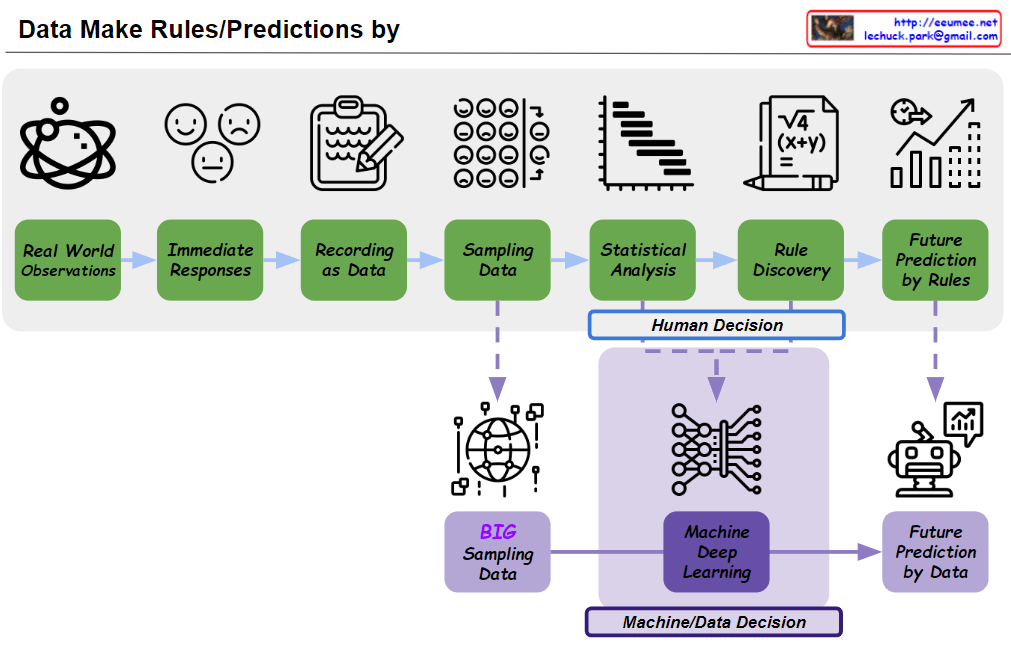
Data Make RULES

From DALL-E with some prompting
The image depicts the evolution of the decision-making process from data collection to conclusion. Where decisions were once made entirely by humans before the advent of AI/ML, the progress in big data processing and machine learning/deep learning now allows machines or the data itself to make decisions. Initially, the process was human-centric, starting from real-world observations to data recording, followed by statistical analysis and rule discovery to predict the future. With advancements, we now extract large samples from large datasets and utilize deep learning to recognize complex patterns, leading to a machine-centric process that predicts the future based on data. This shift emphasizes the power of data and the significance of machine learning.

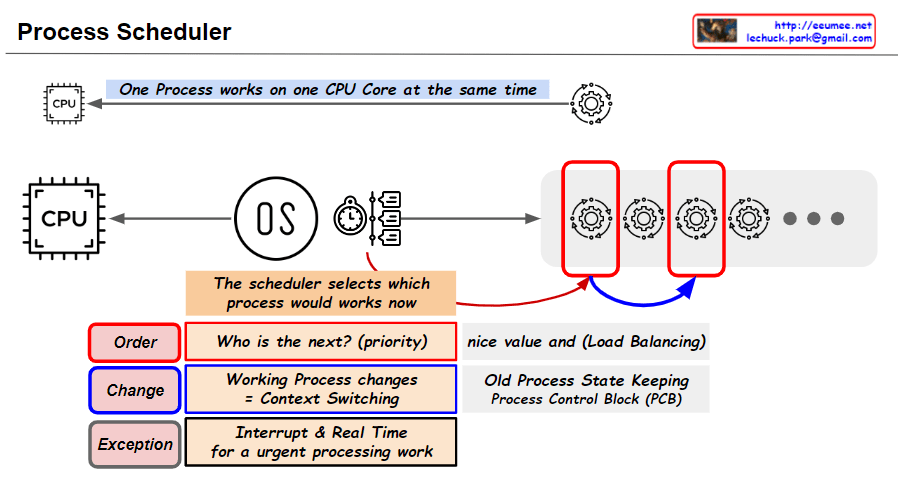
Process scheduler

From DALL-E with some prompting
The image highlights the essential mechanisms of process scheduling to share a single CPU core resource among multiple processes. The scheduler determines the order of processes to be executed based on priority and changes the current running process through context switching. Additionally, it promptly addresses exceptions requiring urgent processing through interrupts and real-time handling. This scheduling approach ensures efficient allocation of CPU resources and stable operation of the system.

maintain 1

From DALL-E with some prompting
The image contrasts the concept of maintaining the number “1” in the digital world versus the real world.

  • In the Digital World: The “1” represented in binary code is said to be very easy to maintain in the digital realm, implying that as long as there is electricity, the data “1” can be precisely preserved.
  • In the Real World: It questions the existence of a perfect “1,” showing values like 0.99999 and 1.00001 around the numerical representation of “1,” suggesting that maintaining an absolute “1” in the real world is challenging.
  • The phrases “Everything is Changed” and “Everything is Connected” at the bottom emphasize that in the real world, everything is subject to change and interconnected.

Overall, the image presents a philosophical inquiry into how the concept of “1” can be applied and interpreted differently between the digital and real worlds. While the digital world can uphold the accuracy and consistency of data, the real world embeds complexities and nuances within the concept of constancy.

Resource Management

From DALL-E with some prompting
The image provides an overview of data management and operational processes within a resource management system. Real resources contain immutable static data, while operational processes handle changeable static data, both supplemented by vital business, historical, and metric data. Notably, the changeable static data is central to operations and requires continuous updating and management for efficient system functioning. The entire process, inclusive of change management, focuses on optimizing operations while maintaining service stability.

AI-Driven Facility Operations Implementation

From DALL-E with some prompting
The image depicts the process of applying operational optimization to machinery using AI-driven data analysis. It emphasizes the necessity of incrementally and step-by-step implementing AI-suggested optimizations while considering operational stability. AI collects and analyzes machine data to propose optimizations, which are then tested and verified in stages before full operational implementation. This approach underlines the importance of minimizing operational risks while effectively deploying AI solutions