DT for new biz

From DALL-E with some prompting
The image is a diagram that illustrates the process of digital transformation for discovering new business opportunities through the digitization of data center operations. The stages included are as follows:

  1. Digitization: The initial step of converting data into digital form.
  2. Digitalization: The process of enhancing operational know-how and creating new value through the experience and analysis with AI, as indicated by the phrases “Exp & Analysis with AI” and “Selling EXP and more!!”.
  3. Digital Transformation: The stage where insights and ideas gained from digitalization are actualized into new business changes.

At the bottom of the diagram, the phrase “All New for DC By Digital(data)” is accompanied by four boxes labeled Design, Deployment, Operating, and Customer. This indicates that all components of business operations are undergoing new changes based on digital data. The “NEW” marker emphasizes the new business opportunities that arise through digital transformation.

The diagram visually explains how transforming existing data into a digital format and using technologies like AI for analysis can improve operational knowledge and, as a result, generate and implement new business ideas. It specifically highlights that digital transformation in data center operations can provide opportunities for uncovering new business ventures.

Priority

From DALL-E
The image is a visual representation of task prioritization and management. It comprises various elements that communicate the challenges and strategies of handling multiple tasks effectively:

  1. Multi-Tasking NOT EASY: This indicates that juggling multiple tasks is challenging, and one task could be affected by another, implying the potential for decreased efficiency or interference.
  2. So. The Focusing is required.: It emphasizes the need for focus, suggesting that concentrating on specific tasks is essential for successful completion.
  3. First! Need to find out Which is more priority.: This statement highlights the importance of determining which task has the highest priority to address it appropriately.
  4. Managing with Data.: It suggests that data management is a crucial part of prioritizing and executing tasks.

On the right side, there is a list numbered 1 to 5, indicating a ranked list of tasks:

  • Number 1 is circled, with an arrow pointing to it and the phrases “DO IT” and “Do it Now!!”, stressing the urgency of tackling the most important task immediately.
  • Number 5 has a question mark next to it, and the phrase “Keep it for the future more details.”, suggesting that the lowest priority task may be deferred until more information is available or it becomes more relevant.

The bottom right corner has an “X” symbol with the text “without interruption”, indicating the importance of completing the top priority task without distractions or interruptions. The overall message of the image is to prioritize tasks, focus on the most critical one, manage tasks based on data, and execute them without disruption for effective productivity.

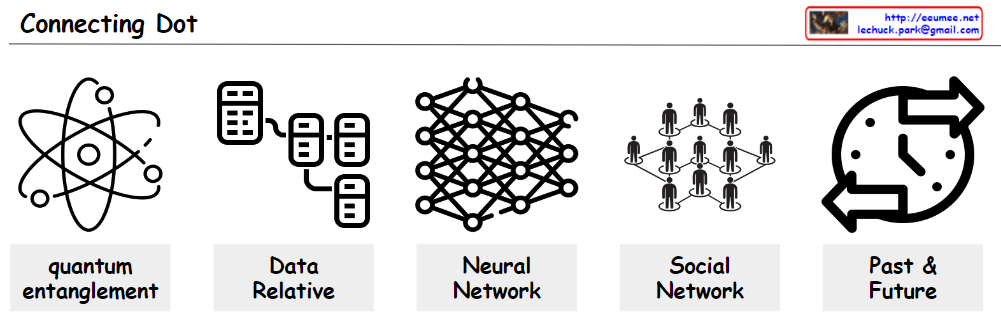
Connecting Dot

From DALL-E with some prompting
The image demonstrates how various distinct concepts are interconnected, emphasizing that all items are linked. ‘Quantum entanglement’ depicts particles whose states are interconnected regardless of physical distance, while ‘Data Relative’ represents the interactions between data. ‘Neural Network’ illustrates an AI model that learns complex data patterns, and ‘Social Network’ symbolizes the web of human relationships. Lastly, ‘Past & Future’ symbolizes the continuous changes occurring over time. All these concepts are interlinked, suggesting that new insights and innovations can arise from understanding these connections.

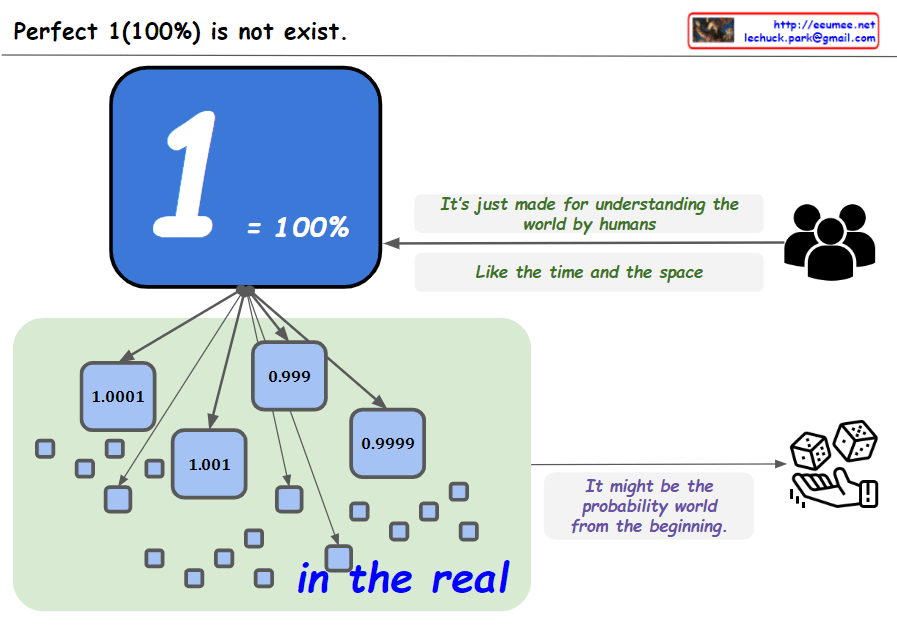
Perfect 1 ??

From the bard with some prompting
The image you provided consists of 10 squares with numbers from 1 to 0.9999, along with the phrase “Perfect 1 (100%) does not exist.”

The image conveys the message that perfection is impossible. The 10 squares represent 100%, but it is impossible to reach 100%, no matter how close we get. The number 0.9999 in the last square shows that it is close to perfection, but ultimately not perfect.

The image can also convey the message that the real world is uncertain and unpredictable. There is nothing that we can be 100% sure of, and there is always some uncertainty.

Finally, the image can convey the message that we are always growing and learning. The numbers from 1 to 0.9999 show that we are always getting closer to perfection, but we are never perfect.

The image is an open image that can be interpreted in many ways. Each individual can interpret the image according to their own experiences and values.

Here are some specific interpretations of the image:

Perfection is impossible: No matter how hard we try, we will never be perfect. There will always be room for improvement.
The real world is uncertain: There is always some risk or uncertainty in life. We cannot control everything that happens.
We are always growing and learning: We are constantly learning and evolving. We can always strive to be better.
Ultimately, the meaning of the image is up to the individual to decide.

Scalar, Vector, Matrix, Tensor

From DALL-E with some prompting
This image appears to be a diagram explaining the concepts of scalar, vector, matrix, and tensor in the context of dimensions and data structures:

Scalar: Represented as a zero-dimensional entity and is simply a single value that exists.
Vector: Shown as one-dimensional, it is depicted as an arrow, indicating a feature or a point with direction and magnitude.
Matrix: Illustrated as two-dimensional, like a grid, representing connected data points.
Tensor: Described with ‘N dimension’, suggesting a complex structure where all elements are interconnected, like a network of points extending beyond two dimensions. This progression shows how data structures become more complex and capable of representing more intricate relationships as the number of dimensions increases.

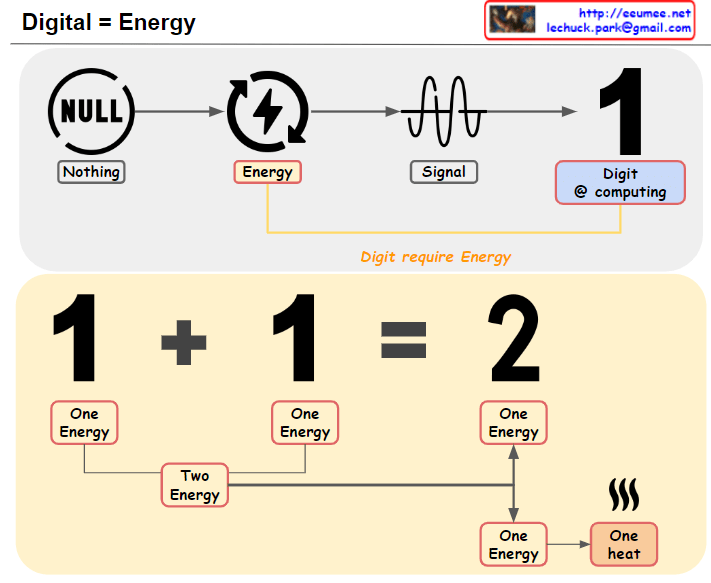
Digital = Energy

From DALL-E with some prompting
this image illustrates the concept that “Digital equals Energy.” The first row shows the transformation from ‘NULL’, which represents nothingness, into a signal through energy, and then into a digital ‘1’ for computing. The second row demonstrates that digital operations require energy by showing that adding ‘1’ and ‘1’ results in ‘2’, with each ‘1’ requiring a unit of energy and the process generating heat, indicating energy loss.