Works with data

From DALL-E with some prompting
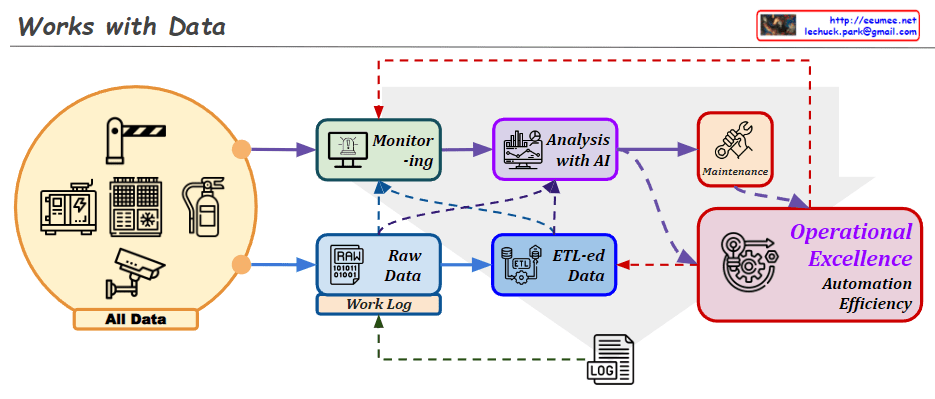
The image describes a data workflow process that involves various stages of data handling and utilization for operational excellence. “All Data” from diverse sources feeds into a monitoring system, which then processes raw data, including work logs. This raw data undergoes ETL (Extract, Transform, Load) procedures to become structured “ETL-ed Data.” Following ETL, the data is analyzed with AI to extract insights and inform decisions, which can lead to actions such as maintenance. The ultimate goal of this process is to achieve operational excellence, automation, and efficiency.
Service cycle

From DALL-E with some prompting
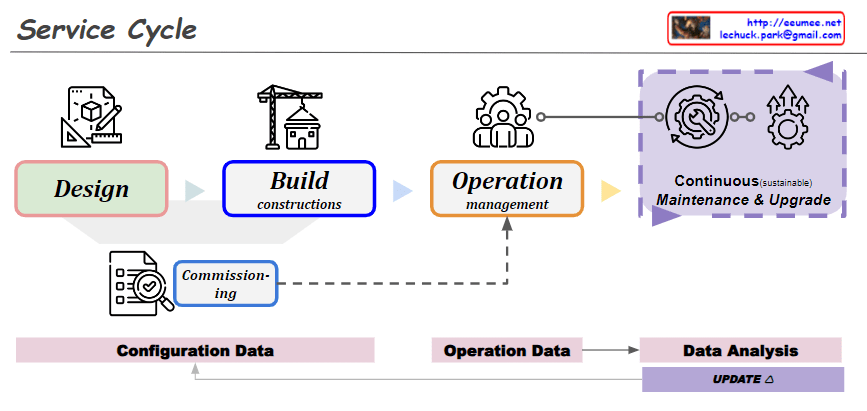
The image depicts a “Service Cycle” comprising several phases in a service’s lifecycle. These phases are visually represented and include “Design,” “Build constructions,” and “Operation management.” Additionally, the cycle includes “Commissioning” and “Continuous (sustainable) Maintenance & Upgrade” stages, emphasizing the ongoing process of maintaining and upgrading services. The flow of information through “Configuration Data,” “Operation Data,” and “Data Analysis” is also presented, highlighting the importance of data in managing and improving service operations.

Difference

From DALL-E with some prompting
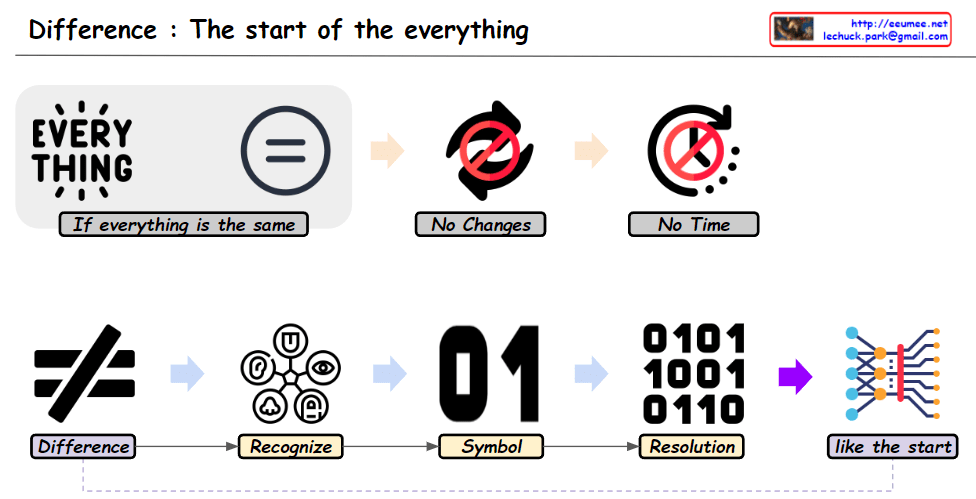
The image represents how AI approaches differences using infinite computing power, akin to recognizing the initial differences that sparked evolution. It shows that without variation (“EVERYTHING” icon), there is no concept of change or time, but differences lead to recognition (“Recognition”), which evolves into symbolization (“Symbol”) and understanding through resolution (“Resolution”). As complexities grow, so does our interpretative capacity, and now AI retraces the evolutionary journey back to the beginning. Through the human process of creating numbers and adding complex interpretations, AI now comprehends the initial differences that started it all.

Beyond data

From DALL-E with some prompting
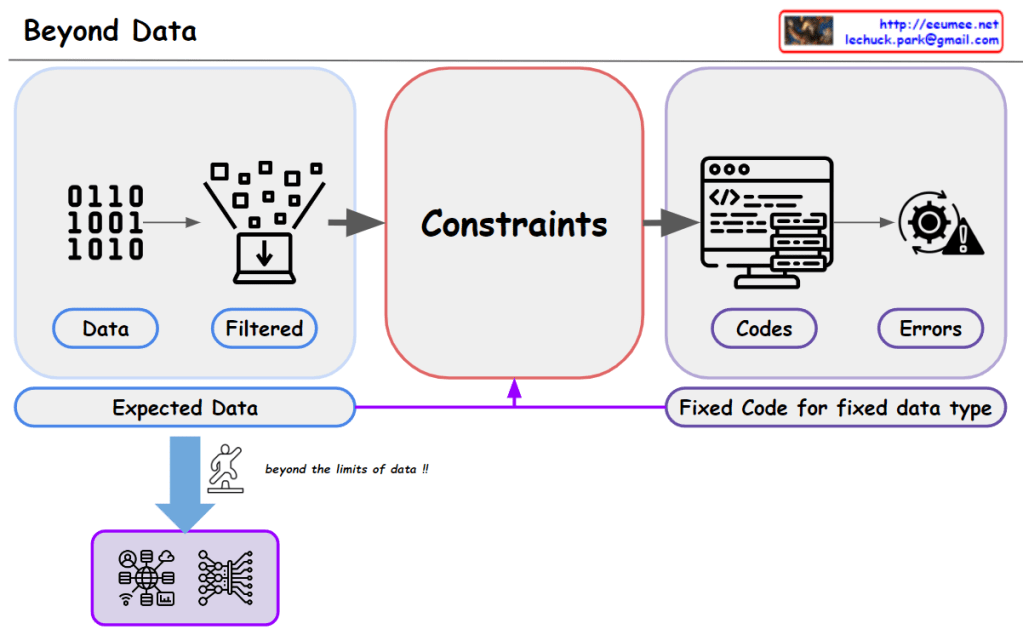
This image depicts the process of overcoming the constraints of traditional programming based on expected data through big data and deep learning. Starting on the left, binary digits labeled as “Data” are processed through a “Filtered” stage to become the necessary “Expected Data.” The box labeled “Constraints” in the center represents the limitations that can occur in programming. These constraints suggest barriers that can be overcome with big data processing and deep learning technologies. On the right, there’s a section transitioning from “Codes” to “Errors,” which signifies possible errors during the coding process. However, the text “Fixed Code for fixed data type” reflects that program code is pre-established for expected data types and does not transcend the boundaries of this data, thereby limiting its potential. The phrase “beyond the limits of data!!” at the bottom expresses the ambition of future programming to surpass the limitations of data processing by utilizing big data and deep learning.

Requires for DL

From DALL-E with some prompting
The image outlines the importance of data in the era of deep learning (DL). It starts with “Data,” representing various sources and types, which feeds into “Deep Learning,” depicted by a neural network diagram. The process leads to “Result,” symbolized by charts and graphs indicating the output or findings. The central message, “Data determines the results,” stresses that the quality of data significantly impacts the outcome of deep learning processes. Below, “Data Verification” suggests the need for ensuring data accuracy, which ties into the cycle of “UPDATE” and “Analysis,” highlighting an iterative process to refine and improve deep learning applications. The phrase “What to deal with DL” hints at the challenges and considerations in managing and utilizing deep learning effectively.

The time is

From DALL-E with some prompting
The image conveys that innovation is more than just seeking new things; it is achieved through numerous changes performed within a given absolute time. The upper section shows three change attempts within a limited timeframe, suggesting that evolution occurs through these trials and failures. The lower section emphasizes the capability to undertake nine changes in the same time period, highlighting faster and more substantial evolution. It underlines the idea that digital transformation enables more rapid and extensive changes than those made by humans, which is a crucial element in driving innovation and evolution.