Entropy

From ChatGPT with some prompting
This image explains entropy growth from two perspectives: human and particle viewpoints.


1. Left (Human View: Ordered State)

  • Image: Dots tightly packed in a cube.
  • Human Perspective: A highly ordered state with low entropy, as dots are confined to specific positions.
  • Particle Perspective: Particles experience restrictions, resulting in a sense of disorder due to limited freedom.

2. Middle (Transition State)

  • Image: Dots spreading out.
  • Human Perspective: Increasing disorder as the system transitions to multiple possible states, leading to higher entropy.
  • Particle Perspective: Particles gain more freedom, moving toward their individual order.

3. Right (Human View: Disordered State)

  • Image: Dots randomly distributed.
  • Human Perspective: Maximum disorder, representing the highest entropy state.
  • Particle Perspective: Particles achieve their highest freedom, forming their unique “order” in randomness.

4. Entropy Growth (Human vs. Particle View)

  • Human Perspective: Order โ†’ Disorder (entropy increases).
  • Particle Perspective: Restrictions decrease, and particles transition from “disorder” to finding their own freedom and order.

This dual perspective illustrates entropy as both an increase in disorder (human view) and an emergence of particle freedom and order (particle view).

WEB SERVICE 3-TIERS

From Claude with some prompting
WEB(Front) Layer

  • Primary Components:
    • Static Data: HTML, CSS, JavaScript files
    • Storage: Browser-based storage solutions
  • Performance Optimization:
    • CDN: Global content delivery
    • Caching: Response time improvement
  • Enhanced Custom Experience:
    • Optimized user interface
    • Client-side performance enhancements
  1. WAS(Back) Layer
  • Core Functions:
    • Program Code: Server-side application logic
    • Computing: Business process handling
  • Development Features:
    • Enhanced Development Environment (CI/CD):
      • Continuous Integration for automated testing
      • Continuous Deployment for automated delivery
      • Automated build and release processes
      • Development workflow optimization
    • Biz Logic: Business rules implementation
    • Microservices: Modular service architecture
  1. DB Layer
  • Data Management:
    • Dynamic Data: Real-time data processing
    • Variable(Memory): Memory-based data handling
  • Business Data:
    • Biz Data Scheme & ACID:
      • Data structure and relationships
      • Transaction integrity
      • Data consistency
    • RDBMS/NoSQL: Flexible database solutions
  1. Infrastructure Characteristics
  • High Availability (Biz Continues):
    • Uninterrupted service operation
    • Fault tolerance
    • Business continuity
  • Scalability (Biz Changes):
    • System expansion capability
    • Business growth support
    • Flexible architecture
  1. Key Integration Points
  • WEB โ†” WAS: Static data and program code interaction
  • WAS โ†” DB: Dynamic data and business logic connection
  • Biz Logic โ†” Biz Data: Direct business data operations

This architecture demonstrates a modern, well-structured web service that emphasizes:

Robust business logic handling
Efficient data management
Clear separation of concerns
Automated development processes
Scalable infrastructure
High availability
Enhanced user experience

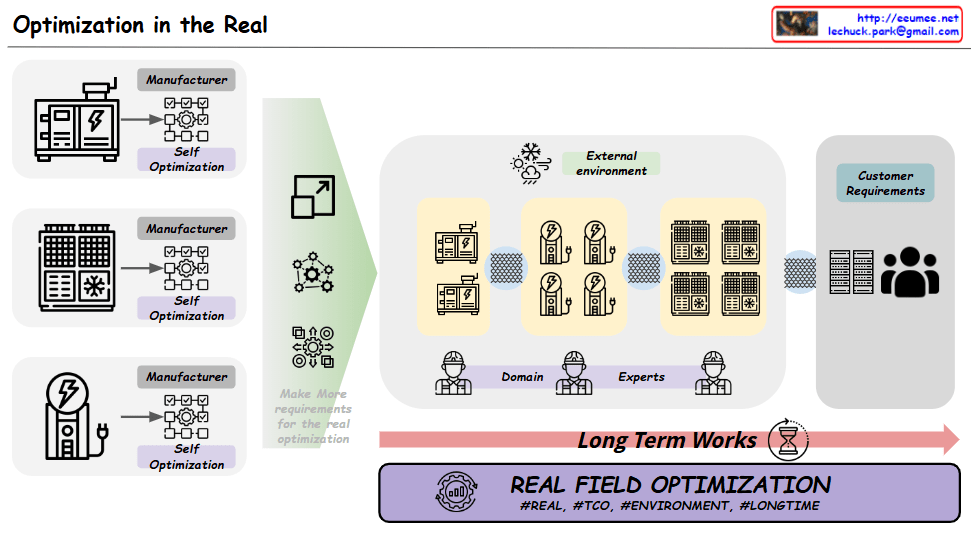
Optimization in the Real

From Claude with some prompting
The Real Field Optimization diagram and its extended implications:

  1. Extended Scope of Optimization:
  • Begins with equipment Self-Optimization but extends far beyond
  • Increasing complexity in real operating environments:
    • Equipment/system interactions
    • Operational scale expansion
    • Service quality requirements
    • Various stakeholder requirements
  1. Real Operating Environment Considerations:
  • Domain Experts’ practical experience and knowledge
  • Customer requirements and feedback
  • External Environment impacts
  • Variables emerging from Long Term operations
  1. TCO (Total Cost of Ownership) Perspective:
  • Beyond initial installation/deployment costs
  • Operation/maintenance costs
  • Energy efficiency
  • Lifecycle cost optimization
  1. Data-Driven Optimization Necessity:
  • Collection and analysis of actual operational data
  • Understanding operational patterns
  • Predictive maintenance
  • Performance/efficiency monitoring
  • Data-driven decision making for continuous improvement
  1. Long-Term Perspective Importance:
  • Performance change management over time
  • Scalability considerations
  • Sustainable operation model establishment
  • Adaptability to changing requirements
  1. Real Field Integration:
  • Interaction between manufacturers, operators, and customers
  • Environmental factor considerations
  • Complex system interdependencies
  • Real-world constraint management

This comprehensive optimization approach goes beyond individual equipment efficiency, aiming for sustainable operation and value creation of the entire system. This can be achieved through continuous improvement activities based on real operational environment data. This represents the true meaning of “Real Field Optimization” with its hashtags #REAL, #TCO, #ENVIRONMENT, #LONGTIME.

The diagram effectively illustrates that while equipment-level optimization is fundamental, the real challenge and opportunity lie in optimizing the entire operational ecosystem over time, considering all stakeholders, environmental factors, and long-term sustainability. The implicit need for data-driven optimization in real operating environments becomes crucial for achieving these comprehensive optimization goals.