Platform

This image is a diagram titled “Platform” that explains three types of platform business models.

3 Platforms:

  1. Information Sharing Platform (Sharing Information / Who? Information)
    • Users share information, but the “Who?” question raises concerns about who actually provides the information and who captures its value
    • Highlights the structural issue where users provide content for free while platforms monopolize advertising revenue
  2. Platform-Controlled Work (Work for Platform / Controlled by Platform)
    • Workers ostensibly work for the platform but are actually controlled by the platform
    • Reflects the reality of platform labor where workers are classified as “independent contractors” but are actually dependent on the platform’s algorithms, fee policies, and rating systems
    • Represents the unequal power relationships found in the gig economy
  3. Platform Usage (Using Platform)
    • Users actively utilize the platform to create new value
    • Shows high user satisfaction with the “I LOVE THIS” indicator
    • Represents a positive relationship where users proactively leverage platform tools

Bottom Integrated Concept:

  • “Together” → “on the platform” → “make values”

Key Message: This diagram demonstrates that platforms are not neutral technologies but embody different power relationships and value distribution structures. The second type particularly critiques the structural problems of platform labor, revealing that despite the surface narrative of “creating value together,” unequal power relationships actually exist. This is a critical visualization that analyzes the various interests and power structures hidden behind the platform economy.

With Claude

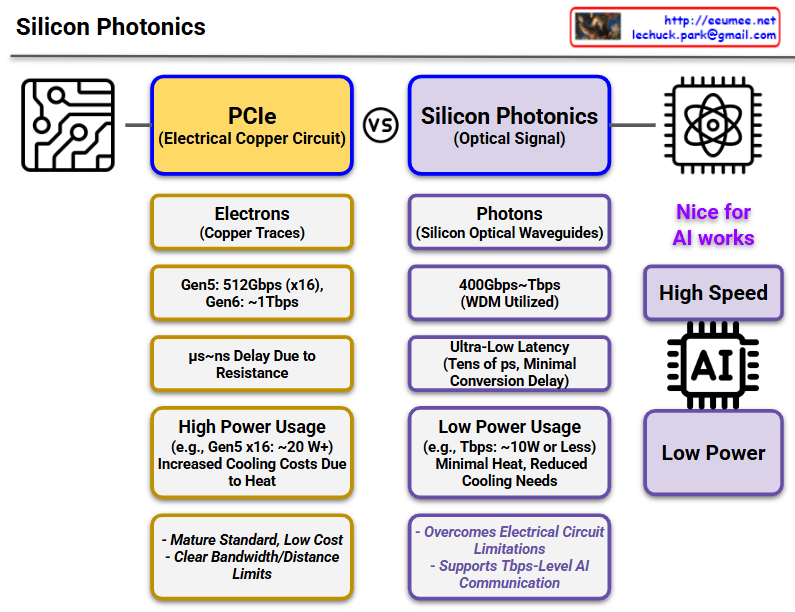
Silicon Photonics

This diagram compares PCIe (Electrical Copper Circuit) and Silicon Photonics (Optical Signal) technologies.

PCIe (Left, Yellow Boxes)

  • Signal Transmission: Uses electrons (copper traces)
  • Speed: Gen5 512Gbps (x16), Gen6 ~1Tbps expected
  • Latency: Ξs~ns level delay due to resistance
  • Power Consumption: High (e.g., Gen5 x16 ~20W), increased cooling costs due to heat generation
  • Pros/Cons: Mature standard with low cost, but clear bandwidth/distance limitations

Silicon Photonics (Right, Purple Boxes)

  • Signal Transmission: Uses photons (silicon optical waveguides)
  • Speed: 400Gbps~7Tbps (utilizing WDM technology)
  • Latency: Ultra-low latency (tens of ps, minimal conversion delay)
  • Power Consumption: Low (e.g., 7Tbps ~10W or less), minimal heat with reduced cooling needs
  • Key Benefits:
    • Overcomes electrical circuit limitations
    • Supports 7Tbps-level AI communication
    • Optimized for AI workloads (high speed, low power)

Key Message

Silicon Photonics overcomes the limitations of existing PCIe technology (high power consumption, heat generation, speed limitations), making it a next-generation technology particularly well-suited for AI workloads requiring high-speed data processing.

With Claude

Human Control

Human-Centered AI Decision-Making System

This diagram illustrates a human-in-the-loop AI system where humans maintain control over critical decision-making processes.

System Components

Top Process Flow:

  • Data Quality → Analysis → Decision
  • Sequential workflow with human oversight at each stage

Bottom Control Layer:

  • AI Works in the central processing area
  • Ethics Human Rules (left side) – Human-defined ethical guidelines
  • Probability Control (right side) – Human oversight of AI confidence levels

Human Control Points:

  • Human Intent feeds into the system at the beginning
  • Final Decision remains with humans at the end
  • Human Control emphasized as the foundation of the entire system

Key Principles

  1. Human Agency: People retain ultimate decision-making authority
  2. AI as Tool: AI performs analysis but doesn’t make final decisions
  3. Ethical Oversight: Human-defined rules guide AI behavior
  4. Transparency: Probability controls allow humans to understand AI confidence
  5. Accountability: Clear human responsibility throughout the process

Summary: This represents a responsible AI framework where artificial intelligence enhances human decision-making capabilities while ensuring humans remain in control of critical choices and ethical considerations.

With Claude