Human Rules Always


The Evolutionary Roadmap to Human-Optimized AI

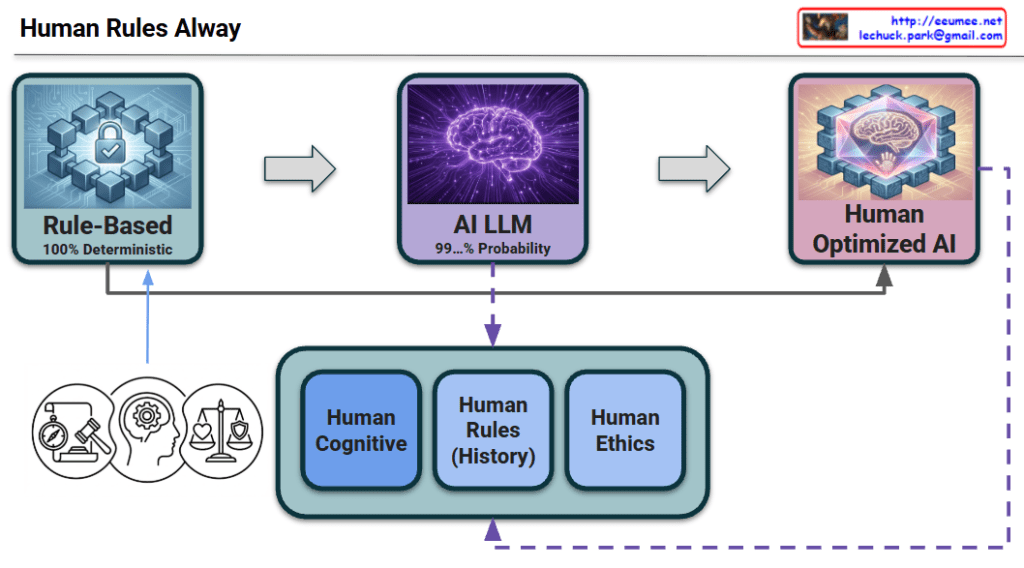
This diagram visualizes the history and future direction of intelligent systems. It illustrates the evolution from the era of manual programming to the current age of generative AI, and finally to the ultimate goal where human standards perfect the technology.

1. The 3 Stages of Technological Evolution (Top Flow)

  • Stage 1: Rule-Based (The Foundation / Past)
    • Concept: “The Era of Human-Defined Logic”
    • Context: This represents the starting point of computing where humans explicitly created formulas and coded every rule.
    • Characteristics: It is 100% Deterministic. While accurate within its scope, it cannot handle the complexity of the real world beyond what humans have manually programmed.
  • Stage 2: AI LLM (The Transition / Present)
    • Concept: “The Era of Probabilistic Scale”
    • Context: We have evolved into the age of massive parallel processing and Large Language Models.
    • Characteristics: It operates on 99…% Probability. It offers immense scalability and creativity that rule-based systems could never achieve, but it lacks the absolute certainty of the past, occasionally leading to inefficiencies or hallucinations.
  • Stage 3: Human Optimized AI (The Final Goal / Future)
    • Concept: “The Era of Reliability & Efficiency”
    • Context: This is the destination we must reach. It is not just about using AI, but about integrating the massive power of the “Present” (AI LLM) with the precision of the “Past” (Rule-Based).
    • Characteristics: By applying human standards to control the AI’s massive parallel processing, we achieve a system that is both computationally efficient and strictly reliable.

2. The Engine of Evolution: Human Standards (Bottom Box)

This section represents the mechanism that drives the evolution from Stage 2 to Stage 3.

  • The Problem: Raw AI (Stage 2) consumes vast energy and can be unpredictable.
  • The Solution: We must re-introduce the “Human Rules” (History, Logic, Ethics) established in Stage 1 into the AI’s workflow.
  • The Process:
    • Constraint & Optimization: Human Cognition and Rules act as a pruning mechanism, cutting off wasteful parallel computations in the LLM.
    • Safety: Ethics ensure the output aligns with human values.
  • Result: This filtering process transforms the raw, probabilistic energy of the LLM into the polished, “Human Optimized” state.

3. The Feedback Loop (Continuous Evolution)

  • Dashed Line: The journey doesn’t end at Stage 3. The output from the optimized AI is reviewed by humans, which in turn updates our rules and ethical standards. This circular structure ensures that the AI continues to evolve alongside human civilization.

This diagram declares that the future of AI lies not in discarding the old “Rule-Based” ways, but in fusing that deterministic precision with modern probabilistic power to create a truly optimized intelligence.


#AIEvolution #FutureOfAI #HybridAI #DeterministicVsProbabilistic #HumanInTheLoop #TechRoadmap #AIArchitecture #Optimization #ResponsibleAI

Priority

From DALL-E
The image is a visual representation of task prioritization and management. It comprises various elements that communicate the challenges and strategies of handling multiple tasks effectively:

  1. Multi-Tasking NOT EASY: This indicates that juggling multiple tasks is challenging, and one task could be affected by another, implying the potential for decreased efficiency or interference.
  2. So. The Focusing is required.: It emphasizes the need for focus, suggesting that concentrating on specific tasks is essential for successful completion.
  3. First! Need to find out Which is more priority.: This statement highlights the importance of determining which task has the highest priority to address it appropriately.
  4. Managing with Data.: It suggests that data management is a crucial part of prioritizing and executing tasks.

On the right side, there is a list numbered 1 to 5, indicating a ranked list of tasks:

  • Number 1 is circled, with an arrow pointing to it and the phrases “DO IT” and “Do it Now!!”, stressing the urgency of tackling the most important task immediately.
  • Number 5 has a question mark next to it, and the phrase “Keep it for the future more details.”, suggesting that the lowest priority task may be deferred until more information is available or it becomes more relevant.

The bottom right corner has an “X” symbol with the text “without interruption”, indicating the importance of completing the top priority task without distractions or interruptions. The overall message of the image is to prioritize tasks, focus on the most critical one, manage tasks based on data, and execute them without disruption for effective productivity.