Data Standardization

From DALL-E with some prompting
The image emphasizes the importance of data quality in the digital transformation of large-scale operations. By securing “Data Quality” through data standardization, optimized operations based on verified data enable reliable decision-making, monitoring, and optimization. AI-enhanced analysis and optimization accelerate business transformation, drive data-led innovation, and achieve sustainable operation and customer satisfaction.

  1. Data Standardization: Emphasizes the importance of “Data Quality,” indicating that high-quality, standardized data is foundational.
  2. Operation based on verified data/system: Shows the use of verified data to ensure reliable decision-making, monitoring, and optimization, leading to sustainable operations, business intelligence, and customer satisfaction.
  3. Accelerating (AI) digital business transformation: Describes how optimized and customized processing, along with an AI data analysis platform, can accelerate digital transformation. This leads to work automation, user customization, resource optimization, data-driven innovation, AI predictions and analytics, and expanding standardization.

The overall message suggests that standardizing data quality is crucial for building AI systems that can drive digital transformation and improve business operations and customer satisfaction.

DT for new biz

From DALL-E with some prompting
The image is a diagram that illustrates the process of digital transformation for discovering new business opportunities through the digitization of data center operations. The stages included are as follows:

  1. Digitization: The initial step of converting data into digital form.
  2. Digitalization: The process of enhancing operational know-how and creating new value through the experience and analysis with AI, as indicated by the phrases “Exp & Analysis with AI” and “Selling EXP and more!!”.
  3. Digital Transformation: The stage where insights and ideas gained from digitalization are actualized into new business changes.

At the bottom of the diagram, the phrase “All New for DC By Digital(data)” is accompanied by four boxes labeled Design, Deployment, Operating, and Customer. This indicates that all components of business operations are undergoing new changes based on digital data. The “NEW” marker emphasizes the new business opportunities that arise through digital transformation.

The diagram visually explains how transforming existing data into a digital format and using technologies like AI for analysis can improve operational knowledge and, as a result, generate and implement new business ideas. It specifically highlights that digital transformation in data center operations can provide opportunities for uncovering new business ventures.

Road to “the new”

From DALL-E with some prompting

The image visually explains the process of creating new ideas and innovations. Each stage is as follows:

Experience: The icon represents human experiences.
Digitization: The process of converting experiences into digital data.
Data: The digitized information.
AI/ML (Artificial Intelligence/Machine Learning): Technologies that analyze and learn from the data.
Accelerator: Represents the acceleration of the analysis and learning process through AI/ML.
Analysis: The process of analyzing data to extract useful insights.
Idea: The emergence of new ideas from data analysis. The phrase “Easy to Get” indicates that this process has become more accessible.
New: Two text icons depicting the implementation of new ideas into innovative products or services.


The image illustrates the flow of digitizing experiences into data, using AI/ML to analyze and accelerate this data, easily obtaining new ideas, and transforming them into new innovations.

Unknown conditions

From DALL-E with some prompting
The image conveys that the response to external conditions and the infinite number of conditions that humans cannot precisely analyze is becoming possible through Artificial Intelligence (AI), especially deep learning. The top part represents the traditional programming approach, where predefined actions are executed given known conditions, as indicated by the “if (conditions) then (actions)” code snippet and the “100% analyzed” phrase, highlighting the need for conditions to be fully analyzed. In contrast, the bottom part illustrates how AI, even with unknown conditions, can learn from data and autonomously determine appropriate actions. Data-driven AI actions suggest the capability to recognize complex patterns and make autonomous decisions, demonstrating the potential of deep learning technologies to go beyond human analysis in various contexts.

New BIZ ?

From DALL-E with some prompting
This diagram explains the process of finding new business opportunities from the perspective of digital transformation. The first step, ‘Digitization,’ involves converting real-world information into digital data while ensuring data quality. The next step, ‘Digitalization,’ extends the use of digital data to enhance automated processes. By executing these two steps, new opportunities can be discovered, and through ‘Digital Transformation,’ these discoveries can be converted into actual innovations. Overall, this process presents a methodology for leveraging digital technology to innovate business models and create new value.

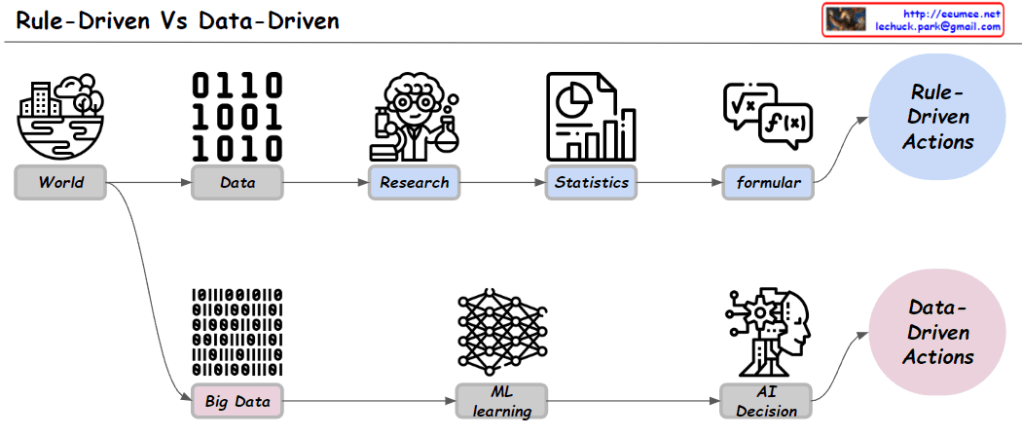
Rule-Driven Vs Data-Driven

From the Bard with some prompting

Rule-based and data-driven systems are two different approaches to artificial intelligence (AI).

Data-driven systems make decisions based on data. For example, a data-driven system could be used to recommend products to customers based on their purchase history.

Here is a summary of the key differences between rule-based and data-driven systems:

  • Decision-making process: Rule-based systems use if-then rules, while data-driven systems use data.
  • Examples: Rule-based systems can be used for simple tasks, such as turning on a fan. Data-driven systems can be used for more complex tasks, such as recommending products to customers.
  • Strengths: Rule-based systems are simple and easy to understand. Data-driven systems are accurate.
  • Weaknesses: Rule-based systems can be difficult to adapt to new situations. Data-driven systems can be inaccurate if data is insufficient.

In conclusion, rule-based systems are simple and easy to understand, but they can be difficult to adapt to new situations. Data-driven systems are accurate, but they can be inaccurate if data is insufficient.

Digital = Energy

From DALL-E with some prompting
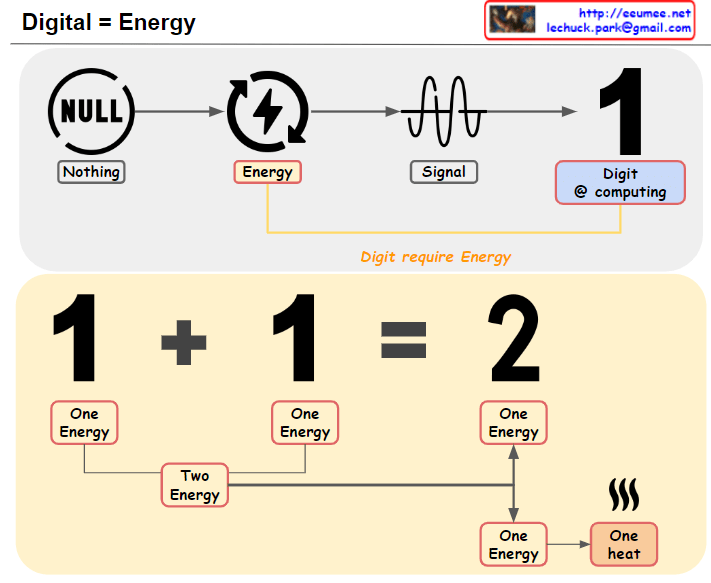
this image illustrates the concept that “Digital equals Energy.” The first row shows the transformation from ‘NULL’, which represents nothingness, into a signal through energy, and then into a digital ‘1’ for computing. The second row demonstrates that digital operations require energy by showing that adding ‘1’ and ‘1’ results in ‘2’, with each ‘1’ requiring a unit of energy and the process generating heat, indicating energy loss.