PUE Details

With a Claude’s Help
This image provides detailed information on Power Usage Effectiveness (PUE), a key metric for measuring the energy efficiency of a data center.

The overall structure shows that power received from the High Power Receiver is distributed to various components, including IT equipment and cooling systems, through the Power Distributor.

To calculate PUE, several granular metrics are required, such as IT power, cooling power, and total power consumption. These detailed items are grouped into larger categories for easier management and standardization.

For example, IT power is further broken down into servers, storage, and network equipment. Cooling power includes CRAC units, cooling towers, and pump systems. The power supply stages are also differentiated to identify points of power loss.

Furthermore, detailed monitoring of individual IT and cooling equipment power consumption enables more accurate PUE calculation and optimization.

In summary, effective PUE management requires categorizing the total power usage into IT power, cooling power, and other power, and then further subdividing these groups into standardized, measurable components. Real-time monitoring and data analysis are crucial for continually improving energy efficiency in the data center.
The Era of True Artificial Intelligence: Bridging Human and Machine Learning  

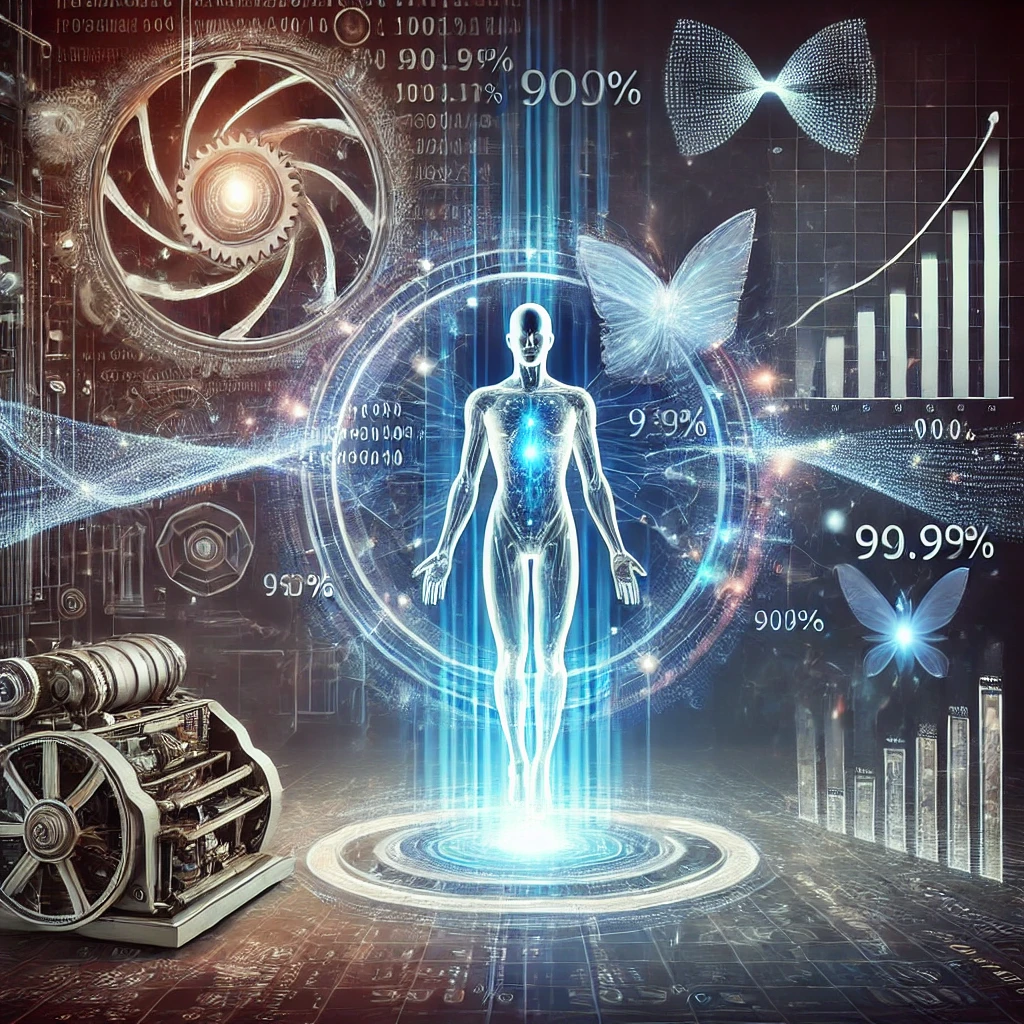
AI has now reached a level that can truly be called Artificial Intelligence. This is especially evident in the era of Machine Learning (ML). Humans learn through experiences—essentially data—and make judgments and take actions based on them. These actions are not always perfect or correct, but through continuous learning and experience, they strive for better outcomes, which inherently reflects a probabilistic and statistical perspective.

Similarly, ML learns from massive datasets to identify rules and minimize errors. However, it cannot achieve 100% perfection because it cannot learn all possible data, which is essentially infinite. Despite this, recent advancements in infrastructure and access to vast amounts of data have enabled AI to reach accuracy levels of 90% to 99.99%, appearing almost perfect.

Nevertheless, there still remains the elusive 0.00…1% of uncertainty, stemming from the fundamental limitation of incomplete data learning. Ultimately, AI is not so different from humans in how it learns and makes probabilistic decisions. For this reason, we can truly call it Artificial Intelligence.

The time

with a claude’s help
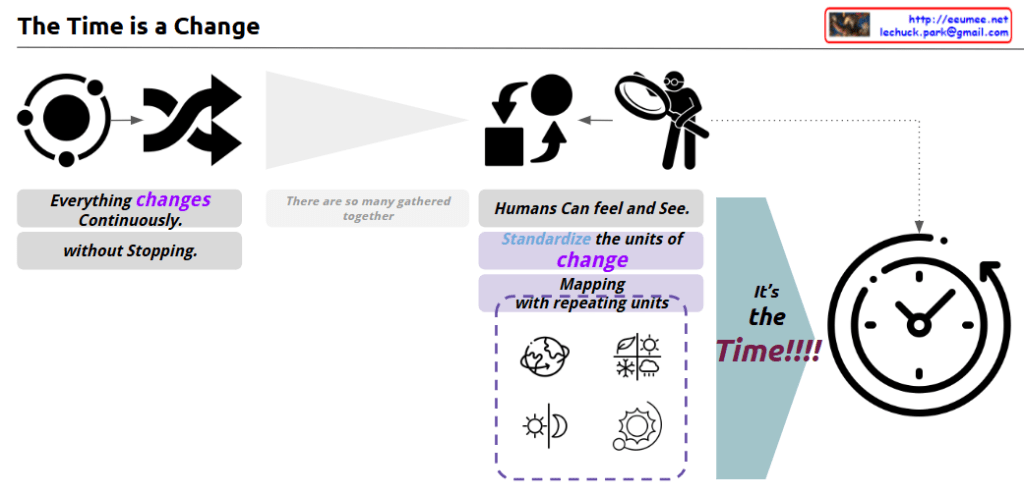
This image provides deep insights into the essence of time. The key points can be summarized as follows:

  1. Continuity of change: As shown in the image, everything is in a constant state of change. This phenomenon is observed even at the most fundamental atomic level.
  2. Observation and unitization: Humans observe these changes, identify recurring patterns, and define units of time accordingly. For example, units like year, 4 seasons, and day have been created based on the cycles of the Earth’s rotation and revolution.
  3. Humanization of the time concept: The defined time units have been concretized into forms that humans can easily understand and use. In other words, observing natural phenomena and interpreting them from a human-centric perspective is the essence of the time concept we know.
  4. Relationship between change and measurement: Time is a concept measured based on change. The time units we use routinely in daily life are essentially standardizations of natural cycles of change.

From a scientific perspective, this image explains the concept of time from multiple angles. The ceaseless change at the atomic level is a scientific fact, and the accumulation of these microscopic changes manifests as the macroscopic changes we perceive in nature. Humans have observed and measured these natural patterns of change to construct the concept of time.

However, the time units are not entirely objective. They can vary based on human physiological and cultural factors. Therefore, time can be viewed as a product of human interpretation and utilization of natural phenomena.

In summary, this image effectively illustrates the essence of the time concept from various perspectives. It shows how the changes in nature and human observation and measurement have given rise to the idea of time.

Time Series Prediction : 3 types

with a Claude’s help
This image provides an overview of different time series prediction methods, including their characteristics and applications. The key points are:

ARIMA (Autoregressive Integrated Moving Average):

  • Suitable for linear, stable datasets where interpretability is important
  • Can be used for short-term stock price prediction and monthly energy consumption forecasting

Prophet:

  • A quick and simple forecasting method with clear seasonality and trend
  • Suitable for social media traffic and retail sales predictions

LSTM (Long Short-Term Memory):

  • Suitable for dealing with nonlinear, complex, large-scale, feature-rich datasets
  • Can be used for sensor data anomaly detection, weather forecasting, and long-term financial market prediction

Application in a data center context:

  • ARIMA: Can be used to predict short-term changes in server room temperature and power consumption
  • Prophet: Can be used to forecast daily, weekly, and monthly power usage patterns
  • LSTM: Can be used to analyze complex sensor data patterns and make long-term predictions

Utilizing these prediction models can contribute to energy efficiency improvements and proactive maintenance in data centers. When selecting a prediction method, one should consider the characteristics of the data and the specific forecasting requirements.

Data Gravity

With Claude’s help
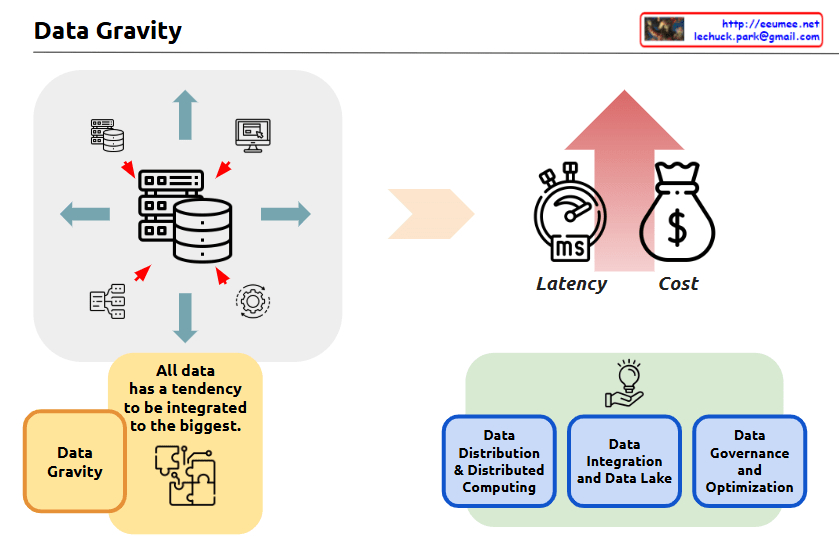
The image is titled “Data Gravity” and it appears to be an infographic or diagram that illustrates some key concepts related to data and data management.

The central part of the image shows a set of icons and arrows, depicting how “all data has a tendency to be integrated to the biggest” – this is the concept of “Data Gravity” mentioned in the title.

The image also highlights three key factors related to data:

  1. Latency – Represented by a stopwatch icon, indicating the time or delay factor involved in data processing and movement.
  2. Cost – Represented by a money bag icon, indicating the financial considerations around data management and processing.
  3. Data Gravity – This concept is explained in the yellow box, where it states that “all data has a tendency to be integrated to the biggest.”

The image also shows three main components related to data management:

  1. Data Distribution & Distributed Computing
  2. Data Integration and Data Lake
  3. Data Governance and Optimization

These three components are depicted in the bottom half of the image, illustrating the different aspects of managing and working with data.

Overall, the image seems to be providing a high-level overview of key concepts and considerations around data management, with a focus on the idea of “Data Gravity” and how it relates to factors like latency, cost, and the various data management practices.