Basic Optimization

With a Claude
This Basic Optimization diagram demonstrates the principle of optimizing the most frequent tasks first:

  1. Current System Load Analysis:
  • Total Load: 54 X N (where N can extend to infinity)
  • Task Frequency Breakdown:
    • Red tasks: 23N (most frequent)
    • Yellow tasks: 13N
    • Blue tasks: 11N
    • Green tasks: 7N
  1. Optimization Strategy and Significance:
  • Priority: Optimize the most frequent task first (red tasks, 23N)
  • 0.4 efficiency improvement achieved on the highest frequency task
  • As N approaches infinity, the optimization effect grows exponentially
  • Calculation: 23 x 0.4 = 9.2 reduction in load per N
  1. Optimization Results:
  • Final Load: 40.2 X N (reduced from 54 X N)
  • Detailed calculation: (9.2 + 31) X N
    • 9.2: Load reduction from optimization
    • 31: Remaining task loads
  • Scale Effect Examples:
    • At N=100: 1,380 units reduced (5,400 → 4,020)
    • At N=1000: 13,800 units reduced (54,000 → 40,200)
    • At N=10000: 138,000 units reduced

The key insight here is that in a system where N can scale infinitely, optimizing the most frequent task (red) yields exponential benefits. This demonstrates the power of the “optimize the highest frequency first” principle – where focusing optimization efforts on the most common operations produces the greatest system-wide improvements. The larger N becomes, the more dramatic the optimization benefits become, making this a highly efficient approach to system optimization.

This strategy perfectly embodies the principle of “maximum impact with minimal effort” in system optimization, especially in scalable systems where N can grow indefinitely. 

Data Center Pipeline

With a Claude
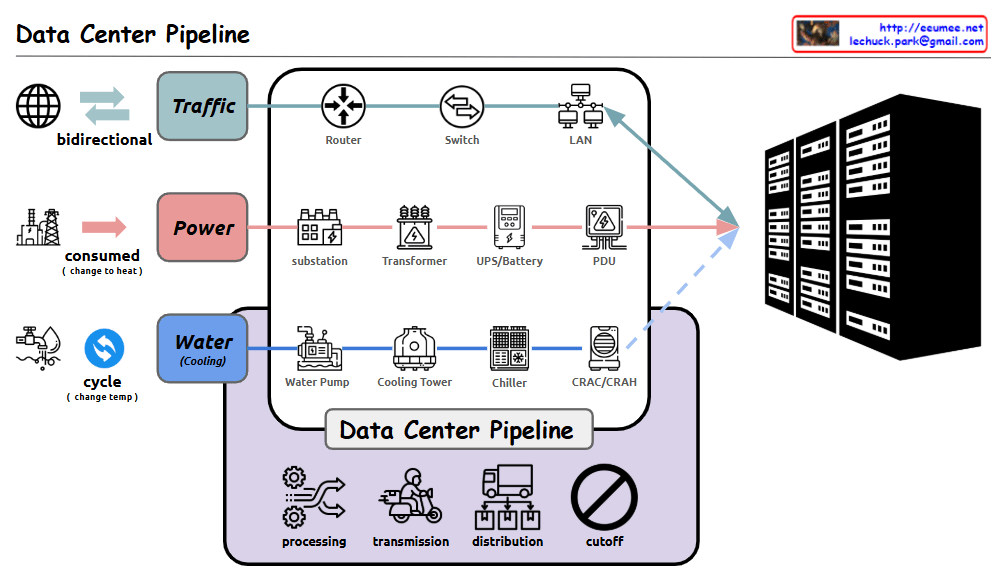
Detailed analysis of the Data Center Pipeline diagram:

  1. Traffic Pipeline
  • Bidirectional network traffic handling
  • Infrastructure flow: Router → Switch → LAN
  • Responsible for stable data transmission and reception
  1. Power Pipeline
  • Power consumption converted to heat
  • Flow: Substation → Transformer → UPS/Battery → PDU (Power Distribution Unit)
  • Ensures stable power supply and backup systems
  1. Water (Cooling) Pipeline
  • Circulation cooling system through temperature change
  • Flow: Water Pump → Cooling Tower → Chiller → CRAC/CRAH (Computer Room Air Conditioning/Handler)
  • Efficiently controls server heat generation
  1. Data Center Management Functions
  • Processing: Data and system processing
  • Transmission: Data transfer
  • Distribution: Resource allocation
  • Cutoff: System protection during emergencies

Comprehensive Summary: This diagram illustrates the core infrastructure of a modern data center. It shows the seamless integration of three critical pipelines: network traffic for data processing, power supply for system operation, and cooling systems for equipment protection. Each pipeline undergoes multiple processing stages, working harmoniously to ensure stable data center operations. The four core management functions – processing, transmission, distribution, and cutoff – guarantee the efficiency and stability of the entire system. This integrated infrastructure design enables reliable operation of data centers, which form the foundation of modern digital services. The careful balance between these systems is crucial for maintaining optimal performance, ensuring business continuity, and protecting valuable computing resources. The design demonstrates how modern data centers handle the complex requirements of digital infrastructure while maintaining reliability and efficiency. 

Software Defined Power Distribution

With a Claude
the Software Defined Power Distribution (SDPD) system, including the added standards and protocols shown in the image:

  1. SDN Similarity
  • Like Software-Defined Networking controls network traffic, SDPD applies similar software-defined principles to power distribution
  1. Key Components
  • Real-time Monitoring: Power consumption and system status analysis using IoT sensors and AI
  • Centralized Control: Power distribution optimization through an integrated platform
  • Flexibility/Scalability: Software-based upgrades and expansion
  • Energy Efficiency: Data center power optimization and rapid fault response
  1. Standards and Protocols
  • IEC 61850: Substation automation communication standard
  • IEEE 2030.5: Smart energy profile standard
  • Modbus/DNP3: Industrial communication protocols
  • OpenADR: Automated demand response standard

Final Summary: Why Software Defined X (SDx) is necessary for power distribution

  • Modern power systems face increasing complexity and require real-time response capabilities
  • Data-driven decision making and automated control are essential
  • Software Defined approach (SDPD) provides:
    1. Real-time data collection/analysis for optimized power flow
    2. Rapid response and efficient management through centralized control
    3. Flexible system expansion and upgrades through software-based architecture
    4. Achievement of improved energy efficiency and reduced operational costs

The software-defined approach has become essential in the power sector, just as it has in networking, because it enables:

  • Intelligent resource allocation
  • Improved system visibility
  • Enhanced operational efficiency
  • Better fault tolerance and recovery
  • Cost-effective scaling and updates

This demonstrates why a data-centric, software-defined approach is crucial for modern power systems to achieve efficiency, reliability, and scalability.

Analog to Digital & Analysis

With Claude
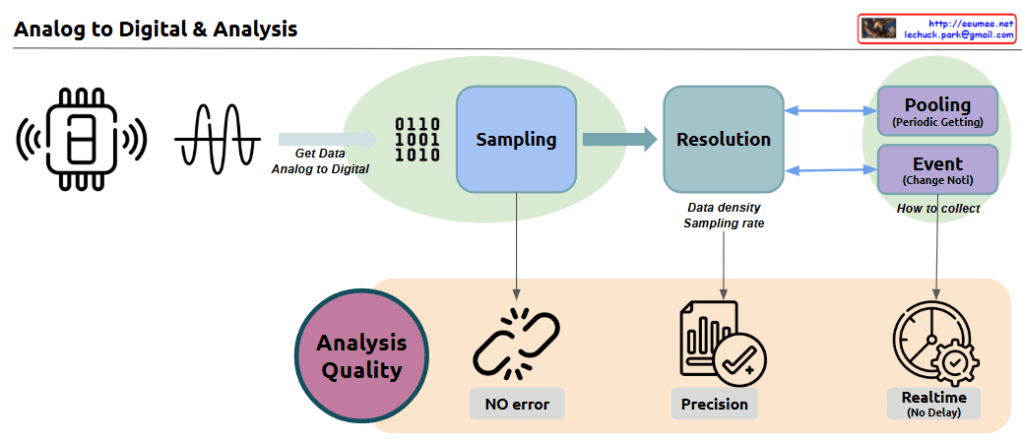
Here’s the analysis of the image and key elements :

  1. Sampling Stage
  • Initial stage of converting analog signals to digital values
  • Converts analog waveforms from sensors into digital data (0110 1001 1010)
  • Critical first step that determines data quality
  • Foundation for all subsequent processing
  1. Resolution Stage
  • Determines data quality through Data density and Sampling rate
  • Direct impact on data precision and accuracy
  • Establishes the foundation for data quality in subsequent analysis
  • Controls the granularity of digital conversion
  1. How to Collect
  • Pooling: Collecting data at predetermined periodic intervals
  • Event: Data collection triggered by detected changes
  • Provides efficient data collection strategies based on specific needs
  • Enables flexible data gathering approaches
  1. Analysis Quality
  • NO error: Ensures error-free data processing
  • Precision: Maintains high accuracy in data analysis
  • Realtime: Guarantees real-time processing capability
  • Comprehensive quality control throughout the process

Key Importance in Data Collection/Analysis:

  1. Accuracy: Essential for reliable data-driven decision making. The quality of input data directly affects the validity of results and conclusions.
  2. Real-time Processing: Critical for immediate response and monitoring, enabling quick decisions and timely interventions when needed.
  3. Efficiency: Proper selection of collection methods ensures optimal resource utilization and cost-effective data management.
  4. Quality Control: Consistent quality maintenance throughout the entire process determines the reliability of analytical results.

These elements work together to enable reliable data-driven decision-making and analysis. The success of any data analysis system depends on the careful implementation and monitoring of each component, from initial sampling to final analysis. When properly integrated, these components create a robust framework for accurate, efficient, and reliable data processing and analysis.

Server Room Metric Correlation

With Claude
Server Room Metric Correlation Analysis & Operations Guide

1. Diagram Structure Analysis

Key Component Areas

  1. Server Zone (Left)
  • Server racks and equipment
  • Workload-driven CPU/GPU operations
  • Load metrics indicating rising system demands
  • Resource utilization monitoring
  1. Power Supply Zone (Center Bottom)
  • Power metering system
  • Power consumption monitoring
  • Load status tracking with increasing indicators
  1. Hot Zone (Center)
  • Heat generation and thermal management area
  • Exhaust temperature monitoring
  • Return temperature tracking
  • Overall temperature management
  1. Cool Zone (Right)
  • Cooling system operations
  • Inlet temperature control
  • Cooling supply temperature management
  • Cooling system load monitoring

2. Core Metric Correlations

Basic Metric Flow

  1. Load Generation
  • Server workload increases
  • CPU/GPU utilization rises
  • System load elevation
  1. Power Consumption
  • Load-driven power usage increase
  • Power efficiency monitoring
  • Overall system load tracking
  1. Thermal Management
  • Heat generation in Hot Zone
  • Exhaust/Return temperature differential
  • Cooling system response
  1. Cooling Efficiency
  • Cool Zone temperature regulation
  • Cooling system load adjustment
  • System stability maintenance

3. Key Operational Indicators

Primary Metrics

  1. Performance Metrics
  • Server workload levels
  • CPU/GPU utilization
  • System response metrics
  1. Environmental Metrics
  • Zone temperatures
  • Air flow patterns
  • Cooling efficiency
  1. Power Metrics
  • Power consumption rates
  • Load distribution
  • Efficiency indicators

4. Monitoring Focus Points

Critical Correlations

  1. Load-Power-Temperature Relationship
  • Workload impact on power consumption
  • Heat generation patterns
  • Cooling system response efficiency
  1. System Stability Indicators
  • Temperature zone balance
  • Power distribution effectiveness
  • Cooling system performance

This comprehensive analysis of server room metrics and their correlations enables effective monitoring and management of the entire system, ensuring optimal performance and stability through understanding the interconnected nature of all components and their respective metrics.

The diagram effectively illustrates how different metrics interact and influence each other, providing a clear framework for monitoring and maintaining server room operations efficiently.