The Computing for the Fair Human Life.


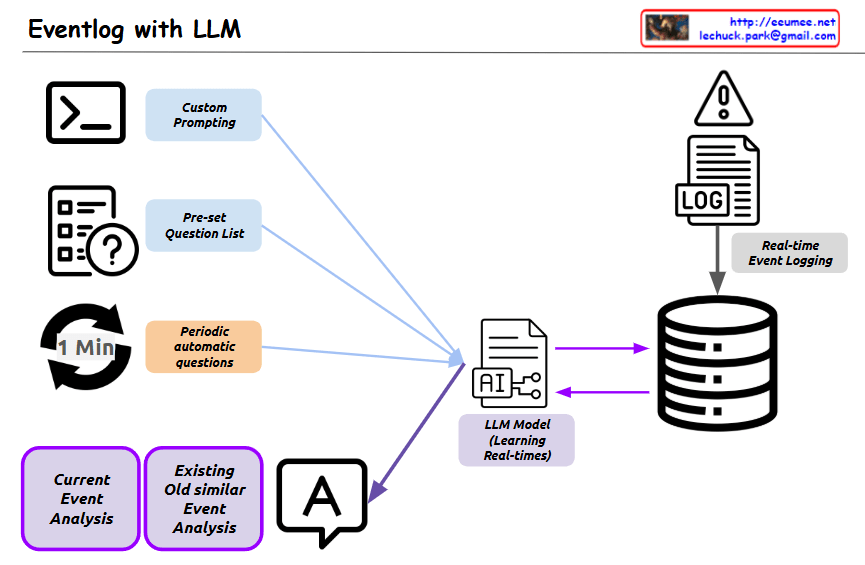
This system collects and updates unstructured text-based event logs in real-time, which are then learned by the LLM. Through user-input questions, predefined question lists, or periodically auto-generated questions, the system analyzes current events and compares them with similar past cases to provide comprehensive analytical results.
The primary purpose of this system is to efficiently process large volumes of event logs from increasingly large and complex IT infrastructure or business systems. This helps operators easily identify important events, make quick judgments, and take appropriate actions. By leveraging the natural language processing capabilities of LLMs, the system transforms complex log data into meaningful insights, significantly simplifying system monitoring and troubleshooting processes.
With Claude

This image depicts a problem-solving methodology diagram titled “STEP by STEP.”
The diagram illustrates an efficient step-by-step approach to problem solving:
Each stage is divided into a 20% (blue) and 80% (green) ratio, demonstrating the application of the Pareto principle (80/20 rule). This suggests a strategy of first resolving the fundamental 80% of problems that are easier to solve, then approaching the more complex 20% using the same methodology.
The circular nodes and arrows at the top represent the progression of this sequential problem-solving process, with the red target icon in the upper left symbolizing the ultimate goal.
This methodology emphasizes a systematic approach to complex problems by breaking them down, addressing them logically, and digitalizing when necessary for efficient resolution.
With Claude

This dashboard is designed to monitor the comprehensive performance of server room cooling systems by displaying temperature changes alongside server power consumption data, while also tracking water flow rate (Water LPM) and fan speed. The main utilities and applications of this approach include:
This dashboard goes beyond a simple monitoring tool to serve as a comprehensive decision support system for optimizing thermal management in server rooms, improving energy efficiency, and ensuring equipment stability. The heat map visualization approach, in particular, makes complex temperature data intuitively interpretable, allowing operators to quickly assess situations and respond appropriately.
With Claude
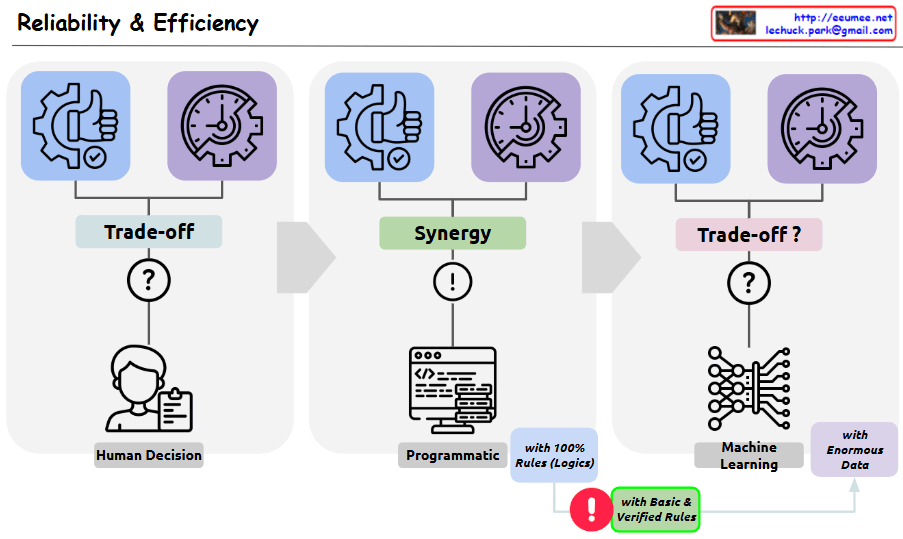
This image is a diagram showing the relationship between Reliability and Efficiency. Three different decision-making approaches are compared:
Importantly, the “Basic & Verified Rules” section at the bottom presents a solution to overcome the indeterminacy (probabilistic nature and resulting trade-offs) of machine learning. It emphasizes that the rules forming the foundation of machine learning systems should be simple and clearly verifiable. By applying these basic and verified rules, the uncertainty stemming from the probabilistic nature of machine learning can be reduced, suggesting an improved balance between reliability and efficiency.
with Claude

This image explains IO_uring, an asynchronous I/O framework for Linux. Let me break down its key components and features:
The diagram shows the flow between user space and kernel space, with shared memory acting as an intermediary. This design allows for efficient I/O handling, particularly beneficial for applications requiring high performance and low latency.
The framework represents a significant improvement in Linux I/O handling, providing a more efficient way to handle I/O operations compared to traditional methods. It’s particularly valuable for applications that need to handle multiple I/O operations simultaneously while maintaining high performance.
With Claude
 Lechuck Park