

Rule-Based vs LLM AI

Rule-Based AI vs. Machine Learning: Finding the Fastest Hiking Route

Rule-Based AI

  • A single expert hiker analyzes a map, considering terrain and conditions to select the optimal route.
  • This method is efficient and requires minimal energy (a small number of lunchboxes).

Machine Learning

  • A large number of hikers explore all possible paths without prior knowledge.
  • The fastest hiker’s route is chosen as the optimal path.
  • This approach requires many attempts, consuming significantly more energy (a vast number of lunchboxes).

πŸ‘‰ Comparison Summary

  • Rule-Based AI: Finds the best route through analysis β†’ Efficient, low energy consumption
  • Machine Learning: Finds the best route through trial and error β†’ Inefficient but discovers optimal paths, high energy consumption

with ChatGPT

Rule-base AI vs ML

The primary purpose of this image is to highlight the complementary nature of Rule-base AI and Machine Learning (ML), demonstrating the need to integrate these two approaches.

Rule-base AI (Top):

  • Emphasizes the importance of fundamental and ethical approaches
  • Designing strict rules based on human expertise and logical thinking
  • Providing core principles and ethical frameworks

Machine Learning AI (Bottom):

  • Highlighting scalability and innovation through data-driven learning
  • Ability to recognize complex patterns and adaptive learning
  • Potential for generating new insights and solutions

Hybrid Approach:

  • Combining the strengths of both approaches
  • Maintaining fundamental principles and ethical standards
  • Simultaneously achieving innovation and scalability through data-driven learning

The image illustrates the complementary nature of Rule-base AI and Machine Learning (ML). Rule-base AI represents precise, human-crafted logic with limited applicability, while ML offers flexibility and innovation through data-driven learning. The key message is that a hybrid approach combining the fundamental ethical principles of rule-based systems with the scalable, adaptive capabilities of machine learning can create more robust and intelligent AI solutions.

with Claude
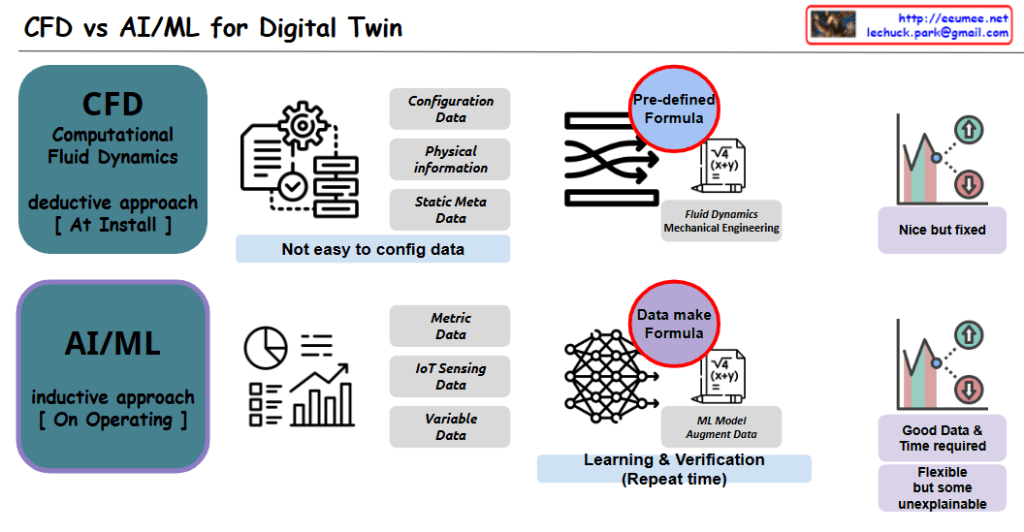
CFD & AI/ML

CFD (Computational Fluid Dynamics) – Deductive Approach [At Installation]

  • Data Characteristics
    • Configuration Data
    • Physical Information
    • Static Meta Data
  • Features
    • Complex data configuration
    • Predefined formula usage
    • Result: Fixed and limited
    • Stable from engineering perspective

AI/ML – Inductive Approach [During Operation]

  • Data Characteristics
    • Metric Data
    • IoT Sensing Data
    • Variable Data
  • Features
    • Data-driven formula generation
    • Continuous learning and verification
    • Result: Flexible but partially unexplainable
    • High real-time adaptability

Comprehensive Comparison

Harmonious integration of both approaches is key to future digital twin technologies

CFD: Precise but rigid modeling

AI/ML: Adaptive but complex modeling

The key insight here is that both CFD and AI/ML approaches have unique strengths. CFD provides a rigorous, physics-based model with predefined formulas, while AI/ML offers dynamic, adaptive learning capabilities. The future of digital twin technology likely lies in finding an optimal balance between these two methodologies, leveraging the precision of CFD with the flexibility of machine learning.

With Claude
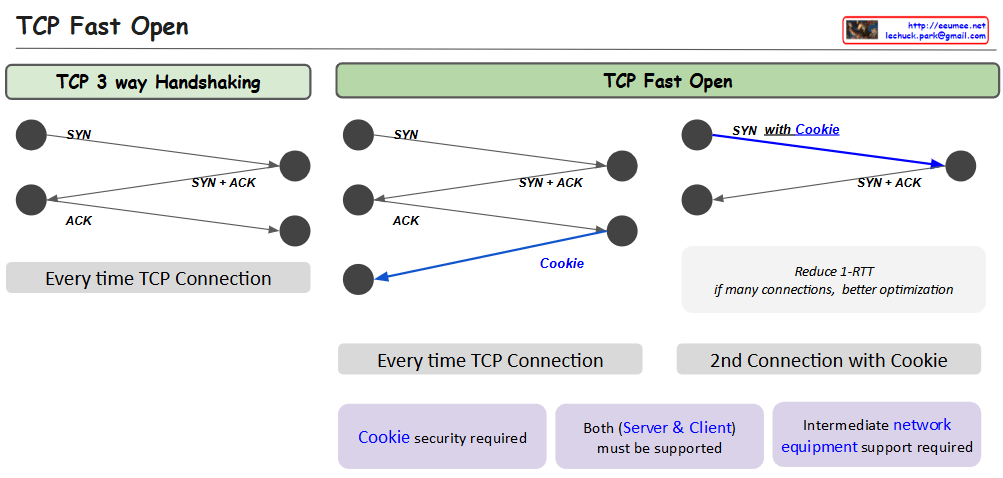
TCP fast open

The image compares two TCP connection establishment methods:

  1. TCP 3-Way Handshaking (Traditional Method):
  • Shows a standard connection process with three steps:
    1. SYN (Synchronize) packet sent
    2. SYN + ACK (Synchronize + Acknowledge) packet returned
    3. ACK (Acknowledge) packet sent back
  • This happens every time a new TCP connection is established
  • Requires a full round-trip time (RTT) for connection setup
  1. TCP Fast Open:
  • Introduces a “Cookie” mechanism to optimize connection establishment
  • First connection follows the traditional 3-way handshake
  • Subsequent connections can use the stored cookie to reduce connection time
  • Benefits:
    • Reduces Round-Trip Time (1-RTT)
    • Better optimization for multiple connections
  • Requirements for TCP Fast Open:
    • Cookie security must be implemented
    • Both server and client must support the method
    • Intermediate network equipment must support the technique

The blue arrows in the TCP Fast Open diagram represent the cookie exchange and optimized connection process, highlighting the key difference from the traditional method.

With Claude

Experience Selling

Experience Selling: Transforming Domain Expertise into Intellectual Capital

Paradigm Shift in Knowledge Economy

Core Value Proposition

  • Transforming specialized domain experience into structured digital data
  • Converting tacit knowledge into explicit, scalable intellectual assets

AI-Powered Knowledge Transformation

  • Digitalization of expert experiences
  • Large Language Model (LLM) training on domain-specific datasets
  • Creating replicable decision-making models from individual expertise

Key Message: In the AI era, experience is no longer a limited personal resource but a dynamic, expandable intellectual asset that can be transformed, shared, and monetized globally.

Cooling Works & Metrics

Data Center Cooling System Overview

Cooling System Operation Flow

  1. Cooling Tower: Produces cooling water by releasing heat to the outside environment. This stage involves dissipating heat into the atmosphere.
  2. Chiller: Absorbs heat from the cooling water to produce chilled water. The condenser plays a crucial role in this process.
  3. Air Handling Unit: Uses chilled water to cool air, creating cooling air for the server room.
  4. Server Room: The cooled air is ultimately supplied to the server room to remove heat from IT equipment.

Key Control and Conversion Equipment

  • Pump: Regulates the pressure and speed of cooling and chilled water to maintain appropriate flow rates throughout the system.
  • Header: Handles the distribution and collection of cooling and chilled water, ensuring uniform distribution across the system.
  • Heat Exchanger/Condenser: Performs heat exchange processes at various stages, with the condenser playing a particularly important role in the chiller.
  • Fan: Circulates cooling air to the server room.

Core Measurement Metrics

  • Temperature: Monitors the temperature of cooling water, chilled water, and air at each stage to evaluate system efficiency.
  • Water Flow Rate: Measures the amount of cooling and chilled water circulating in the system to ensure adequate cooling capacity.
  • Supply/Return Temperature Differential: Measures the temperature difference before and after passing through each component to assess heat exchange efficiency.
  • Power Usage: Monitors the power consumption of pumps, chillers, fans, and other equipment to manage energy efficiency.

These metrics are monitored in detail by pump and condenser to optimize the overall performance of the cooling system and improve energy efficiency.

With Claude