AI Infrastructure Architect & Technical Visualizer "Complex Systems, Simplified. I translate massive AI infrastructure into visual intelligence." I love to learn computer tech and help people by the digital.
From DALL-E with some prompting The image illustrates the concept of digitization. It shows an analog signal being converted into a digital format, represented by a sequence of binary numbers. The process emphasizes the importance of accuracy and precision in digitization, noting that even small errors in digitizing the signal can lead to significant computing errors. Therefore, maintaining high accuracy and precision is marked as important to ensure the integrity of the huge computing tasks that rely on the digitized data.
The image displays a programming challenge titled “1464. Maximum Product of Two Elements in an Array”. The task is to choose two different indices i and j from an array of integers to maximize the value of (nums[i]-1)*(nums[j]-1).
Example 1 gives the array [3,4,5,2], selecting indices i=1 and j=2 yields the maximum value (4-1)(5-1) = 12. In Example 2, the array [1,5,4,5] yields a maximum value of (5-1)(5-1) = 16 when indices i=1 and j=3 are chosen. For Example 3, with the array [3,7], any selection of indices results in (3-1)*(7-1) = 12.
The suggested solution involves sorting the array in descending order and then selecting the first two numbers. Alternatively, while quicksort could be used, it is noted that a more efficient O(1) method exists for directly finding the first and second largest numbers. Code snippets are provided, demonstrating the iteration over the array to find the largest and second-largest numbers.
The constraints specify that the length of the nums array is between 2 and 500 and each element in the array is less than or equal to 10^3.
From DALL-E with some prompting The image highlights the centrality of data in digital operations. Data manifests in various forms and is at the core of all digital processes, from traditional CPU tasks to contemporary AI/ML services. The CPU utilizes the Von Neumann architecture to execute instructions that process data. Programs manipulate this data to perform desired operations. Databases store and manage this data, while AI/ML learns from the data and generates predictive models. Ultimately, all these processes culminate in services that are delivered to users. Throughout these stages, the fundamental programming principle of ‘If’ (condition) and ‘Then’ (action) is applied, facilitating data-driven decisions and enabling automated processing.
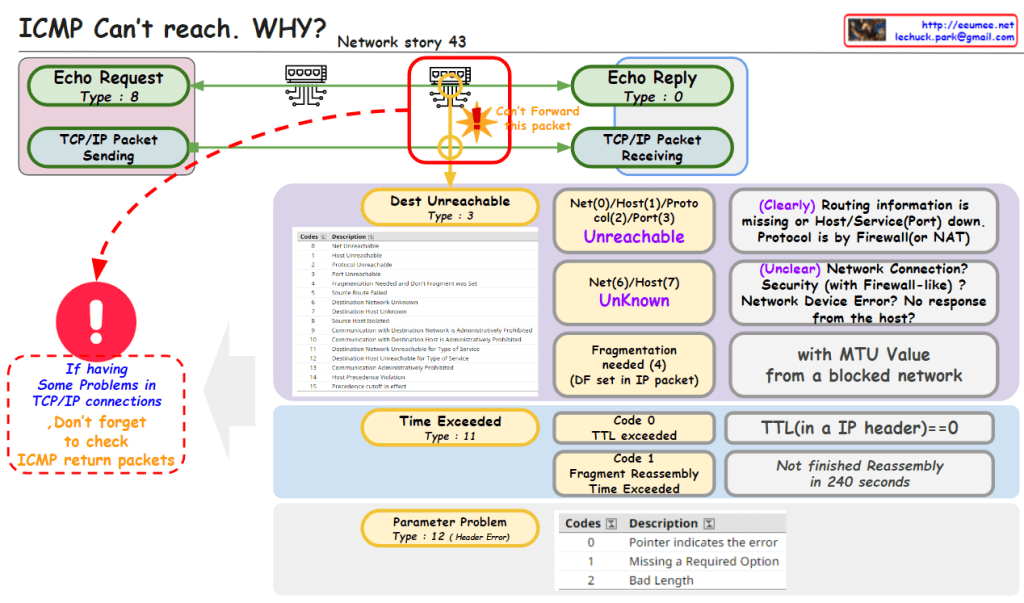
From DALL-E with some prompting The image is an educational diagram explaining different ICMP (Internet Control Message Protocol) messages that indicate problems in TCP/IP network connections. When an “Echo Request” is sent and the network is unable to forward the packet, the ICMP may return various error messages:
“Destination Unreachable” (Type 3) can mean that the network/host/protocol/port is unreachable. The reasons can be varied, such as the route is missing, the host or service on the port is down, or the protocol is blocked by a firewall or NAT (Network Address Translation).
“Time Exceeded” (Type 11) indicates that the time-to-live (TTL) of a packet has reached zero, meaning the packet has taken too long to reach its destination, or fragment reassembly time was exceeded.
“Parameter Problem” (Type 12) points to issues like header errors where certain required information is missing or incorrect.
The diagram also emphasizes the importance of checking ICMP return packets for troubleshooting network issues. It provides a detailed list of ICMP types and codes along with their descriptions to assist in identifying the specific nature of the network problem.
From DALL-E with some prompting This image illustrates the process of how AI and humans interact with data. Initially, data undergoes computation, followed by human-led analysis. Rules are then discovered, which inform the creation or improvement of models. These processes lead to the sharing and generation of new ideas, feeding into an acceleration of AI capabilities.
The analysis and AI-discovered rules are used to construct or enhance models, which are then verified by AI to confirm the outcomes. Ultimately, the new ideas, products, or services developed through this process are shared and disseminated across society. This entire cycle fosters rapid advancements in AI, enabling improvements in human efficiency and task execution.
From DALL-E with some prompting The image represents the integration of AI into facility operation optimization. The process begins with AI suggesting guidelines based on predictive models that take into account variables like weather temperature and cooling load. These models undergo evaluation and analysis to assess risks and efficiency before being validated.
Guidance for optimization is then provided, focusing on reducing power usage in cooling towers, chillers, and pumps. A domain operator analyzes the risks and efficiency gains from the proposed changes.
The final stage involves a gradual application of the AI recommendations to the actual operation, with continuous updates to the AI model ensuring real-time adaptability. The percentage indicates the extent to which the AI’s guidance is applied, suggesting that while the guide may be 100% complete, the actual application may vary.
This is followed by the application and analysis (monitoring) phase, which ensures that the optimizations are working as intended and provides feedback for further improvements. This iterative process emphasizes the importance of continuously refining AI-driven operations to maintain optimal performance with minimal risk.







 Lechuck Park