PING with “Don’t Fragment”

From DALL-E with some prompting
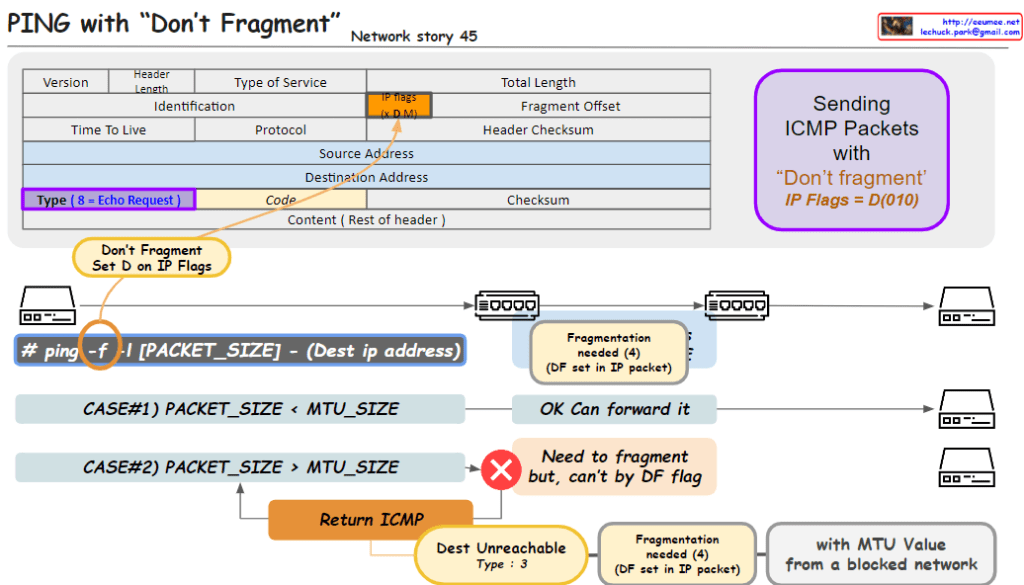
The image outlines a networking concept involving the transmission of ICMP (Internet Control Message Protocol) packets with the “Don’t Fragment” flag set, which is part of the IP (Internet Protocol) flags. Here’s a breakdown of the key elements in the image:

  1. Header Section:
    • Type of Service: Indicates the quality of service for the packet.
    • IP Flags: Contains the “Don’t Fragment” (DF) flag, indicated by setting the D bit to 0. The “MF” bit represents whether the packet is the last fragment.
    • Type: For an ICMP Echo Request, this value is set to 8.
    • Code: Used to further specify the message.
  2. Packet Transmission:
    • The command ping -f is used to send a ping with the DF flag set, which means the packets should not be fragmented, even if their size exceeds the MTU (Maximum Transmission Unit) of the network path.
    • Case #1: If the packet size is less than the MTU, the packet is forwarded without issue.
    • Case #2: If the packet size is greater than the MTU, it needs to be fragmented. However, because the DF flag is set, it can’t be fragmented, resulting in a “Destination Unreachable” message with code 3 (Fragmentation needed and DF set).
  3. Error Handling:
    • The ICMP error message “Destination Unreachable” with a code of “3” is returned if a packet with the DF flag set needs to be fragmented to continue along the network path but cannot be due to the flag.

This image is a guide to understanding how the “Don’t Fragment” flag in IP packets affects their transmission over networks and how ICMP is used for error reporting when the flag is set.

probability World

From DALL-E with some prompting
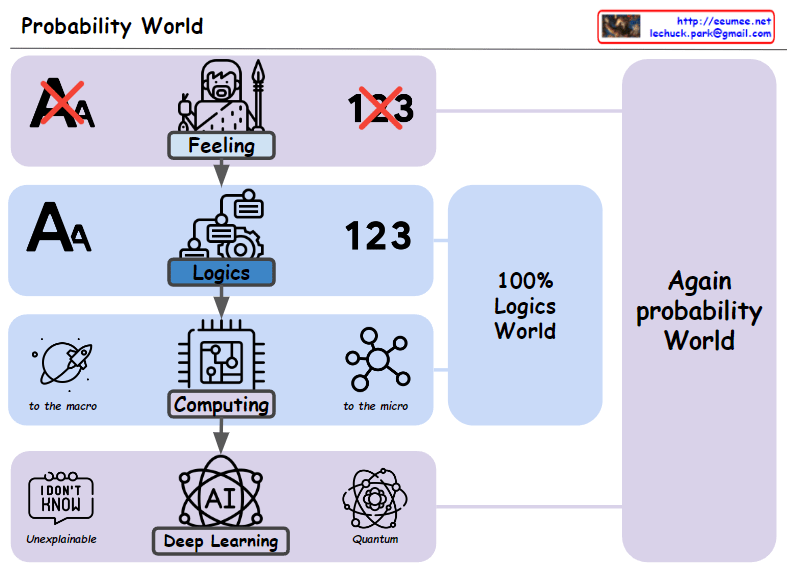
The image depicts the evolution of human experience and perception, starting from feelings and emotions, progressing to the world of logic and numbers for clarity, then advancing to complex computations and data processing, and finally delving into realms that require deeper understanding, like quantum mechanics, exploring the boundaries between what is known and unknown.

The top section labeled “Feeling” symbolizes the subjective and intuitive world of human experience, while the adjacent “1×3” represents the uncertainty of inaccurate calculations or outcomes. “Aa” and “123” represent clear and concrete understanding obtained through objective and logical thought. “Computing” signifies complex calculations and processing in both the macro and micro worlds, and “AI” and “Deep Learning” symbolize advanced technologies performing such complex calculations. Lastly, “Quantum” represents realms beyond our current scientific understanding, and the return to the “Again probability World” suggests that our knowledge and understanding can still be probabilistic and incomplete.

This diagram visually expresses the continuous cycle of human understanding evolving from emotions to logic, and then to the unknown, indicating that the journey of discovery and comprehension is an ongoing process.


Digitalization of the data center

From DALL-E with some prompting
The image represents the digital transformation process in data center operations. The top section labeled ‘AI/DT Services’ showcases a variety of Artificial Intelligence and Digital Transformation services including predictive analytics, energy management, reliability, automation, and customer engagement. These services contribute to establishing service standards and ensure the services stay updated through continuous improvements.

The middle section, ‘Data Processing,’ covers the processes involved in data collection, transformation (ETL), and visualization. These processes are responsible for data control, verification through the network, and feeding into an analysis platform.

The bottom section, ‘DC Facility,’ illustrates the fundamental infrastructure of a data center, including power supply, cooling systems, security, CCTV, and fire detection, which are essential for the efficient operation of a data center.

All three sections are underpinned by a ‘Data-Driven Process’ and suggest a transition from legacy processes to modern, data-centric operations through ‘Digital Trans’ (presumably short for Digital Transformation).

Synchronization

From DALL-E with some prompting
this image illustrates the concept of ‘Synchronization’. Synchronization is a mechanism used to ensure that when multiple processes or threads share data, they all have a consistent view of that data. If each edit were made to shared data concurrently, it could lead to inconsistent data states. The image contrasts ‘Not Same State’ with ‘Same State’, suggesting that only one process at a time should be able to modify shared data to maintain consistency.

Mutual exclusion

From DALL-E with some prompting
this image illustrates the concept of ‘Mutex (Mutual exclusion)’ and ‘Critical Section’ which are pivotal in multi-threaded programming. Mutexes are used to control simultaneous data access by multiple threads, maintaining data consistency. A critical section is a part of the code that only one thread can access at a time, and it’s where sensitive data is processed. Threads gain access to this section by acquiring a mutex lock (pthread_mutex_lock), and after completing their work, they release the lock (pthread_mutex_unlock) to allow other threads to enter. This mechanism ensures that all threads view and maintain a consistent state of the data, allowing safe modifications and sustained data integrity.

Requires 4 Digitalizations

From DALL-E with some prompting
The image appears to be a flowchart or diagram explaining the requirements for digitalization. It starts on the left and moves to the right, outlining the transition from traditional facility-based operations to data service-based operations.

  • Facility-based Operation: On the top and bottom left, there are icons representing a computer and servers, symbolizing traditional facility-centric operations.
  • Operation Digitalization: In the center, there is a process that represents the transition of these facility-based operations to digitalization. It is labeled ‘Operation Digitalization’ and includes elements like data analysis and service development.
  • Data Service-based Operation: On the top right, icons representing modern data services like cloud computing illustrate the shift from facility-based to data-centric operations.

The bottom section includes the following detailed elements:

  • Enhancing Data Precision & Performance
  • Data Analysis System
  • DC Service Development
  • Data-based Operating

These elements are linked to the required experiences from traditional facilities (Facility Exp) and DC development (DevOps) as well as operational experience (DC Operation Exp). These components emphasize the various skills and experiences necessary for a digital transformation.

The overall diagram provides a high-level view of the different aspects of the digital transformation process, emphasizing that this transformation requires not only technical and operational capabilities but also a change in organizational experience and knowledge.