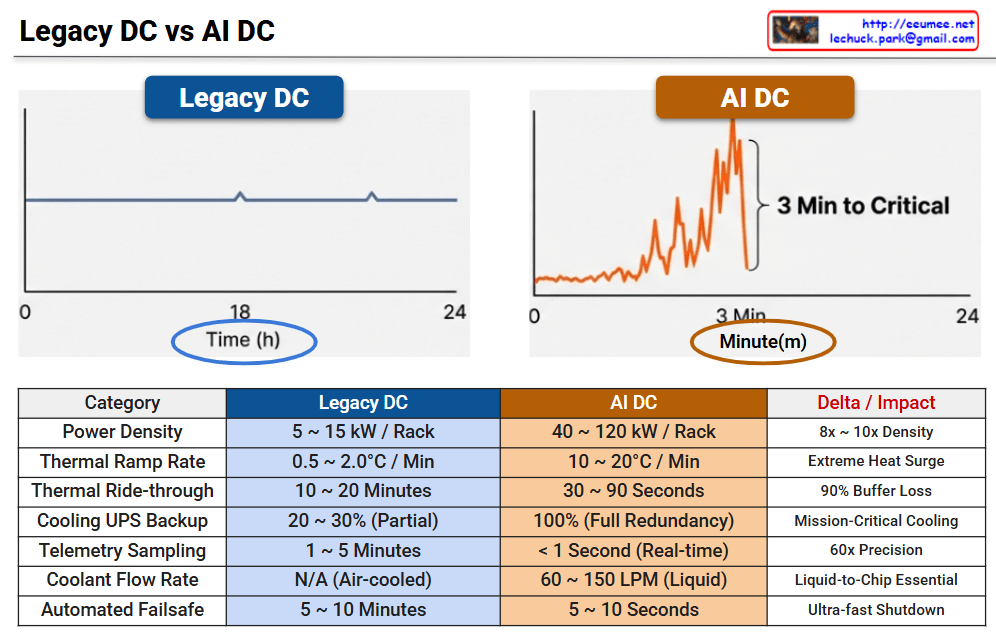
This infographic illustrates the radical shift in operational paradigms between Legacy Data Centers and AI Data Centers, highlighting the transition from “Human-Speed” steady-state management to “Machine-Speed” real-time automation.
📊 Legacy DC vs. AI DC: Operational Metrics Comparison
| Category | Legacy DC | AI DC | Delta / Impact |
| Power Density | 5 ~ 15 kW / Rack | 40 ~ 120 kW / Rack | 8x ~ 10x Density |
| Thermal Ramp Rate | 0.5 ~ 2.0°C / Min | 10 ~ 20°C / Min | Extreme Heat Surge |
| Thermal Ride-through | 10 ~ 20 Minutes | 30 ~ 90 Seconds | 90% Buffer Loss |
| Cooling UPS Backup | 20 ~ 30% (Partial) | 100% (Full Redundancy) | Mission-Critical Cooling |
| Telemetry Sampling | 1 ~ 5 Minutes | < 1 Second (Real-time) | 60x Precision |
| Coolant Flow Rate | N/A (Air-cooled) | 60 ~ 150 LPM (Liquid) | Liquid-to-Chip Essential |
| Automated Failsafe | 5 ~ 10 Minutes | 5 ~ 10 Seconds | Ultra-fast Shutdown |
🔍 Graphical Analysis
1. The Volatility Gap
- Legacy DC: Shows a stable, predictable power load across a 24-hour cycle. Operations are steady-state and managed on an hourly basis.
- AI DC: Features extreme load fluctuations that can reach critical levels within just 3 minutes. This requires monitoring and response to be measured in minutes and seconds rather than hours.
2. The Cooling Imperative
With rack densities reaching 120 kW, air cooling is no longer viable. The shift to Liquid-to-Chip cooling with flow rates up to 150 LPM is mandatory to manage the 10–20°C per minute thermal ramp rates.
3. The End of Manual Intervention
In a Legacy DC, operators have a 20-minute “Golden Hour” to respond to cooling failures. In an AI DC, this buffer collapses to seconds, making sub-second telemetry and automated failsafe protocols the only way to prevent hardware damage.
💡 Summary
- Density & Cooling Leap: AI DC demands up to 10x higher power density, necessitating a fundamental shift from traditional air cooling to Direct-to-Chip liquid cooling.
- Vanishing Buffer Time: Thermal ride-through time has shrunk from 20 minutes to less than 90 seconds, leaving zero room for manual human intervention during failures.
- Real-Time Autonomy: The operational paradigm has shifted to “Machine-Speed” automated control, requiring sub-second telemetry to handle extreme load volatility and ultra-fast failsafe needs.
#AIDataCenter #AIOps #LiquidCooling #InfrastructureOptimization #DataCenterDesign #HighDensityComputing #ThermalManagement #DigitalTransformation
With Gemini

 Lechuck Park