From Claude with some prompting
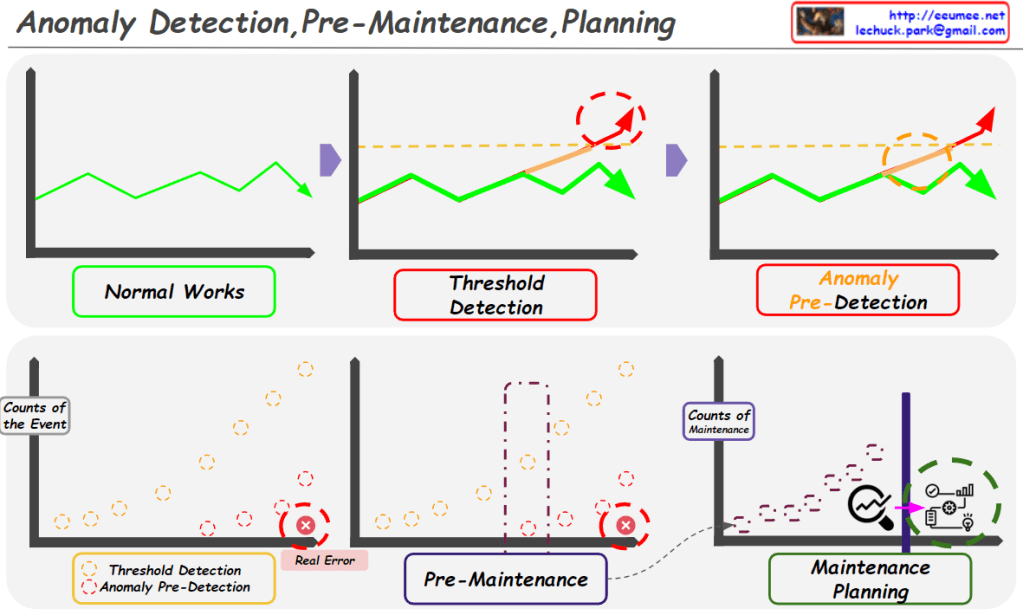
This image illustrates the concepts of Anomaly Detection, Pre-Maintenance, and Planning in system or equipment management.
Top section:
- “Normal Works”: Shows a graph representing normal operational state.
- “Threshold Detection”: Depicts the stage where anomalies exceeding a threshold are detected.
- “Anomaly Pre-Detection”: Illustrates the stage of detecting anomalies before they reach the threshold.
Bottom section:
- “Threshold Detection Anomaly Pre-Detection”: A graph showing both threshold detection and pre-detection of anomalies. It captures anomalies before a real error occurs.
- “Pre-Maintenance”: Represents the pre-maintenance stage, where maintenance work is performed after anomalies are detected.
- “Maintenance Planning”: Shows the maintenance planning stage, indicating continuous monitoring and scheduled maintenance activities.
The image demonstrates the process of:
- Detecting anomalies early in normal system operations
- Implementing pre-maintenance to prevent actual errors
- Developing systematic maintenance plans
This visual explanation emphasizes the importance of proactive monitoring and maintenance to prevent failures and optimize system performance.

 Lechuck Park