Overcome the Infinite

Overcome the Infinite – Game Interface Analysis

Overview

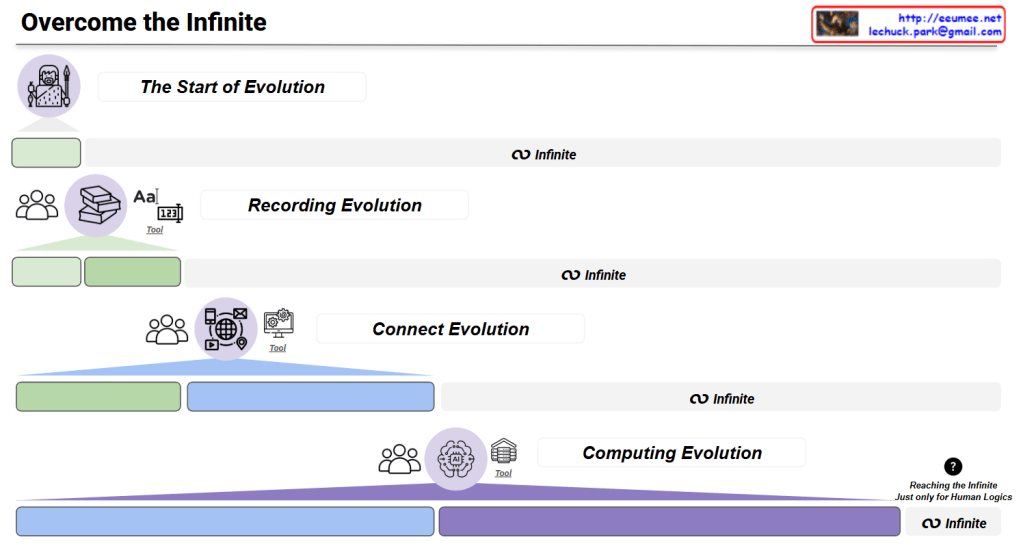
This image presents a philosophical game interface titled “Overcome the Infinite” that chronicles the evolutionary journey of human civilization through four revolutionary stages of innovation.

Game Structure

Stage 1: The Start of Evolution

  • Icon: Primitive human figure
  • Description: The beginning of human civilization and consciousness

Stage 2: Recording Evolution

  • Icon: Books and writing materials
  • Innovation: The revolution of knowledge storage through numbers, letters, and books
  • Significance: Transition from oral tradition to written documentation, enabling permanent knowledge preservation

Stage 3: Connect Evolution

  • Icon: Network/internet symbols with people
  • Innovation: The revolution of global connectivity through computers and the internet
  • Significance: Worldwide information sharing and communication breakthrough

Stage 4: Computing Evolution

  • Icon: AI/computing symbols with data centers
  • Innovation: The revolution of computational processing through data centers and artificial intelligence
  • Significance: The dawn of the AI era and advanced computational capabilities

Progress Indicators

  • Green and blue progress bars show advancement through each evolutionary stage
  • Each stage maintains the “∞ Infinite” symbol, suggesting unlimited potential at every level

Philosophical Message

“Reaching the Infinite Just only for Human Logics” (Bottom right)

This critical message embodies the game’s central philosophical question:

  • Can humanity truly overcome or reach the infinite through these innovations?
  • Even if we approach the infinite, it remains constrained within the boundaries of human perception and logic
  • Represents both technological optimism and humble acknowledgment of human limitations

Theme

The interface presents a contemplative journey through human technological evolution, questioning whether our innovations truly bring us closer to transcending infinite boundaries, or merely expand the scope of our human-limited understanding.

With Claude
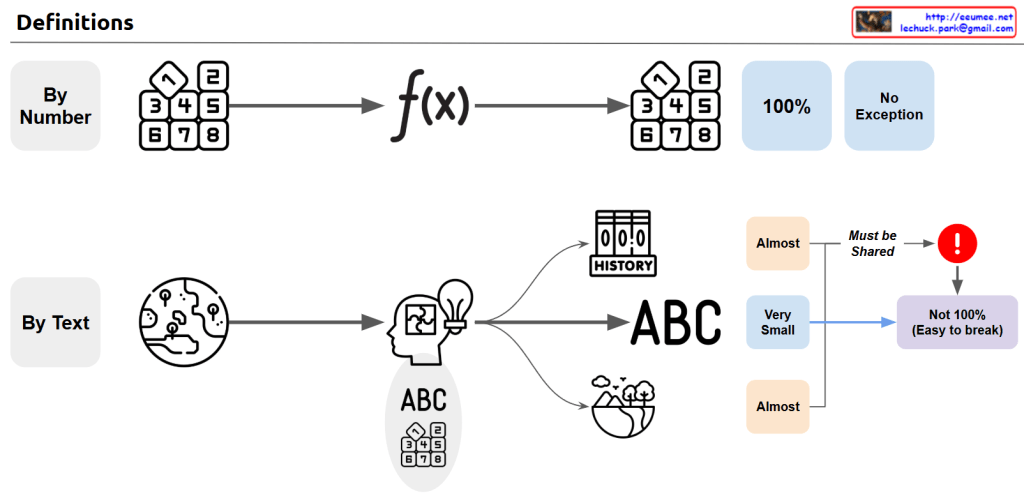
Definitions

With a Claude’s Help
this diagram that illustrates two approaches to definitions:

  1. Definitions By Number:
  • Input and output through function f(x) is precise and clear
  • 100% accuracy in results
  • No exceptions
  • Always yields consistent results regardless of context
  • Mathematical/numerical definitions are unambiguous
  1. Definitions By Text:
  • The concept being defined is connected to multiple contextual elements:
    • Historical background (History)
    • Linguistic expression (ABC)
    • Social/cultural context (represented by the global icon)
  • Characteristics and limitations:
    • Can only directly express a “Very Small” portion of the complete meaning
    • Often uses “Almost” in descriptions
    • Key Point: “Must be Shared”
      • Related background knowledge
      • Historical context
      • Social consensus
      • Cultural understanding
    • If these contextual elements are not properly shared, it becomes “Not 100% (Easy to break)”
      • Perfect communication of meaning becomes difficult
      • Possibility of misunderstanding or misinterpretation exists

The diagram ultimately explains:

  • While numerical definitions are objective and precise
  • Text-based definitions are inherently incomplete on their own
  • For proper understanding of text-based definitions, related contextual knowledge and background must be shared
  • This explains why the same words or sentences can be interpreted differently depending on cultural context and background knowledge

This concept is particularly important in understanding:

  • Why linguistic definitions can vary across cultures
  • The importance of shared context in communication
  • Why mathematical/numerical definitions remain consistent across different contexts
  • The inherent limitations of purely textual definitions without proper context

This diagram effectively shows why precise communication through text alone can be challenging without shared contextual understanding, while numerical definitions remain universally consistent.

Understanding and Predicting

From Claude with some prompting
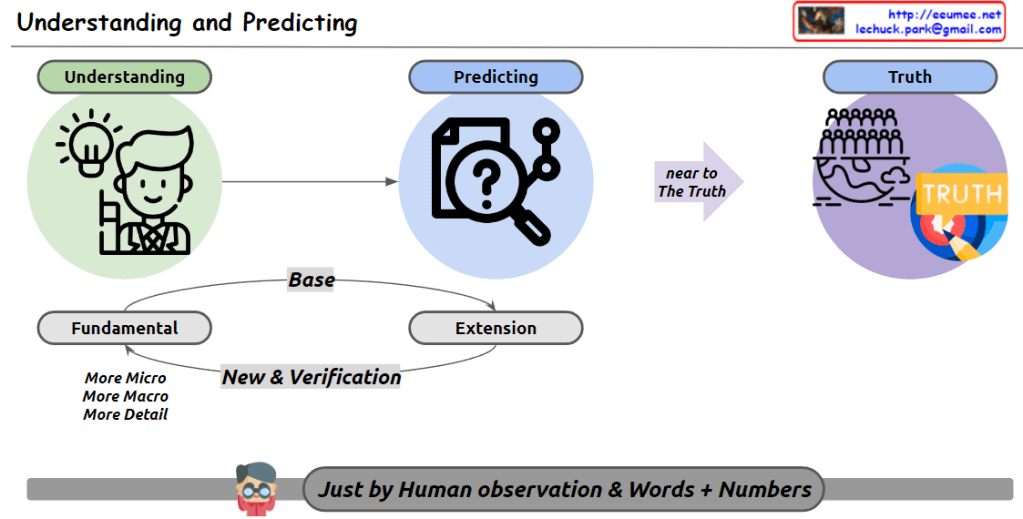
This image illustrates the human process of approaching truth through understanding and prediction. The key components are:

  1. Understanding: Represented by a lightbulb and a human icon, signifying the acquisition of basic knowledge.
  2. Predicting: Symbolized by a magnifying glass with a question mark, indicating the stage where understanding is used to make predictions.
  3. Truth: Depicted by a group of people and a “TRUTH” label, representing the ultimate goal.

These elements are connected sequentially, with prediction aiming to get “near to the Truth.”

The process is built on two foundational concepts:

  • Fundamental
  • Extension

These concepts interact through “New & Verification,” with the fundamental aspect encompassing “More Micro, More Macro, More Detail.”

Key Insights:

  1. Continuous Approach to Truth: Humans are constantly moving towards truth through understanding and prediction. This is a dynamic process, not a static one.
  2. Knowledge Expansion and Refinement: We expand our knowledge by exploring fundamental concepts more microscopically, macroscopically, and in greater detail. This represents growth in both depth and breadth of human knowledge.
  3. Limitations of Human Perception: The phrase “Just by Human observation & Words” at the bottom of the image highlights a fundamental limitation. We can only understand and express the world through our observations and language, not through direct access to matter itself.
  4. Role and Limitations of Numbers: While mathematical expressions can help overcome some linguistic limitations, they too face boundaries when confronting the infinite complexity of the microscopic and macroscopic worlds.
  5. Infinite Nature of Knowledge: As we learn more, we discover there is even more to learn. This paradox suggests an endless journey of discovery and understanding.
  6. Dynamic Process: The pursuit of knowledge is ongoing and ever-evolving, constantly expanding and becoming more refined.

In conclusion, this image portrays the continuous human quest for knowledge and truth, acknowledging our perceptual and expressive limitations while emphasizing our persistent efforts to expand and deepen our understanding of the world around us.

01 world

From Claude with some prompting
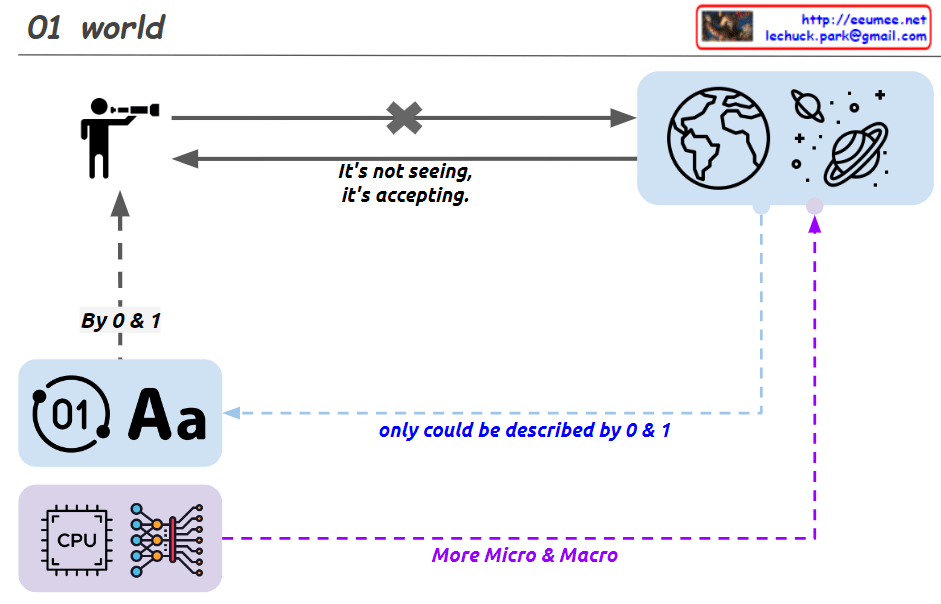
This image depicts the evolution of how humans perceive and express the world around them.

It starts with the binary system of 0 and 1, from which letters and numbers were created, leading to the creation of the digital world represented by “01 Aa”.

Humans take in data from the world through various channels such as sight, sound, and touch in a comprehensive manner. This received data is then distinguished and perceived as 0 and 1, A and B, and so on.

With the advancement of computing technology and AI, tools like CPUs and neural networks enabled a deeper understanding of the world from both microscopic and macroscopic perspectives.

The images of the Earth and the universe symbolize the entirety of the world that humans perceive.

Therefore, this image illustrates the evolution of human perception, starting from the binary system, progressing through the comprehensive intake of data from various channels, and culminating in the development of computing and AI technologies.